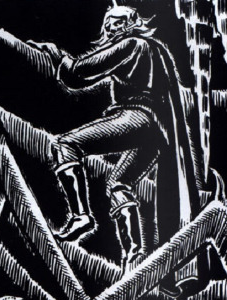
Vhaeraun, Demihuman Deities. P.27
Second Edition
Note: Vhaeraun’s first appearance was in the Monster Mythology dnd manual from 1992. However, everything covered in that manual is covered and expanded upon in Demihuman Deities. For that reason, that is the book I have decided to start with.
(Demihuman Deities, 2nd Ed. p. 40)
Vhaeraun
The Masked Lord, the Masked God of Night, the Shadow
Lesser Power of the Carceri
CE
PORTFOLIO: Thievery, drow males, territory, evil activity on the surface world
ALIASES: Vhaerun
DOMAIN NAME: Colothys/Ellaniath
SUPERIOR: None
ALLIES: Mask, Shar, Talona
FOES: Cyrrollalee, Deep Duerra, Eilistraee, Ghaunadaur, Laduguer, Lolth, the Seldarine, Sharess, Blibdoolpoolp, the Blood Queen, Diinkarazan, Diirinka, Great Mother, Gzemnid, Ilsensine, Ilxendren, Laogzed, Maanzecorian (dead), Psilofyr
SYMBOL: Black half-mask
WOR. ALIGN.: LN, N, CN, LE, NE, CE
Vhaeraun (Vay-RAWN) is the god of thievery and the furthering of drow aims, interests, and power in the Night Above, as the surface world is known to the faithful. He is also the god of drow males opposed to the matriarchy of Lolth, teaching that males are as skilled and valuable as females, and thus passively opposing the teachings of Lolth's priesthood on this point. He believes that drow should work with the other elven races for common advancement and never associate or trade with duergar, svirfneblin, or other dwarven and gnome races. (Humans
and halflings can be tolerated.)
Vhaeraun is vain, proud, sometimes haughty, bears grudges of legendary length, and never forgets slights or deceptions. Any underhanded means and treachery is acceptable to him if it furthers his aims or is done in his service-but if others so treat him or his people, it is a deep sin that cannot go unpunished. He actively involves himself in drow affairs and moderately often
sends an avatar to assist the work of his priests if the proper rituals are performed and the need is genuine. Vhaeraun is the brother of Eilistraee and the son of Araushnee, who was cast out and became Lolth, and Corellon Larethian.
The Masked Lord was cast out of the Seldarine and banished from Arvandor, along with his mother and sister, when his complicity was revealed in Araushnee's plot to destroy Corellon. While he hates all of the Seldarine, Vhaeraun harbors a particular enmity for Sehanine Moonbow, who escaped the Masked Lord's prison at great cost to herself and unmasked the culpability of both Vhaeraun and Araushnee. Likewise, the Masked Lord nurtures an abiding hatred of Eilistraee. The Dark Maiden always held Corellon's favor more than her hateful brother, and she thwarted Vhaeraun's early efforts to bring all the Ilythiiri (southern, dark-skinned elves) under his sway, enabling Lolth and Ghaunadaur to make great inroads among those who would become the drow. Vhaeraun reserves his greatest hatred for the Spider Queen who gave birth to him long ago. The Masked Lord lacks the strength to challenge Lolth directly, so he works against her in shadow, undermines her in silence, and looks to unite the other drow powers against her.
Vhaeraun's Avatar
(Thief 30, Fighter 25)
Vhaeraun frequently dispatches his avatar to answer a summoning ritual performed by his priests. He appears as a well-muscled, slim, graceful, handsome drow male with eyes and hair that change in hue from red (for anger) to gold (triumph) to blue (amusement) and green (puzzlement or curious interest) to reflect his mood. He never wears armor of any sort, but he always wears a long, flowing black cloak.
AC-2; MV 15; HP 191; THACO -4; #AT 7/2 Dmg 1d8+10 (long
sword +4, +4 STR, +2 spec. bonus in long sword) and 1d6+5
(short sword +1, +4 STR)
MR 65%; SZ H (16 feet high)
STR 18/76, DEX 24, CON 18, INT 20, Wis 14, CHA 21
Spells P: See below, W: See below
Saves PPDM 3, RSW 4, PP 4, BW 4, Sp 5
Special Att/Def: Vhaeraun wields Nightshadow, a jet-black long sword +4 of quickness that is invisible in darkness and Shadowflash, a silver short sword +1 that can flash with an eerie light equal to a continual light at will. (Those who witness such a flash, apart from Vhaeraun, must succeed at a saving throw vs. spell to avoid being blinded for 1d4+1 rounds.) While holding Nightshadow, he can create a magical bladebend effect once every 6 rounds. The bladebend causes the blade of any one edged weapon currently held within 70 feet of Vhaeraun to twist about to strike its holder for maximum damage. (The blade then instantly returns to normal.)
Those looking at Vhaeraun's cloak in darkness can see through it the stars, the moon, or whatever else is behind it even if Vhaeraun is obviously within the portion they are observing. Vhaeraun's cloak melts into nothingness if removed from him or if he is slain. Its folds can harmlessly absorb seven spells of any level per day and also attract both magic missiles and area-of-effect spells such as fireball, completely protecting the wearer (and nearby beings who would otherwise be harmed) as if the cloak were some sort of infinitely charged special brooch of shielding.
Vhaeraun can use magical items given to him by worshipers regardless of class restrictions, so long as they function for beings of his alignment. The Masked God has no spellcasting ability of his own, but in addition to his physical attacks during a round, he can duplicate any priest or wizard spell in the mind of a priest or follower of his faith who is within 180 feet, regardless of school or sphere. Vhaeraun always passes without trace and can turn invisible at will. Vhaeraun can cast bladebend once every 6 rounds, and such attacks always hit for full damage.
He is immune to the effects of illusions (apart from those created by a divine being) and cannot be charmed. He can only be struck by +1 or better magical weapons.
Other Manifestations
Vhaeraun prefers to appear as an avatar but only comes when summoned by a magical ritual. (In fact, he forbids his priests to use spells from the summoning sphere or sphere as they are only to summon him.) When he cannot send his avatar (in other words, when the ritual of summoning has not been performed), he sends a flitting black shadow. It cloaks a favored being about the face like a half-mask and remains for 9 rounds. During that time, the favored being is empowered with true seeing; empowered to strike creatures normally hit only with the most
powerful magical weapons, such as those struck only by +3 or better magical weapons, even if the weapon employed is not magical; unable to fall, fumble, or miss its footing or a leap or catch; able to move silently and pass without trace; and healed of 2d4 points of current damage.
This manifestation never favors the same being more than once per day.
Vhaeraun may also send a manifestation to signify his displeasure or his defiance of rivals or enemies of his people. This takes the form of a floating, insubstantial half-mask of shadows that drifts silently to confront the beings he wishes to (passing any magical barriers, and entering any place, regardless of guards, holiness to another deity, etc.). The mask can only move and (twice per appearance) utter a chilling, mocking laugh. Those hearing it must succeed at a saving throw vs. spell or be affected as if by a fear spell.
(The Drow of the Underdark, 2nd ED. p. 42)
VHAERAUN (lesser god)
Vhaeraun is the god of thievery and the furthering of drow aims, interests, and power on the surface world. He is also the god of drow males opposed to the matriarchy of Lolth, teaching that females are no better than males. He believes that drow should work with other elven races for common advancement- never associating or trading with duergar, svirfneblin, or other dwarven and gnomish races. (Humans and halflings can be tolerated.) Vhaeraun is handsome, even vain, and does not forget slights and deceptions.
Roleplaying Notes: Vhaeraun is proud, sometimes haughty, and bears grudges of legendary length. Any underhanded means and treachery is acceptable to him if it furthers his aims or is done in his service, but if others so treat him or his people, it is a deep sin that cannot go unpunished.
Vhaeraun is an active god, who finds it hard to hold aloof from the doings and needs of worshippers; there is a 15% chance that he will manifest if called on and if the proper ritual is performed, his avatar is 20% likely to appear.
Statistics: AL ne; WAL any evil (drow of any alignment); AoC drow males and evil activity (particularly thievery) on the surface world, or against drow of other faiths in the Underdark; SY a black half-mask.
Vhaeraun's Avatar (thief 20)
Str 16 Dex 19 Con 16
Int 18 Wis 12 Cha 19
MV 16 SZ 16’ MR 60%
AC 4 HD 20 HP 160
#AT 1 (2) THAC0 1 Dmg by weapon (or spell)
Special Att/Def: Although he cannot normally use spells, Vhaeraun can duplicate and use any spell in the mind of a priest or follower of his faith, who is within 120’
This can be done in addition to physical attacks during a round. These spells function as if cast by an 18th level wizard. Once every 6 rounds, Vhaeraun can cause a 70’ range bladebend: the blade of any one edged weapon currently drawn and held twists about to strike its holder for full damage.
Vhaeraun's Manifestations
Vhaeraun prefers to appear as an avatar, but when he cannot (i.e. when rituals of summoning have not been performed), he sends a black, flitting shadow. It cloaks a favored being about the face, like a half-mask, and remains for 9 rounds.
During that time, the favored being is:
- empowered with true seeing empowered to strike creatures normally hit only with the most powerful magical weapons, even if the weapon employed is not magical
- unable to fall, fumble, or miss foot-ing on a leap or catch
- can move silently and pass without trace (as with the spell, a faint trail of magic is left)
- healed of 2d4 hp of current damage
- This manifestation never favors the same being more than once per day.
Vhaeraun may also send a manifestation to signify his displeasure, or his defiance of rivals or enemies of his people. This takes the form of a floating, insub-stantial half-mask of shadows, that drifts silently to confront the beings he wishes to (passing any magical barriers, and entering any place, regardless of guards, holiness to another deity, etc.). The mask can only move and (twice per appearance) utter a chilling, mocking laugh. Those hearing it must save vs. spell or be affected as if by a fear spell (without saving throw).
(On Hollowed Ground, 2nd Ed. p. 100)
Note: On Hollowed Ground was written for the planescape setting, and contradicts some of the knowledge we have from both other books and Greenwood. The full passage has been included mostly for the information regarding his proxy and Ellaniath, however for specifically the Forgotten Realms is best regarded as optional.
VHAERAUN
Lesser Power, "The Masked God of Night"
AoC: Thievery, territory
TO: NO
WAL: NE (drow males)
SYMBOL:Black half-mask
HOME P/L/R: Carceri/Colothys/Ellaniath
Whereas Lolth demands recognition of the superiority of the female drow, Vhaeraun stands for the equality of the males fact is, his drow priests must be male, just as Lolth's may not. That might make a body think Vhaeraun's ready to stand up to Lolth and pull her legs off one by one. 'Course, as he's just a lesser power, Vhaeraun's afraid of the Spider Queen, and steers well clear of her machinations - at least openly. Instead, he tries to work against her in shadow, to under-mine her in silence. Meanwhile, from his realm on Carceri (Lolth's faithful'd call it a hiding place), Vhaeraun looks to unite the other drow powers against her. Thus, his priests move quietly through drow cities and the surface lands, slowly gathering power for their deity's ends.
Vhaeraun is also the power of thievery and territory, and this is keenly demonstrated whenever a berk stumbles into his realm. Ellaniath is forever unknown to any plane-walker, because the god wipes the memory of the place from the minds of all who visit it. Some say that's his ultimate form of theft stealing a body's very essence.
Vhaeraun's proxies keep themselves dark, too. Since they work against Lolth, they don't want to draw attention to themselves or make their identities public. The only known proxy is Allinzir Gi'Leera (Px/♂ drow/T4/Revolutionary League/NE), a subtle schemer who can fade into the shadows and isn't bothered by light. As for the rest of Vhaeraun's proxies, folks know only that they're exclusively male drow, and that they possess abilities related to true seeing, thievery, catlike grace, and striking creatures hit only by magical weapons.
For more information on proxies, view Allinzir’s character tab on the Vhaeraunite’s without a settlement sheet Note to self: This leads back to the original Google doc. Offer proper link when it is included on the page.
Third Edition
Note: Much of the blurb in the Player’s Guide to Faerun was a repeat of what can be found above - Most of his characterization in 3e happens through novel’s. Only the changes have been marked.
Player's Guide to Faerun, 3e - DEMONWEB PITS p. 149
Realm
The divine realms of Ghaunadar, Vhaeraun, Kiaransalee, and Selvetarm are strung like tiny baubles on the fabric of the Demonweb. The Demonweb itself belongs to Lolth—only a fool would try to deny it—though her realm is actually separate from the web.
[...]
Vhaeraun: The Masked Lord’s small realm, called Ellaniath, amounts to little more than a hiding place where the god can hole up when Lolth’s patience with him runs out. He keeps his hatred of Lolth hidden behind his mas, but he constantly and subtly schemes against her. Lolth is no fool—she encourages this kind of behavior in her servants, and she expects no less from her own child.
Lords Of Darkness, 3rd Ed. p. 29
Vhaeraun, the Masked Lord, drow deity of thievery and evil activity on the surface, is the most prominent drow deity among the surface-dwelling drow. The son of Lolth and Corellon Larethian, he wishes to cast off the shackles that his mother has placed upon the drow so they may forcibly reclaim their birthright in the surface lands, which they call the Night Above. Vhaeraun’s followers are survivors who managed to escape the tyranny of Lolth’s female clerics and eventually find a home for themselves on the surface. His followers are skilled at stealth and observing others, having honed these skills under the gaze of the Spider Queen.
Followers of the Masked Lord are encouraged to form surface communities and (in some groups, such as the Auzkovyn clan) even intermarry with surface elves of similar temperament, for Vhaeraun believes that the various elven races should stand together to advance the race as a whole. This attitude is tempered by his vehement insistence that all dwarven and gnome races should be avoided. Almost all his clerics are male, the few exceptions being worshipers of other drow deities who converted to his faith. Vhaeraun’s followers are the most likely of all the surface drow to agree to aid others in the destruction of Lolth-worshipers, and they suffer the least from the fractious infighting often seen in other groups. Deep dragons, yeth hounds, and undead shadows sometimes accompany them.
Because Vhaeraun has thievery as part of his portfolio and resembles the deity Mask in many ways, Mask has taken an interest in Vhaeraun and may attempt to steal or absorb Vhaeraun’s power in an attempt to make up for the parts of his portfolio that were lost to Cyric.
Events of War of the Spider Queen, as told by: Player's Guide to Faerun 3rd Ed. p. 169
History
Deep beneath the surface of Faerûn, in sunless caverns ruled by the dark and twisted drow, a staggering event occurred late in the summer of 1372 DR. Lolth had always been a fickle patron, often abandoning one of her servants for days or tendays at a time because of some perceived slight, but in the waning days of the month of Eleasias, the high priestesses of Menzoberranzan came to a startling realization—their goddess had completely abandoned them. Lolth granted no spells, answered none of her clergy’s prayers, and sent no signs to show her pleasure or displeasure. The Matron Mothers, while undeniably worried, merely assumed that they had in some way offended the Spider Queen. So they made the proper sacrifices, performed rituals of atonement, and waited for the goddess to restore her favor. When autumn came and Lolth’s clerics were still unable to call upon the Spider Queen’s blessings, they began to grow nervous.
Adding to their concern was the fact that several dozen male drow of various Houses had simply vanished. Though it was not uncommon for drow males to desert their families and join one of the minor merchant clans or the Bregan D’aerthe mercenaries, these males had simply disappeared. The Matron Mothers suspected that they must have had some knowledge of Lolth’s silence—after all, why else would they dare to risk the priestesses’ wrath?
The Matron Mothers were not the only ones to notice this sudden exodus. Gromph Baenre noted the disappearance of the males, and despite the warnings of the Matron Mothers, he commanded Pharaun Mizzrym, a Master of Sorcere, to investigate the matter. Pharaun viewed the assignment as a death trap, since he knew that Gromph would have him slain if he failed and the priestesses would doubtless do the same to keep Lolth’s disappearance a secret if he succeeded. Even so, he had no real choice but to agree. Realizing that he would need significant aid in this task, the drow wizard turned to his friend Ryld Argith, a Master of Melee-Magthere. Though Ryld was understandably reluctant, he was also extraordinarily bored and discontented with his life at Menzoberranzan’s dueling academy, so he allowed Pharaun to talk him into joining the investigation.
While the pair searched for leads in the lower levels of Menzoberranzan, even more plots were brewing in the higher halls of power. Gromph Baenre, seeking to undermine his sister Quenthel’s position as Mistress of Arach-Tinilith, sent several demonic assassins in the guise of sendings from Lolth to murder her—or at least to convince the other priestesses that the Spider Queen was displeased with Quenthel. Faeryl Zauvirr, an ambassador from the drow city of Ched Nasad, was falsely accused of treachery, imprisoned, and tortured for attempting to leave the city and discover why Ched Nasad had sent no word and no caravans to Menzoberranzan since Lolth had suddenly gone silent.
After a significant amount of digging in the seediest sections of Menzoberranzan, Pharaun and Ryld discovered that the missing drow males were working with an alhoon (an undead mind flayer) to spark a slave uprising that would bring the city to its knees. Although the alhoon was successful in instigating the rebellion, Menzoberranyr troops were able to put down the uprising, and Pharaun and Ryld slew the creature.
Not entirely convinced that Lolth’s silence and the alhoon’s slave uprising were unrelated, Triel Baenre, the Matron Mother of House Baenre, ordered her sister Quenthel to lead an expedition to Ched Nasad to determine why the City of Glimmering Webs had fallen out of contact. Pharaun, Ryld, Faeryl Zauvirr, and Triel’s draegloth son Jeggred traveled with Quenthel, and the mercenary scout Valas Hune served as guide.
The band wasted no time setting out from Menzoberranzan, but the road was far from an easy one. Before reaching Ched Nasad, the drow had to pass through the ruins of Ammarindar below Hell-gate Keep, battling Kaany Vhok’s tanarruks the entire way. While traveling through Ammarindar, Pharaun managed to attract the interest of Aliisza, Vhok’s half-succubus consort and aide.
Once they reached Ched Nasad, the situation improved very little. Though Lolth’s silence had not become public knowledge in the City of Glimmering Webs, there was a definite sense of unrest among the city’s population—no doubt caused largely by the fact that the Menzoberranyr had unwittingly arrived at the outset of an attempted coup. The heads of several smaller Houses of Ched Nasad, seeing Lolth’s silence as an opportunity to improve their lot in life, hired a band of duergar mercenaries to assault the city. In the confusion, the drow nobles hoped to seize the reins of power themselves.
More intrigue followed the group when Quenthel Baenre and Jeggred attempted to fulfill their secondary mission—securing a caravan of goods from a merchant company owned by the Baenre family. Faeryl Zauvirr betrayed the Mistress of Arach-Tinilith, taking both her and Jeggred prisoner and using the goods to help fund her mother’s rebellion. The conspirators then attempted to capture Pharaun, Ryld, and Valas Hune, but their plans went awry when the duergar mercenaries began their attack on the city. In the ensuing confusion, the Menzoberranyr managed to fight their way free of their captors, recover Quenthel and Jeggred, and slay the traitorous Faeryl while the city burned around them. Unfortunately, the battle for Ched Nasad went considerably differently than the conspiring houses had anticipated. The duergar mercenaries employed an alchemical substance that burned the very stone from which Ched Nasad had been carved, and they used it perhaps too vigorously during the battle.
Between the duergar’s stonefire and the defending drow’s battle magic, Ched Nasad was destroyed. The Menzoberranyr barely managed to escape through a portal, along with two refugees from Ched Nasad—Halisstra Melarn and her battle-captive Danifae. The exact number of survivors from Ched Nasad’s fall remains uncertain, but given the total annihilation of the city, it seems unlikely that any more than a few hundred might have escaped alive.
The portal through which the Menzoberranyr escaped led to an ancient Netherese ruin in Anauroch. After some debate, and a fierce battle with the lamias that inhabited the ruin, the intrepid band elected to seek out a priest of Vhaeraun, in the hopes that another god might be able to discover what had become of Lolth.
While the Menzoberranyr and their Vhaeraunite guide traveled astrally to the Demonweb Pits, Menzoberranzan itself faced a sudden three-pronged attack. A secret society of drow males called the Jaezred Chaulssin had discovered Lolth’s absence shortly after the priestesses themselves had. Since then, members of this group had been acting behind the scenes to fulfill their goal of overthrowing the matriarchal drow society and replacing it with a hierarchy of their own. The Jaezred Chaulssin had been behind Menzoberranzan’s slave uprising, and its members had inadvertently helped cause the destruction of Ched Nasad. Now, with an army of gray dwarf mercenaries and Kaanyr Vhok’s tanarruks in their employ, the males laid siege to Menzoberranzan. Through treachery and betrayal from within the city, they scored a great victory against the Menzoberranyr, though they were unable to take the city as they had planned.
Meanwhile, in the Demonweb Pits, a second threat to the drow way of life manifested itself. The Vhaeraunite priest did indeed manage to guide the Lolth-worshipers to the very heart of the Spider Queen’s realm, and they found Lolth’s apparently insensate form at the nadir of the pit. The Vhaeraunite, however, had planned betrayal from the start. Using his magics, he created a gate and summoned Vhaeraun himself, who attacked the apparently comatose Lolth and injured her terribly. The drow god Selvetarm, drawn by the attack on his queen, appeared and attacked Vhaeraun.
The two gods battled, then plummeted from the webs on which they fought into the emptiness below. What effects, if any, this event may have on worshipers of either god remains unknown.
Applicable events of The Lady Penitent, as told by “Grand History of the Realms”:
History
1375 Nightal 20: Lolth and Eilistraee battle to the death in a divine game of sava, with the fate of the drow hanging in the balance. A Darksong Knight in service to Eilistraee slays Selvetarm, Champion of Lolth, with an artifact known as the Crescent Blade. Drow followers of Vhaeraun employ High Magic for the first time since the Descent. They succeed in opening a portal to Eilistraee’s realm, which the Masked Lord employs in an attempt to assassinate his sister. The effort backfires, as Eilistraee kills her brother instead. The Church of Vhaeraun is absorbed into the Church of Eilistraee. The Church of Selvetarm is absorbed into the Church of Lolth.
Fourth Edition
Note: Vhaeraun is dead during the events of Spellplague. However for the sake of timeline consistency, here are the events of spellplague as told by Grand History of the Realms. (3.5e, p. 159)
History
1385 DR Year of Blue Fire
Unthinkable catastrophe ensues when Cyric, aided and abetted by Shar, murders Mystra in Dweomerheart. The plane itself disintegrates at once, destroying Savras and sending the gods Azuth and Velsharoon reeling into the endless Astral Plane. Without Mystra to govern the Weave, magic bursts its bonds all across Faerûn and the surrounding planes and runs wild. In Faerûn, this event is known as the Spellplague. Thousands of mages are driven insane or destroyed, and the very substance of the world becomes mutable beneath veils of azure fire that dance across the skies by night or by day. Many planes are shifted or destroyed as well. Only greater deities prove strong enough to maintain their realms against the resultant chaos. Tyr, Lathander, and Sune move against Cyric and successfully imprison the Black Sun in his Supreme Throne, under a sentence of house arrest to last one thousand years.
Sages in centuries to come mark the Weave’s destruction in the Year of Blue Fire as the end of the old world, and the terrible beginning of the new.
Note: Vhaeraun is dead during the events of Spellplague. However for the sake of timeline consistency, here are the events of spellplague as told by Grand History of the Realms. (3.5e, p. 159)
History
1385 DR Year of Blue Fire
Unthinkable catastrophe ensues when Cyric, aided and abetted by Shar, murders Mystra in Dweomerheart. The plane itself disintegrates at once, destroying Savras and sending the gods Azuth and Velsharoon reeling into the endless Astral Plane. Without Mystra to govern the Weave, magic bursts its bonds all across Faerûn and the surrounding planes and runs wild. In Faerûn, this event is known as the Spellplague. Thousands of mages are driven insane or destroyed, and the very substance of the world becomes mutable beneath veils of azure fire that dance across the skies by night or by day. Many planes are shifted or destroyed as well. Only greater deities prove strong enough to maintain their realms against the resultant chaos. Tyr, Lathander, and Sune move against Cyric and successfully imprison the Black Sun in his Supreme Throne, under a sentence of house arrest to last one thousand years.
Sages in centuries to come mark the Weave’s destruction in the Year of Blue Fire as the end of the old world, and the terrible beginning of the new.
Drow Magazine 413, 4th Ed. p. 62
VHAERAUN AFTER THE SPELLPLAGUE
During a prolonged conflict between Lolth and Eilistraee, who is the patron goddess of good-aligned drow and Vhaeraun’s sister, Vhaeraun attempted to assassinate his sister. His plan backfired, and Eilistraee claimed his life. If your DM’s campaign takes place after this event, which occurred ten years before the Spellplague, you should discuss how a skulker of Vhaeraun might fit into the campaign. Some drow, either ignorant of Vhaeraun’s death or in denial of it, continue to worship the Masked Lord, and your character might be one of these. You might be dedicated to trying to restore your god to life, channeling divine power that comes from your own dedication to that aim rather than from the god. Or perhaps the power you wield comes from a vestige of Vhaeraun’s divine energy—or from another god who has decided to impersonate Vhaeraun and manipulate his followers.
If your DM’s campaign takes place before the Spellplague, Vhaeraun and his worship are alive and as healthy as the practice of a forbidden faith can be under the oppressive rule of Lolth’s priestesses.
Fifth Edition
For both Eilistraee and Vhaeraun, 5th edition presents a sort of branching paths of canon. For the first path, there is what Wizards of the Coast has published regarding their fates. This is what most of published Dungeons and Dragons will build on, and has been included for the sake of thin neutrality. However the second path is largely considered by most to be the more in-depth one, and the one that the Forgotten Realms wiki (and therefore, this page) will prioritize: That is, what Ed Greenwood has offered as Canon for the twins. Information from Mordenkainen Presents: Monsters of the Multiverse has been placed at the bottom of this page.
It is important to note that in both version of events, the backstory proposed in War of the Spider Queen and The Lady Penitent is not considered RetConned, but rather the point in which the path splits. Both routes consider both series canon to their lore.
Candlekeep post, Ed Greenwood
Mortals in the Realms can rarely know the doings and specifics of the gods with certainty, because clergies and even the gods themselves sometimes avoid the truth, or the whole truth, or slant what they say so much. So it is with the “deaths” of Eilistraee and Vhaeraun. Vhaeraun entered Eilistraee’s realm and sought to destroy her, but perished there by her hand, and she subsumed his portfolios—or so the story spread among drow. Most assumed that meant she became the drow deity of thievery, but in truth, Eilistraee (who pronounces her own name “AISLE-iss-try-ee,” by the way) defeated Vhaeraun with Mystra’s indirect aid [Mystra IS the Weave, and it was the Weave that frustrated and drank Vhaeraun’s magics, but augmented those of Eilistraee] but did not slay her brother. Rather, she trapped his sentience within the Weave, leaving him in an “endless dream” engineered by Mystra, who enfolded him. In this dream, Mystra slowly convinced Vhaeraun to cooperate in a pact with herself and Eilistraee so that they could all survive what was to come: the Sundering, wherein both Eilistraee and Mystra would be “slain,” magic would go wild, and the worlds of Abeir and Toril would pass through each other and then be sundered.
Eilistraee emerged from her battle with her brother as The Masked Lady, and fulfilled her own portfolios of song, beauty, dance, swordwork, hunting, moonlight, and those of her brother, too: thievery, trickery, drow poisoners and poisons, drow males, and evil doings in the surface world. The death of Qilué Veladorn robbed her of some of her divine essence for a time (it leaked into the Weave, and only returned to her when Mystra herself recovered and could direct it back to its rightful home), but Eilistraee wasn’t slain, merely reduced to manifestations.
So from the end of 1375 to the summer of 1379, The Masked Lady has her “full” powers, and from late Flamerule of 1379 to the same month in 1489 DR, she is much reduced, being seen by mortals almost exclusively as her manifestation of a moving black mask outlined in a silver radiance and with two eyes of silver flame, that appears and silently guides (by pointing and touching and by imparting visions). After Flamerule 1489, Vhaeraun and Eilistraee are separate deities with the same powers and portfolios they had before 1375, but a new understanding, respect, and even friendship for each other. Some of their followers still war with each other, but the two deities do not. Thus far, Eilistraee’s teachings after the Sundering are the same as before the Sundering.
The Masked Lady: a 9-foot-tall long-legged, graceful, and dancing drow female surrounded by her constantly-swirling long tresses and a swirling black ankle-length cloak, her face always covered by a full-face mask. She has all the abilities, powers, and avatar specifics given in the 3e sourcebook FAITHS AND PANTHEONS, except that what she’s borrowed from Vhaeraun means her avatar does not lose her Extra Domain salient ability, and so retains all the things listed as being lost to her avatar on p25 of F&P. She carries the Moonsword, as noted, and the black cloak she gained from Vhaeraun acts as a second Moonsword (it can transform itself into one, and fly about to attack or aid her or others, as she wills, with her own movement rate and the best possible maneuverability) and can emit magical darkness as she wills, in extent and specifics, up to 90-foot-sphere about itself limits.
The Mask: an always-silent black full-face (brow to chin) mask that can absorb the energy of all spells into itself (including dispel magic) and be augmented thereby, and can heal or impart spells to mortals by touch. The mask can vary in size from as large as an adult drow’s fingernail to as large as huge castle gates, but is usually about double the size of a full-face mask a mortal adult drow might wear. It varies in visibility as Eilistraee wills, its silver radiance waxing or waning as she wills, and also in tangibility, from “not there” to velvety-soft to as hard as adamantine. As the Mask, Eilistraee never speaks, but can write words of fire in the mind of a mortal within 90 feet, and impart vivid and detailed mental visions (still images or “movies”) with the same range.
And there you have it. I hope this is of help in your campaign. As for the future, and Eilistraee? Well, I Do Have Plans...but we'll see. ;}
Candlekeep post, Ed Greenwood
Hi again, all.
Wrigley, Ed will indeed answer you when he can. Whenever I drop in to the Keep, I scoop up all posts and forward them to him. So he will reply...sometime. Promise!
**(And BTW, all, the fact that Eilistraee herself pronounces her name that way doesn't mean that others across the Realms don't say it differently, and she still answers to all the variants. Qilué and the Seven and El always pronounced it "Isle-ISS-tree," even when addressing the goddess face to face, in the "home" Realms campaign.)**
CorellonsDevout, Vhaeraun is back to being himself, with the same portfolios. His ethos is SUBTLY changed; he is now advocating drow dwelling in the World Above (the surface world) be good citizens where doing so will enhance their chances of staying alive and being accepted, and do their evil deeds as covertly as possible. In other words, do good when and where it profits them to do so.
Greenwood Grotto 4/6/2026
Realm
Actually if you wouldnt mind me using this opportunity to pry a bit about the Masked Lord, just to steal a little treat….
Most of the information we've gotten regarding Ellaniath is largely unreliable, or left rather vague. I understand this is probably rather intentional given the nature of his character, but with your vision of Vhaeraun, do you have any ideas in mind regarding it and the kind of place that it is? Thank you for this sheer amount of answers youve given today :heart: excited to see all of whats to come in the future.
Mystxmomo - Greenwood Grotto 4/6/2026 at 3:49 PM
Ed Greenwood [WRIT], Role icon, Father of the Realms — 12:42 AM
Since the Second Sundering, Ellaniath is located in its own extra-dimensional bubble between the Ethereal Plane, the Shadowfell, and the Material Plane. It takes the form of a small, blue-moonlight-lit realm that takes the form of an endless castle (fortified palace) of chambers looking out onto overgrown “garden” walled courtyards, and ringed by a dark forest. There are no hallways or passages in Ellaniath, just room opening into room opening into room (more often by archways than through doors), and the palace is quiet: a heavy, “listening” silence prevails. Yeth hounds prowl the forest but howl only when beginning a chase or when in agony, shadow-creatures flit silently through the palace, and demodands stand guard outside, along the walls and ramparts, and in the courtyards. They communicate by blowing very brief blasts on deep-toned “shuddering” horns, never by shouts. An alarm call may be a brief whistle, but Vhaeraun can’t abide any sort of racket, and will destroy or exile creatures who make excessive noise.
The seemingly-endless rooms of his palace are richly wood-paneled, covered in deep-pile rugs, and luxuriously furnished with highbacked stuffed chairs, lounges, sidetables, and padded footstools. Hangings drape the walls, all of them tapestries depicting realistic scenes of events Vhaeraun desires to remember, often moments in which he bested his hated mother Lolth, or achieved success and mutual respect working with Eilistraee. Both the tapestries and all corners and edges of the furniture are inlaid with cabochon-cut (smooth-polished and curving) black gemstones of the sorts he favors (onyx, opals, pearls, sapphires, chalcedony, jasper, hematite, jet, obsidian, and so on).
Decanters of wine—Vhaeraun prefers the licorice-tinged elven blackwine—stand ready everywhere, on trays accompanied by “serpent-coil” design flagons. Food, however, is not to be found in the palace; bring thine own.
Many wall-panels are secret doors, opening into dark closets that are “ways” (permanent teleports to other such closets, elsewhere in the palace), and at least two of these ways serve to heal Vhaeraun as he traverses them.
When at home, he strolls idly through Ellaniath, lost in thought, for he is always scheming—or he rests, dreaming, levitating in midair stasis in certain hidden inner bedchambers that resemble warmly-swirling dark voids. At least one of them is the audience chamber from which he most often mind-speaks his sister Eilistraee; he floats horizontally on his back staring at the ceiling, which is sculpted into a larger than life-sized representation of her, looking down at him with smile, surrounded by her flowing unbound hair. Vhaeraun hates Eilistraee and resents her successes, but is hopelessly in love with her and fascinated by her; he studies her aims, utterances, and deeds closely, seeking the success and contentment she seems always to have, that always seems to elude him. Though they remain enemies, they have both mastered the art of being affectionate to each other, and this gentleness torments Vhaeraun, though he can’t resist it. He longs for more.
Conversely, there are no images of his sister Vandria Gilmadrith in his palace, and Vhaeraun never communicates with her or spies on her. He fears her and respects her as steadfast and able to resist his mother Lolth’s schemes and enticements, but his pride won’t let him return her coldness with anything but like iciness.
His son Selvetarm he tries to put from his mind always, and usually succeeds. Vhaeraun likes to consider him as “of no account,” a “wastrel,” though he knows that this is his own fantasy, not the truth.
Vhaeraun knows many “ways” that lead to and from his home, opening in Toril, the Shadowfell, and the Ghost Forest in the Ethereal Plane, but most non-shadow creatures can find and use them only by his will and favor. Deliberate intruders and lost wanderers most often reach Ellaniath by one of three always-open, unconcealed “ways.”
These are Dead Spider Door, the Whispering Waterfall, and the Whirling Way.
Dead Spider Door is a giant-height oval door made of a fused mat of dead spiders and driders of all sizes, slain by Vhaeraun, that can be found at the end of a trap-filled, long-abandoned thieves’ stronghold in the depths of the Seadeeps level in Undermountain. It ushers anyone traversing it into a high-ceilinged chamber in the very heart of Ellaniath.
The Whispering Waterfall is a glowing blue cascade, neither large nor loud, that streams from a spring that wells up to fill a well in the heart of a long-ruined black-spired fortress, called Shadowgard by some though its true name is long forgotten, though sages like Elminster say that some records indicate it was once the abode of loxo, to spill out of its twisted gates and plunge endlessly into the Black Rift; one steps “behind” the torrent just below the gates, and there finds a cavern that is the way—to the dark, yeth hound-prowled forest that rings Ellaniath.
The Whirling Way is so named because all who step into its lamprey-like black maw are spun head-over-heels for about a minute, during which they are whisked to a particular (guarded by demodands, of course) courtyard of Ellaniath.
The likes of Elminster and other learned planeswalkers have taken to calling Ellaniath “the Brooding Palace” because that’s what they see Vhaeraun using it for: a place to brood. The Masked Lord is not a happy or content entity.
5th Edition - Wizards of the Coast and Hasbro canon
Mordenkainen’s Tome of Foes
Vhaeraun
Alignment: Chaotic Evil
Divine Portfolio: Arrogance, thieves
Cleric Aspects: Tickery, War
Symbol: Black mask with blue glass lenses inset over eyes.
VHAERAUN
Vhaeraun stands for the dark elves' superiority over other races and for the primacy of individual drow over other drow. He is a god of arrogance, and thus he condones all acts of avarice, fair and foul alike. Those who take what they want from whom they wish, whether through stealth or bullying, pay homage to Vhaeraun.
He is patron to thieves and often the object of prayer before drow embark on a raid.
Among the male gods of the Dark Seldarine, he is as widely recognized and accepted as Keptolo. But Vhaeraun represents a different aspect of drow masculinity: strong, silent, obedient, swift, and deadly. He is thought of as Lolth 's favored son, in contrast to Keptolo's role as her beautiful consort.
Due to his high status in the Dark Seldarine (for a male) and because of his arrogance, a few of his worshipers look on him as an advocate of equality between male and female drow. That heresy, when it is expressed openly. is liable to be savagely crushed by the priestesses of Lolth.
So most of Vhaeraun's male followers honor him simply by trying to carve out better lives for themselves, and that activity is tolerated.
Even so, adherents of Vhaeraun don't appear in public without wearing masks. This practice exists in part because Vhaeraun is never portrayed unmasked, and partly because anonymity is a wise precaution when one challenges the social structure of the drow in even a small way.
To quash any challenge to the matriarchy that Vhaeraun might inspire in his followers, some drow communities preach that he wears a mask to hide the terrible scars from the wounds inflicted on him by Lolth as punishment for his arrogance. His silence, too, is part of his punishment, for his tongue was removed for questioning Lolth's orders. Worshipers of Vhaeraun who believe this dogma sometimes ritually scar and silence themselves as signs of their devotion, and then serve as voiceless, masked bodyguards for the matrons of their house
Table of contents
Information regarding the church itself
Second edition
Church of Vhaeraun
Third Edition
Vhaeraun Fighting Styles
Fifth Edition
Why Do Even Non-Drow Worship This "Masked God of Night" - Ed Greenwood
Associated Organizations
Second edition
Dark Dagger (Link to FR Wiki)
Skullport (Sourcebook 2nd Ed. p. 18)
Known members:
The Iron Ring (Skullport 2nd Ed. p.19)
Third Edition
Hidden
Important Characters
Jaezred Chaulssin
City of Wyrmshadows
Brief History
Important Sites
Power Groups
Jaezred Chaulssin
Second Edition
Demihuman Deities, 2nd Ed. p. 41
Church of Vhaeraun
CLERGY: Clerics, crusaders, specialty priests, thieves
CLERGY'S ALIGN.: NE, CE
TURN UNDEAD: C: No, Cru: No, SP: No, T: No
CMND. UNDEAD: C: Yes, Cru; No, SP: Yes, at priest level -2,
T: No
Vhaeraun also acts through the appearance or presence of gehreleths (farastu, kelubar, and shator), mephits (air, smoke, and earth), shadow dragons, shadow fiends, yeth hounds, and undead shadows. More commonly he sends a region of absolute, impenetrable darkness, black cats, ravens, dead spiders, agni manis, black opals, black sapphires, blackhued chalcedony, crown of silver, hematite, horn coral, black-hued jasper, jet, black-hued marble, obsidian, black-hued onyx, black-hued pearls, ravenar, or samarskite to show his favor or displeasure and as a sign to inspire his faithful.
All clerics (including cleric/thieves, a multiclassed combination allowed to drow priests of Vhaeraun), crusaders, and specialty priests of Vhaeraun receive religion (drow), religion (elven), and reading/writing (drowic) as bonus nonweapon proficiencies. All priests of the Masked Lord must be male, with the rare exception of suborned priests of Lolth. Priests of Vhaeraun may not cast any spell from the sphere of summoning or the school of summoning that does not directly summon the avatar of the Masked God of Night or request his favor (such as blessing of Vhaeraun). Spells that are strictly of the conjuration school are permitted.
Vhaeraun is little known on the surface world among nondrow or in the Lolth-dominated cities of the dark elves in the Underdark. Among those nondrow aware of the activities of his followers in the surface world, the Masked Lord is often confused with the human god of thieves, Mask. Very few surface dwellers appreciate the threat Vhaeraun and his followers represent to the established order. In the wilds of the Underdark, the faith of Vhaeraun is seen to be slowly expanding in power and influence, and the followers of the Masked Lord are viewed with fearful respect. To priests of Lolth, priests of Vhaeraun are the enemy, to be hunted down by any means possible-torture of suspected drow is a favorite tactic-and eradicated on the altars of Lolth to earn the maximum glory of the goddess and derive the most personal enjoyment out of one's efforts. To dissatisfied, city-dwelling drow, particularly males, who somehow learn of the Masked Lord, Vhaeraun's faith is seen to offer a means of escape from the enslavement the Spider Queen.
In the Underdark, Vhaeraun is worshiped in deep caverns cloaked in multiple, overlapping darkness spells. Such temples are typically natural amphitheaters, with soaring ceilings studded with sparkling beljurils spaced to resemble stars. In the Night Above, the Masked Lord is venerated in shallow woodland caves cloaked by layers of leaves of deep forest canopies that allow little light to reach the forest floor. Such shrines are typically located near or in small communities of surface-dwelling drow who seek the return of the drow to the Night Above as the Masked Lord has called for. One such temple and community may be found in the western fringes of the High Forest, just two days south of the River Dessarin's headwaters near the Lost Peaks.
Vhaeraun's clergy are known collectively as the Masked. Novices of Vhaeraun are known as the Uncloaked. All other members of the clergy are known as Nightshadows. Titles used by Vhaeraunan priests vary widely across temple hierarchies, but typical titles (in no particular order) include Ascendant Darkness, Black Moon, Dark Mantle, Deep Rogue, Enveloping Night, Raven's Caw, Shadow Hunter, Silent Sable, and Twilight's Herald. High-ranking priests of the Masked Lord have unique individual titles.
Specialty priests are known as darkmasks, and traitorous priests of Lolth are known as masked traitors. The clergy of Vhaeraun includes only dark elves, over 99% of whom are male. Vhaeraun's clergy includes specialty priests (55%), thieves (25%, including nonpriest multiclassed thieves), clerics (10%), cleric/thieves (7%), crusaders (2%), and masked traitors (1%).
Dogma: The shadows of the Masked Lord must cast off the tyranny of the Spider Queen and forcibly reclaim their birthright and rightful place in the Night Above. The existing drow matriarchies must be smashed, and the warring practices of twisted Lolth done away with so that the drow are welded into a united people, not a squabbling gaggle of rival Houses, clans, and aims. Vhaeraun will lead his followers into a society where the Ilythiiri once again reign supreme over the other, lesser races, and there is equality between males and females. Priests of Vhaeraun must encourage, lead, or aid bands of drow and allied chaotic evil creatures in thievery and instigate plots, intrigues, and events to continually increase drow influence and real power in the surface Realms. They must manipulate trade, creatures, and intrigues designed to lessen the power of and frustrate the plans of drow priests (particularly those who serve Lolth), and continually foment rebellion or disobedience among drow males. Drow thieves in need must be aided (even if female): healed, bailed out of jail, or forcibly rescued. Drow men oppressed or under attack by drow women must be physically aided in any circumstances. Cruelties against drow men must be avenged.
Day-to-Day Activities: Vhaeraun's priesthood is nearly exclusively male and practices passive opposition to Lolth's priests. They are also active in the surface world, and some preach a heresy of the unity of elven races and their need to work together for dominion. They specialize in intrigue, trickery, and treachery and foment disobedience and rebellion among males. In drow communities, Vhaeraun's priests often disguise their allegiance, for obvious reasons.
Contact and marriage with other elven races is encouraged. Half-drow usually breed true back into the drow race; Vhaeraun sees this practice inexorably raising drow numbers in surface lands. Every priest works to establish some sort of permanent drow settlement on the surface world, and either support that settlement's needs personally, or (preferably) make it self-sup- porting. (The settlement of Vhaeraun worshipers in the High Forest, as discussed above, was established by the drow wizard Nisstyre, captain of the merchant band Dragon's Hoard, before his death in a clash with the Dark Maidens of the Promenade in chambers beneath Skullport.) Poison use, manufacture, and experimentation is also common. Especially effective spells, poisons, and tactics devised by a priest are to be shared with the Masked Lord-and thence, all clergy.
Holy Days/Important Ceremonies: The most important attacks, negotiations, and other activities of the clergy must occur at night. Priests of Vhaeraun utter prayers to the Masked God of Night whenever they accomplish something to further his aims. Offerings of the wealth and weapons of those they vanquish (enemies of the drow, or regalia of female drow priests) are to be melted in black, bowl-shaped altars. Offerings of magic and wealth are made regularly. The more and the more value, the more Vhaeraun is pleased, though he favors daily diligence more than rare, huge hauls.
Midwinter Night, known to Vhaeraun's followers as the Masked Lord's Embrace, is the most sacred time of the year to the followers of the Masked Lord. This annual holy day is celebrated by the Masked Lord's followers with daylong introspective rituals of total sensory deprivation. Each worshiper is expected to cloak himself in a region of magical darkness and levitate at the middle of the effect for a full 24 hours while contemplating Vhaeraun's teachings and dreaming up schemes to advance the Masked Lord's goals in the coming year. All followers of Vhaeraun who wish to perform this ritual are granted the ability to employ both spell-like effects on this day, with the necessary extended duration, by a special boon of the Masked Lord.
In the Night Above, nights of the new moon are considered sacred to the followers of the Masked Lord. Such occasions are observed with midnight stag hunts that range over miles of shadowy woodlands, such as the Forest of Lethyr, the Forest of Mir, the Frozen Forest, the Lurkwood, Rawl-inswood, the Trollbark Forest, and the Winterwood. Packs of Vhaeraun worshipers, mounted on riding lizards brought up from the Underdark, run down a noble hart and then sacrifice its rack of antlers and still-beating heart to the Masked Lord in dark rites that pervert the ancient ways of the surface elves.
Priestly Vestments: Vhaeraun's clergy garb themselves in half-masks, loose silk shirts, form-fitting pants, and leather boots, all of which are jet black. They are never without at least one black-edged bladed weapon on their persons, and most are bedecked with half a dozen or more such weapons. The god's holy symbol is a black half-mask that can, of course, be worn and used like any mask. Priests of Vhaeraun need only be within a mile of their holy symbol to use it in working spells given to them by the Masked Lord. It need not ever be on their persons (except when they first wear it to become attuned or linked to it) or brandished in spellcasting or dealing with undead.
Adventuring Garb: No priest of Vhaeraun can wear any type of armor except leather armor, and dark garb is always preferred. Vhaeraun's clergy favor daggers, short swords, and long swords, but they always select the most appropriate weapon for the task at hand. The Masked Lord's priests are well versed in the use of poisons, and typically prepare several varieties of widely varying onset times, methods of application, and strengths before embarking on a dangerous undertaking.
Third Edition
Most of the information we got regarding Vhaeraun's church can be found in settlements, as it was based heavily in world building rather than direct stats.
Original Archive
Vhaeraun Fighting Styles
Bautha Z'hin: The bautha z'hin style, which means "dodge and walk," relies on the natural agility and light armor the dark elves favor. The drow surround their foes and attack foes from all sides, and they use this style particularly against strange monsters with many attacks and a long reach. The style emphasizes dodging blows and high maneuverability, and practitioners of this style often learn the early elements of the orb alur style, bragging that they never are touched in a fight. Warriors of this style are usually paired with those using the z'ress a'thalak style, especially since the latter act as an anchor and the former position themselves to flank the enemy. This style is favored by drow rogues and fighter/rogues, as well as clerics of Eilistraee and Vhaeraun.
D&D Feats: Dodge, Mobility, Spring Attack.
Sargh'elgg: The sargh'elgg style has simple elements but requires extensive training to master. It is used with light weapons or the traditional drow rapier, and it is designed to get the most out of these weapons and the naturally superior dark elf dexterity. The name means "valor in slaying," which is an overly-inflated title created to give some measure of confidence to those whose poor skills leave this as their only choice. Some martially-minded sorcerers and wizards learn the basics of this style, and because Kiaransalee, Lolth, and Vhaeraun all have favored weapons suitable for the sargh'elgg, it is practiced by many clerics as well. This is the most common fighting style used by a typical low-rank drow guard. (Essentially, that's anyone with no more than the standard amount of training given to a dark elf common soldier.)
D&D Feats: Improved Critical, Weapon Finesse, Weapon Focus.
Fifth Edition
Why Do Even Non-Drow Worship This "Masked God of Night" - Ed Greenwood
It's been stated in realms lore that there are non-drow followers of Vhaeraun. How and why do non-drow follow him if one of Vhaeraun's teachings is drow supremacy? How are they okay with that? And an obvious question that follows, can non-drow become priests of Vhaeraun?
So, here are the quick answers.
There are non-drow who believe that the world as it is right now, their local experiences of it at least, is so bad or inferior that it would likely be better under drow leadership as Vhaeraun, and not Lolth sees it and promotes it. And yes, non-drow can become Vhaeraun clergy if they are willing to be subservient to Drow within his church.
Yet of course, you'll want more detail than that. The whys and not just the whats.
So let me add another layer.
Disaffected with local rule and society, individuals of all races can follow Vhaeraun to try and bring about a local shake up and change. So far, Vhaeraun rare non-drow followers are mainly humans in cities. Athkatla, Baldur's Gate, Sheirtalar, and Zazesspur in particular. Though there are many in Waterdeep who have thus far escaped the notice of the lords and the guilds as a force, as opposed to lone crazed individuals. who want local rulers gone, or nobles humbled, or guilds shattered, and so on. Non-drow can become priests of Vhaeraun, but it's very rare, as the deity is inherently suspicious of non-drow, and because many drow, holding similar suspicions, would refuse to accept, so train and work with, such an individual.
So if someone wants to embrace the faith of Vhaeraun in service, that is, becoming an ordained priest, they are going to have to demonstrate personal support to Vhaeraun's aims, then appeal in prayer to the deity directly. Vhaeraun will respond, manifesting an avatar, and flood supplicant's mind with his own, an excruciatingly painful experience that may well drive the supplicant mad.
His arrogance and force of presence is terrible to most mortal to prove their thoughts and memories personally. Vhaeraun must be certain of their motives and their loyalty. He dare not allow a traitor into the ranks of his relatively, when measured against the ever present malicious darkness that is the worship of his mother Lolth, small and weak church. If he finds treachery, he will typically destroy the mortal mind he has melded with, leaving the hapless would be traitor a drooling, vertigo smitten victim, able to speak and reason only slowly and haltingly, and so extremely vulnerable to almost any hostile being.
If he finds loyalty, he will be delighted, for he sees the road to achieving his aim of drow supremacy as necessitating acceptance of his guidance and that of the mortal drow who serve him by non-drow. He will mark such a mind with a boon, typically darkvision, or, for a gifted mortal, the ability to cast dancing lights at will, or darkness, or fairy fire, once every 48 hours, from the moment of their last casting of a magic he's conferred. This boon is not entirely generous, but also serves to alert all drow, Vhaeraun intends it for his followers, but it works for drow of any primary loyalty, that this individual is his. That is, that he favors this being and they are loyal to him. This is what enables a non-drow wannabe cleric of Vhaeraun to find acceptance in the ranks of his church.
They will never be entirely trusted, as in, they may well be trusted with dangerous, important tasks or missions by senior priests who see them as inherently expendable, but they will always be watched, both overtly and covertly. But so long as they accept their subservient role, they will be accepted.
Vhaeraun himself has bolstered this acceptance by protecting such non-drow priests personally in situations where he manifests, and clearly, by his words and deeds, caring about their health, safety, and welfare. When one of his senior drow priests, Alont Aerlarr of Athkatla, asked the god why he did this, Vhaeraun replied, "To lead and rule others means we must value those others; a shepherd who cares not for the sheep is no worthy shepherd. By valuing our livestock, we increase our own value and demonstrate to all our fitness to lead all other creatures."
Yet, a question has been asked and can be asked again, Vhaeraun non-drow clergy are accepted, but accepted to do what, exactly?
First, the Church of Vhaeraun wants non-drow priests exclusively for service in the night above. The surface world, not down in the Underdark. Second, while serving Vhaeraun in the surface world, they are not to waste time in empty piety, that is long purrs and rituals, but to briefly, verbally dedicate the work they are assigned to Vhaeraun who guides us all true and to do deeds as instructed by superiors. This tireless ongoing service was to promote work together, particularly in cities, between elves and drow in smugly.
Thievery, tax avoidance through deception, that is, forged documents and impersonations, and other work against surface authority, and in legitimate trade, often through non-drow representatives, to conceal growing local drow power that would make drow richer in both coin and property ownership, for example, city buildings, stronger in influence, and constantly brought to the attention of non-drow. This work must always recognize drow males and females as equals, and must thwart the servants and agents of Lolth whenever possible. The divisions and infighting she constantly promotes are to be curbed at every turn.
Drow males who desire more power, but dare not openly defy Lolth and her priestesses, are to be covertly aided so long as they give, brief, verbal, thanks to Vhaeraun
["Lord of Shadows, I thank thee!"].
In such work, non-drow priests of the Lord of Shadow are often issued with enchanted masks, molded and magically stiffened cloth masks that adhere to the face of the wearer, burning their flesh if they aren't loyal to Vhaeraun or are of good alignment.
These typically augment a wearer's own magical powers and abilities, conferring feather falling and limited protection against magical damage, but almost always wear out after a 10 day or so, their powers fading fast from the midpoint of the 11th day from when a mask received its last enchantment. Drow clergy are increasingly given such masks too.
Associated Organizations
Demihuman Deities 2nd Ed. p. 43
The Dark Dagger, composed of drow who venerate Vhaeraun, is a whispered name of growing weight in the dark alleys around the Inner Sea lands. Individually powerful but few in number, Dagger agents habitually use poison (which they are largely immune to, thanks to lifelong incremental dosage procedures). Active in Skullport (in Undermountain, beneath Waterdeep), in Turmish and the Vilhon Reach, and to a lesser extent in Amn and Calimshan, the various Points of the Dagger are now beginning to infiltrate coast cities all around the Sea of Fallen Stars. They like to take control of local thieving guilds and fellowships behind the scenes, hire skilled human and humanoid agents, and establish hidden temples to Vhaeraun. They recruit disaffected half-elves and humans to worship the Masked Lord, whose symbol is identical to that of Mask, the Lord of Shadows. - Demihuman Deities
Under the able leadership of Envenomed Edge Masoj Naerth, the southern Nightshadows have recovered much of their strength since the near disintegration of the Calishite-based cells of the Dark Dagger in the Darkstalker Wars of the Year of the Serpent (1359 DR).
Skullport - Sourcebook 2nd Ed. p. 18
Many exiles make their home in the Port of Shadow, including numerous disaffected drow males drawn to the worship of Vhaeraun. The shadows of Skullport provide the perfect cloak for followers of the Masked Lord who plot against the Lolth-backed matriarchies that rule most drow cities and who seek to further drow aims, interests, and power in the Night Above, as the surface world is known to the faithful. In Skullport, most members of the Masked Lord's faithful are affiliated with the Dark Dagger, a guild of drow rogues active in Turmish, the Vilhon Reach, and, to a lesser extent, Amn and Calimshan. The local guild cell's traditional activities include assassination, extortion of visiting merchants, slave-trading, smuggling goods into and out of Waterdeep, and outright theft of goods passing through the Port of Shadow.
In the Year of the Serpent (1359 DR), following the death of Bhaal, a bid by the Calishite chapter of the Dark Dagger to control that southern realm's underworld during the Darkstalker Wars spilled over into the streets of Skullport. Agents of Ralanel Pesarkhal, then a powerful rival of the Dark Dagger and now the sylpasha of Calimshan, entered the Port of Shadow in the guise of Calishite slave traders. Within a matter of hours, over half of the Skulker membership of the Dark Dagger was dead and the steady flow of money and magic they had been sending to their southern brethren had been interrupted. The Dark Dagger's efforts to control Calimshan's underworld collapsed, and the guild's authority in Skullport was seriously undermined. Over the course of the past decade, Malakuth Tabuirr (CE male drow F8/T10) has slowly rebuilt the Dark Dagger chapter in Skullport, greatly increasing his personal power in the process. The guild now includes more than 20 drow, of which half a dozen or so are priests of Vhaeraun, as well as more than a thrice that number of human and half-elven agents. One notable member is Amryyr Yauntyrr (LE male drow M10/T11), long-time companion of Malakuth. The Dark Dagger has a long list of rivals in Skullport, including the Agents of the Eye, Misker the Pirate Tyrant, and the drow of House Tanor'Thal of Karsoluthiyl. Malakuth's agents take special delight in secretly working to undermine Calishite trading interests in the Port of Shadow.
Drow
Although they no longer rule Undermountain, the drow have long maintained extensive holdings in Halaster's Halls, including Skullport. Drow merchants from Ched Nasad, Eryndlyn, Karsoluthiyl, and Menzoberranzan regularly visit the Port of Shadow, trading in armor, foodstuffs, slaves, weapons, and all manner of illicit goods. However, despite their strength in numbers, long-standing enmities between various factions of drow prevent them from acquiring a larger foothold in Skullport than they already do.
Although most drow venerate Lolth, the Chosen of Eilistraee and the Dark Dagger are notable exceptions; they are dealt with in separate entries in this section. Of those drow who worship the Spider Queen, the most powerful faction active in Skullport today is House Tanor'Thal, which is led by Kesra Tanor'Thal (CE female drow P8 of Lolth/F8), niece of the matron mother of Karsoluthiyl's first house. House Tanor'Thal's trading interests are now ably represented in the Port of Shadow and closely linked to a temple, known as Kyorlamshin, the house has established elsewhere in Undermountain. Drow merchants regularly trek through the Underhalls from Skullport to Kyorlamshin, and from there they make their way via a series of gates to the caverns of Karsoiuthiyl. House Lysaen has recently posed the greatest threat to House Tanor'Thal's monopoly on trade between that city and the Port of Shadow, and Kesra's attentions have been focused of late on preventing that lesser house of Karsoluthiyl from gaining a foothold in Skullport. Meanwhile, relations between the house and Malakuth Tabuirr continue to worsen, and House Tanor'Thal's mercantile interests are secretly being undermined by agents of the Dark Dagger.
Skullport - Sourcebook 2nd Ed. p. 18
Known members:
Masoj Naerth:
Exists. No Other information Known. (Demihuman Deities)
Malakuth Tabuirr:
CE male drow F8/T 10 ; S TR 17, D EX 17, I NT 1 6, C HA
16 (LH9, residence; the Slavers' Market in the LowerPort, work; SI6, work)
(Skullpork 2nd Ed. p. 86) The drow calling himself Malakuth Tabuirr is a skilled trader, cunning opportunist, smuggler, mercenary leader, and slaver. His past is a well-guarded secret, the details of which are known only by his closest allies and his long-time companion, Amryyr Yauntyrr (see below). He lives in a townhouse in the Lower Heart (LH9), often visits the Slavers’ Market in the Lower Port, and has an office in the Halls of the Iron Ring (SI6).
Malakuth was the first-born son of a wealthy drow merchant house that backed the winning side of a house war only to be betrayed and subsequently have all the members of the household condemned to death. The survivors of the bloody war took what they could and fled into the wilds of the Underdark. As luck would have it, Malakuth was leading a caravan to Skullport when the first house of Karsoluthiyl wiped out his entire household. He adopted the surname Tabuirr after his permanent relocation to Skullport.
Like other drow, the smuggler has smooth, inky-black skin (much like the carapace of a black widow spider), spindly limbs, sharp features, and bone-white hair. His narrow, almond-shaped eyes are a greenish brown that shifts to amber when his patience is at an end. He has a devious mind that allows him to formulate complex multilevel schemes and a keen eye for details.
Malakuth despises drow women for their schemes and machinations, their all-consuming passionate political ambitions, and their short-sighted fanaticism to a deity who turns them against one another and half of their race (drow men). Malakuth surrounds himself with other stout-bodied drow loyal to his cause, including a growing handful of priests of Vhaeraun, the drow god of intrigue and thievery. He has turned the upper levels of his townhouse into a shadowy temple venerating Vhaeraun and has recently scheduled several special ceremonies dedicated to the god. In keeping with his feelings about female drow and his reverence for Vhaeraun, he is the leader of the local chapter of the Dark Dagger (see the Power Groups section of the Overview of Skullport chapter).
Malakuth is on good terms with Lord Byronae Trilluach, but he is at odds with both Rhaunaguth and Dalagor, although open hostilities are kept at bay so long as the drow’s interests do not directly conflict with theirs. When dealing with House Tanor'Thal, Malakuth prefers to keep his distance, especially since the household sent the haughty Kesra Tanor'Thal as its emissary to Skullport. He would like nothing more than to pay back House Tanor'Thal for its betrayal, but he realizes that the Skulls have a low tolerance for large-scale conflicts. For now Malakuth is content to harry the Tanor’Thals by covertly raiding their caravans, killing their guards, and stealing their property.
Malakuth is not completely eaten up by his desire for revenge, though, and would never do anything to endanger his companion, Amryyr, whom Malakuth met long ago in when he used to run caravans into Menzoberranzan. Amryyr and he share a great many private in-jokes accumulated through their escapades together over the years, and others who walk in on their conversations are often lost to what is going on between the two due to their numerous references to those experiences.
Malakuth wears drow chain mail +3, a well-worn piwafwi, and a weapon belt bristling with swords, daggers, and poison-coated darts +2. He wears slippers of spider climbing on his feet and a ring of protection +2 on his left hand. Although proficient in many other weapons, Malakuth often uses a matched pair of rapiers +2. (Skullport (Sourcebook))
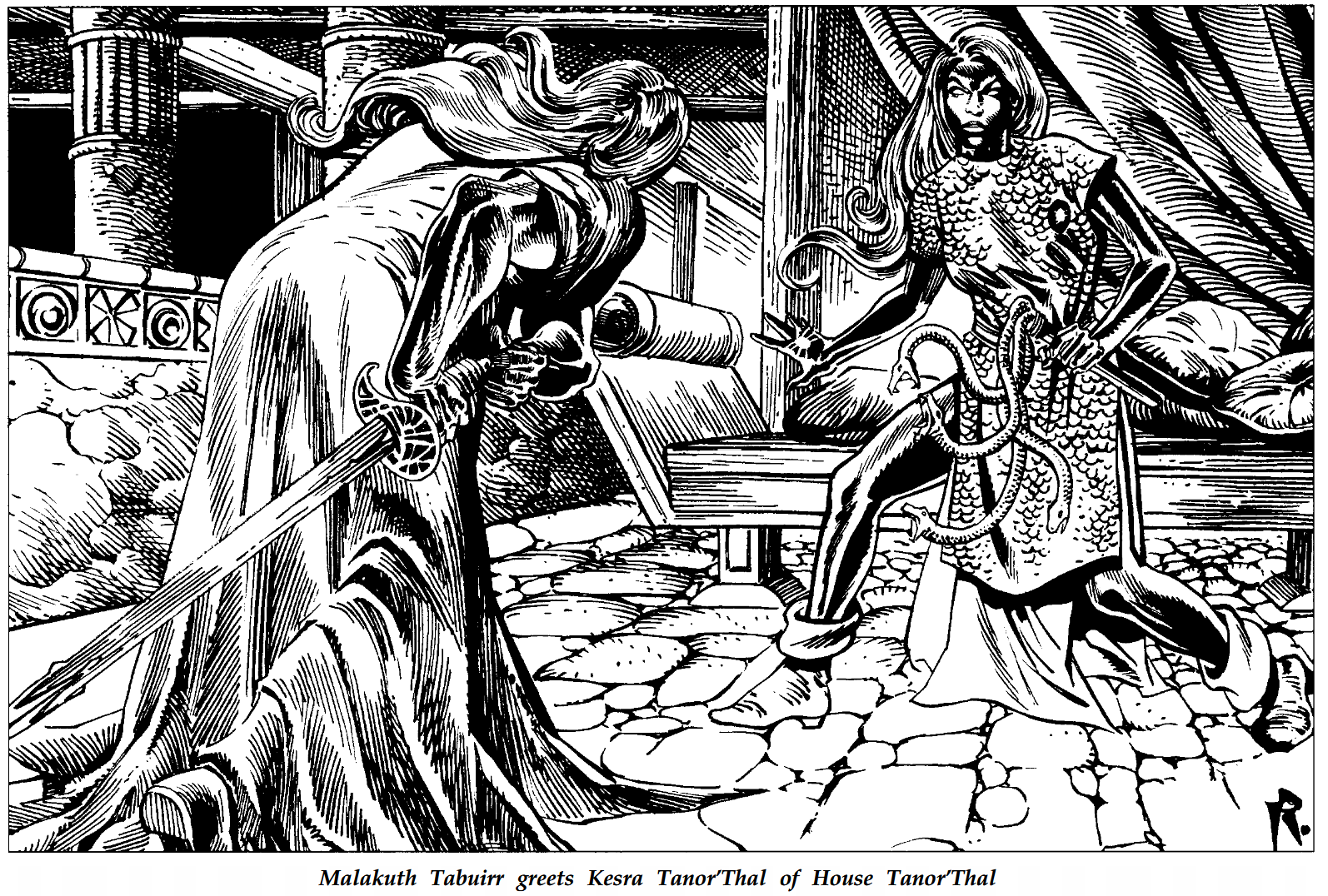
Skullport 2nd Ed. p.77
Amryyr Yauntyrr:
LE male drow M 10 /T 11 ; D EX 17, C ON 16, I NT 19, W IS
I 6, C HA I 8 (LT 10 , work; LH 9 , residence)
Amryyr Yauntyrr is a copper-haired, amber-eyed drow scholar/courier who spends most of his time traveling on extended trips between Skullport and other Underdark locales, including Menzoberranzan. He is rather reserved, but he is sentimental about his long-time companion, Malakuth Tabuirr, whose townhouse (LH9) he lives in when he is in Skullport. He is a member of the Dark Dagger (see the Power Groups section of the Overview of Skullport chapter) mainly because Malakuth is the leader of the local chapter. When in town between trips, he works out of the Fatted Bookworm (LT10) procuring rare books and scrolls and trading in information. Amryyr is loosely affiliated with Xalyth's company in Menzoberranzan, sometimes procuring rare tomes for Xalyth (CE female drow F7). (See the Menzoberranzan boxed set for more information on Xalyth.) He worships Vhaeraun, just as Malakuth does, and has little love for all Lolth worshipers, especially high-strung noble female drow priests of Lolth, since they have ambushed him more than once out of suspicion and overzealous pursuit of their faith. The only female drow he seems to trust is Xalyth of Menzoberranzan, whose solid, humble upbringing, calm demeanor, and obvious intelligence and business savvy he respects.
Amryyr usually wears the traditional drow piwafwi (a magical shielding cloak) with a neck purse under its collar containing his black metal house insignia (that of House Druu’giir); however, he is estranged from his house. He prefers to wear smooth, supple black, purple, or deep green leather garments and high black boots. He often wears quite elegant mithral jewelry sporting an assortment of gems and is fond of wearing multiple earrings in each ear, some of which are magical. He carries several enchanted daggers (of unknown quality), at least one wand, and wears a magical and a nonmagical ring on each hand.
Skullport 2nd Ed. p. 48
LH9. Malakuth Tabuirr's Townhouse (Residence)
4-story Good condition
The infamous drow smuggler and slaver, Malakuth Tabuirr (CE male drow F8/T10; see the Rogues' Gallery chapter), makes his home here. Strangely, the resourceful drow's most prominent business ventures are with his own kind, trading human and elven females for drow goods such as wine, weapons, and armor. He has amassed a substantial body of followers and warriors that he rents out as nocturnal hit squads, assassins, and killers in the Lands Above. Most of these mercenaries are drow males (F1-F4 and F1/T1-F4/T4) who dress in drow chain mail +1 (or greater) and wield scimitars, whips, and hand crossbows, most of which are envenomed as per the dictates of the contract. These emotionless killing machines strike from the shadows in great numbers, often supplementing their already considerable martial skills with magical spells cast by male drow mages (M4+M8).
Wizards in Malakuth's employ are always equipped with magical wands and staves (wands of fire and staves of striking). With the vast fortune he has earned through smuggling and bloodshed, the exterior of Malakuth's home has slowly been transformed over the years to appeal to the drow aesthetic. It has high domed towers, sweeping stone parapets, and pockets of permanent faerie fire highlighting its alien architecture. Several dozen drow, all male (F1-F5 and F1/T1-F5/T5), act as house guards. They are armed with scimitars, hand crossbows with poisoned darts, and whips, many of which are magical.
The upper reaches of the townhouse are reserved for religious services to Vhaeraun, the dark elven god of thievery and intrigue. These affairs are conducted in secret to avoid attracting the notice of the Skulls or the Tanor'Thal drow family. Amryyr Yauntyrr (LE male drow M10/T11; see the Rogues' Gallery chapter), Malakuth's long-time companion, lives in the townhouse along with Malakuth when he is not out on a courier mission. Amryyr works at the Fatted Bookworm (LT10) when he is in town.
The Iron Ring
While not Vhaeraun-exclusive, a member of Vhaeraun’s group is associated with this group. As such, it is mentioned here.
(Skullport 2nd Ed. p.19)
Despite Skullport’s lawless culture, slave trading in the Port of Shadow is a profitable endeavor due in large part to the influence of the Iron Ring, a consortium of the port's most powerful slavers. Named for the distinctive iron key rings and keys that hang from the baldrics and belt of the confederation's members and agents, the Iron Ring includes Ahmaergo the Horned Dwarf (discussed above under Agents of the Eye), Zstulkk Ssarmn (CE male abomination yuan-ti), Transtra (CE female lamia noble M9), Malakuth Tabuirr (discussed above under the Dark Dagger), and Quinan Varnaed (LE male human F4/P14 of Loviatar), the informal leader of the group. While other independent slavers practice their nefarious business in the Port of Shadow, most eventually join the organization of one of the established members of the Iron Ring or end up hanging by the neck outside Mhaug's (LP1). The leaders of the Iron Ring are constantly at each other's throats; however, the bickering rarely rises above threats of violence and the occasional assassination or theft of underlings, a level of strife far below what there might be if the Iron Ring did not exist.
The Iron Ring was initiated by Quinan and Zstulkk, and it quickly grew to its present roster as each of Skullport's other major slavers saw the wisdom of the group's establishment. The consortium's accomplishments include restoring the huge profits and the detente that had existed among slavers prior to a recent period of extensive slave poaching, the rebuilding of the Skull Island prison fortress, the completion of the Tower of Seven Woes in under two years, and the creation of the Skull Island Registry to minimize disputes between rival merchants. The Iron Ring is responsible for keeping slaves safe from the dangers of Skullport and the rest of Undermountain until their eventual sale in the Slavers' Market of the Lower Port, and the group exercises absolute control over goings-on on Skull Island. Apart from the traditional authority of the Skulls and Shradin Mulophor, the leaders of the Iron Ring exercise more oligarchic clout in Skullport than any other power group. By cooperating with one another, the various members have been able to prevent the Lords of Waterdeep from overtly influencing their trade, blocked foreign competition from gaining a toehold in Skullport's slave markets, and put a damper on the activities of the more unruly elements of the port city. The consortium of slavers even donates slave labor on occasion to maintain streets, repair and construct catwalks, and perform other absolutely necessary civic duties.
Third Edition
City of the spider queen 3.5 Ed. Pg. 71
Hidden
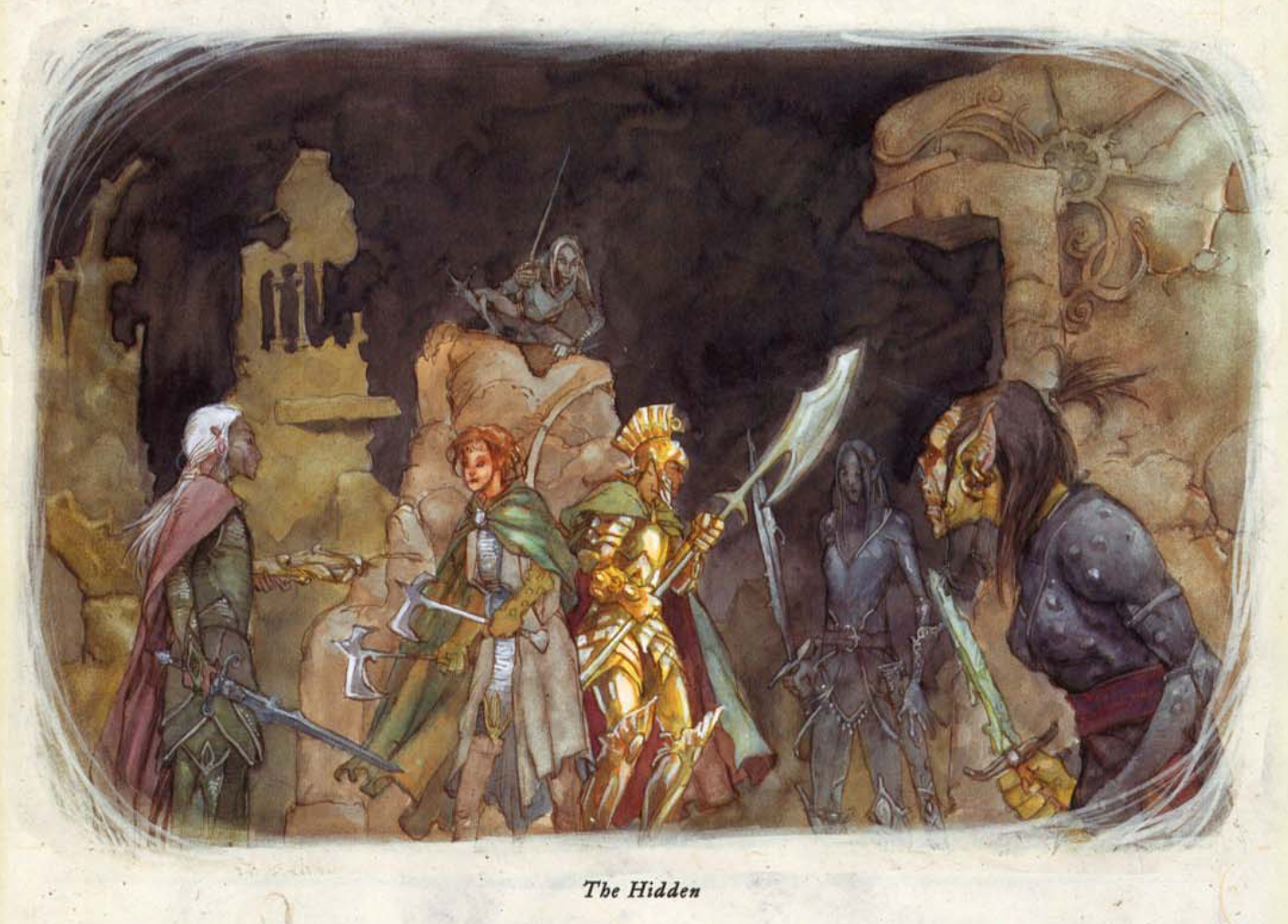
Note: While not technically an organization specifically associated with the Church of Vhaeraun, one of its members “Kâras” is a prominent member in The Lady Penitent trilogy. Thus, he and this organization can be found here.
M4. LAIR OF THE HIDDEN
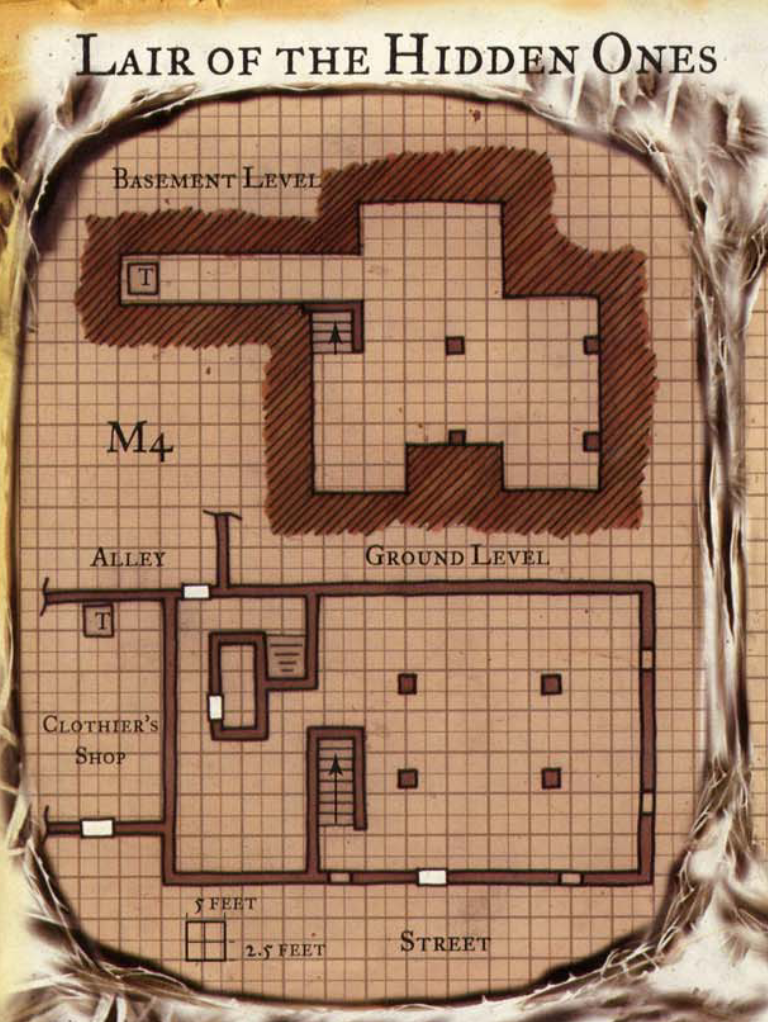
A large inn stands at this intersection in the ruined city. Its upper stories seem to have been destroyed by fire, but its ground floor is more or less intact, even if the broken win-dows and smashed furniture out in the street indicate that it did not escape the attention of looters.
Refer to the map on page 12 of the map booklet. This inn once served various Underdark merchants visiting Maerimydra. It is now the home of a band of skulking drow rogues and spies who are neither followers of Kiaransalee nor undead minions of Irae T'sarran. The Hidden, as they have taken to calling themselves, are shapechangers, shadowdancers, and other "invisibles" who have managed to escape detection since the fall of the city, dodging both Hellspawn patrols and T'sarran scouts.
The primary goal of the Hidden's members (beyond mere survival) is to find allies to help them overthrow both Irae T'sarran and Kurgoth Hellspawn and drive their respective armies out of Maerimydra. The group's ultimate aim is the restoration of the status Maerimydra held before its fall, though this seems a nearly impossible goal at the moment.
Creatures:
While three of the Hidden (Wisp, Logala, and Guk) roam the city, spying out new developments, the rest of the band (Hamadh, Kâros, and Chiirikk) hides out in a large, safe cellar reached either through a narrow stairway in the inn's kitchen or via a secret trapdoor in the building next door (a ruined clothier's shop). Chiirikk and Kâras stand watch in the ground floor of the inn, keeping an eye on the nearby streets from the gloom behind the broken windows. Their position grants them three-quarters cover and a +7 circumstance bonus on Hide checks to remain unseen from the street outside.
Hamadh the Unseen: hp 67; see page 147.
Kâras: hp 41; see page 148.
Chiirikk: hp 185; see page 148.
Wisp, Logala, and Guk are normally away from the lair. If they are all together, the Hidden are an EL 18 encounter.
Hamadh the Unseen: The leader of the group, Hamadh is a drow shadowdancer. He dyes his white hair black and keeps it cut short, and his skin is as inky black as the shadows he lives in. He dresses stylishly in black and dark gray, wearing shadow studded leather armor. He moves, very gracefully, even in combat, swinging his greatsword in both hands like an extension of his lithe body. Hamadh is chaotic neutral, and he has grown uncharacteristically fond of the other members of the group (except Kâras).
Wisp: The other shadowdancer in the group, Wisp is a very small half-drow with a childlike appearance and demeanor. She wears a mithral shirt under her piwafwi (cloak of elvenkind) and carries a keen short sword. She is prone to babble when not - trying to be stealthy, and even while she works her mouth moves silently in an endless internal monologue.
Logala Thenduk: This drow wererat rogue avoids detection by spending most of her time in rat form. She has a number of dire and normal rat allies, from which she garners information about what's happening in the city. Her personality resembles that of her animal form: inquisitive, sneaky, and always hungry.
Kâras: A divine seeker of Vhaeraun, Kâras is undeniably the most evil of the Hidden. Much like Irae T'sarran and the other Maerimydran followers of Kiaransalee, he was part of a small cult that operated in secret in the city. He would rather see the Lolthites back in power than the undead hordes of Kiaransalee, but he plans to seize as much personal power in the transition as possible. He loathes Hamadh and views the other members of the group as useful pawns, but he puts on an agreeable face while pursuing his private goals. Kâras is a very thin but muscular drow man. The left side of his face is covered in scars. He wears elven chain and carries a magic short sword and a hand crossbow.
Chiirikk: This creature is a phasm, though only Hamadh and Logala know this. The other Hidden think that Chiirikk is a drow sorcerer with a mastery of polymorph self (and little else). Chiirikk usually takes the form of an elderly male drow when interacting with the others, but otherwise it rarely appears in the same form twice. It often creeps about the city in the shape of some kind of vermin. It is generally inquisitive and good-natured, which leads Wisp, Kâras, and Guk to think it at least mildly insane.
Guk: A former slave, Guk is a goblin who survived the sack of the city by hiding in an urn. She is an accomplished rogue, who has blossomed under the tutelage of the other members of the Hidden until she is nearly the equal of Logala Thenduk in stealth. She almost never speaks, rivaling even Hamadh in that regard, but occasionally she squeaks loudly when frightened. Guk is a small goblin with yellow eyes and deep red skin. She wears shadow studded leather armor and carries a magic short sword.
Tactics: Kâras and Chiirikk keep an eye on characters who spend more than a few rounds in the vicinity of the inn. If they are impressed with the characters (particularly if they happen to see the party defeat a random encounter) and believe they might be amenable to an alliance, Chiirikk disappears to fetch Hamadh the Unseen, the leader of the group.
If the characters detect the Hidden spies and attack, Kâras and Chiirikk flee immediately to set up an ambush with Hamadh in their cellar. They flee through their trapdoor and escape into the city if pressed hard. (The band members have prearranged meeting places with their scouts in case they are forced to abandon their lair.)
If the sentries summon Hamadh to meet the characters peaceably, he approaches them cautiously while making it quite clear that he wants to parley. Hamadh's approach to negotiation is simple. He suspects that he and the characters share a common goal-the overthrow of Maerimydra's new masters and suggests that he can help them achieve that goal. He begins with an attitude of indifferent, but he is willing to strike a deal to sell them information. Hamadh is unlikely to volunteer his band as followers for the heroes; he is not looking for entanglements of that sort.
The Hidden are most interested in magic items, gems, and other small items of high value. Spells cast for their benefit suffice, too. Each 500 gp worth of items offered by the player characters gives them a +1 bonus on their Diplomacy checks to win the assistance of the Hidden, to a maximum of +20 for 10,000 gp worth of goods or services.
Development: If the heroes fight the Hidden, or even fail to strike a deal, Hamadh leads his band to a new hiding place among the ruined palaces (M5).
Important Characters
Kâras:
Note: He appears in Lady Penitent as a semi-prominent figure after abandoning the Hidden and stealing their treasure, giving more detail to his character and personality as he does. It is worth reading to get a bigger idea of who he is
Note 2: Despite abandoning the Hidden and dying during the events Lady Penitent, Kâras inexplicably appears in the 5e module “Szith Morcane.” As no new information about him is learned, I’ve neglected to archive it.
Kâras is a very thin but muscular drow man. The left side of his face is covered in scars. He wears elven chain and carries a magic short sword and a hand crossbow.
Male drow Rog5/Clr 3 of Vhaeraun/Skr 3; CR 12; Medium-size humanoid (elf); HD 5d6 plus 3d8 plus 3d6; hp 41; Init +4; Spd 30 ft.; AC 22, touch 14, flat-footed 22; Atk +8/+3 melee (1d6+1/19-20, +1 short sword), or +11 ranged (1d4/19-20, hand crossbow); SA rebuke undead 5/day, sneak attack +4d6; SQ drow traits (see Drow NPCs sidebar, page 132), evasion, locate object, obscure object, sacred defense +1, sanctuary, thwart glyph, traps, uncanny dodge (Dex bonus to AC); SR 22; AL CE; SV Fort +7, Ref +12, Will +7; Str 10, Dex 18, Con 10, Int 10, Wis 15, Cha 15.
Skills and Feats: Balance +15, Climb +19, Hide +18, Jump +0, Knowledge (religion) +3, Listen +4, Move Silently +15, Pick Pocket +13, Search +10, Spot. +12, Tumble +13; Dodge, Great Fortitude, Silent Spell, Stealthy.
Locate Object (Sp): Kâras can use locate object once per day..
Obscure Object (Sp): Kâras can use obscure object once per day.
Sacred Defense: Kâras gains a +1 bonus on saving throws against divine spells, as well as the spell-like and supernatural abilities of outsiders.
Sanctuary (Sp): Kâras can use sanctuary once per day.
Thwart Glyph: Karas gains a +4 bonus on all Search and Disable Device checks to locate, disable, or bypass magic glyphs, runes, and symbols.
Spells Prepared (4/4/3; save DC 12+ spell level): 0-create water, detect magic, purify food and drink, resistance; 1st-change self", doom, entropic shield, shield of faith; 2nd-death knell, hold person, invisibility". *Domain spell. Domains: Chaos (cast chaos spells at +1 caster level), Trickery (Bluff, Disguise, and Hide are class skills).
Possessions: +2 elven chain, +1 short sword, lesser ring of silent spells (see Appendix 1), amulet of natural armor +1, hand crossbow and 20 bolts, 6 doses of drow poison.
Hamadh the Unseen: [...] The leader of the group, Hamadh is a drow shadowdancer. He dyes his white hair black and keeps it cut short, and his skin is as inky black as the shadows he lives in. He dresses stylishly in black and dark gray, wearing shadow studded leather armor. He moves, very gracefully, even in combat, swinging his greatsword in both hands like an exten-sion of his lithe body. Hamadh is chaotic neutral, and he has grown uncharacteristically fond of the other members of the group (except Kâras).
[...] “If the sentries summon Hamadh to meet the characters peaceably, he approaches them cautiously while making it quite clear that he wants to parley. Hamadh's approach to negotiation is simple. He suspects that he and the characters share a common goal-the overthrow of Maerimydra's new masters and suggests that he can help them achieve that goal. He begins with an attitude of indifferent, but he is willing to strike a deal to sell them information. Hamadh is unlikely to volunteer his band as followers for the heroes; he is not looking for entanglements of that sort.
The Hidden are most interested in magic items, gems, and other small items of high value. Spells cast for their benefit suffice, too. Each 500 gp worth of items offered by the player characters gives them a +1 bonus on their Diplomacy checks to win the assistance of the Hidden, to a maximum of +20 for 10,000 gp worth of goods or services.”
Hamadh the Unseen: Male drow Rog4/Rgr3 of Vhaeraun/Shd7; CR 15; Medium-size humanoid (elf); HD 4d6+4 plus 3d10+3 plus 7d6+7; hp 67; Init +5; Spd 30 ft.; AC 23, touch 16, flat-footed 23; Atk +15/+10/+5 melee (2d6+5/17-20, +2 keen greatsword), or +16 ranged (1d4/19-20, hand crossbow); SA shadow illusion, sneak attack +2d6; SQ defensive roll, drow traits (see Drow NPCs sidebar, page 132), eva-sion, favored enemy (aberrations +1), hide in plain sight, shadow jump (40 ft.), slippery mind, SR 25, summon shadow, traps, uncanny dodge (Dex bonus to AC, can't be flanked); AL CN; SV Fort +7, Ref +15, Will +4; Str 14, Dex 21, Con 12, Int 14, Wis 10, Cha 10.
Skills and Feats: Balance +14, Disguise +14, Escape Artist +19, Hide +32, Jump +21, Listen +12, Move Silently, Perform +7, Search +14, Spot +19, Tumble +21; Combat Reflexes, Dodge, Mobility, Spring Attack, Stealthy, Track.
Hide in Plain Sight (Su): Hamadh can use the Hide skill even while being observed as long as he is within 10 feet of a shadow.
Shadow Illusion: Once per day, Hamadh can create illusions from the surrounding shadows as though with a silent image spell.
Shadow Jump: Hamadh can travel up to 40 feet between shadows as if by a dimension door spell.
Summon Shadow: Hamadh can have up to two shadow compan-ions, each with 4 HD. These shadows cannot be turned, rebuked, or commanded by any third party.
Possessions: +3 shadow studded leather, +2 keen greatsword, boots of elvenkind, gloves of Dexterity +2, ring of protection +1 (a white gold band set with a line of tiny black pearls), amulet of natural armor +1, potion of nondetection, hand crossbow and 20 bolts, shadow essence poi-son (Fortitude save DC 17; initial damage 1 point of Strength drain, secondary damage 2d6 points of Strength damage).
Jaezred Chaulssin
Note: After further evaluation, Jaezred Chaulssin are at an odd spot regarding being a “Vhaeraunite Organization.” While early sources put emphasis on his involvement with them, later published sources (As of the 4th Edition book "Menzoberranzan: City of Intrigue") would go on to put emphasis on the fact that they abandon him as a patron deity.
I’ve decided to include them and all of the information around them despite this, as many characters involved within the organization have historically been associated with him, and they’ve impacted much of the underdark in his name. Likewise, their renouncing of Vhaeraun is less of a retcon, and more of an evolution of their organization’s views within the canon of Forgotten Realms. (At risk of offering bias), “Dark Dagger” would be a closer idea of an organization that revolved around being an organization within the Church of Vhaeraun.
Note:FR_WYRMSHADOWS will begin a download.
City of Wyrmshadows
“Once this was a drow trade city, openly obedient to the priestesses. Now, it is a blank slate, and even as we speak it is being transformed.” - Patron Father Tomphael Year of Wild Magic (1372 DR)
Chaulssin, the City of Wyrmshadows, is home to progeny of centuries of unions between drow and shadow dragons and serves as the secret base for the assassins of the Jaezred Chaulssin. This chapter details the city, its shadowy rulers, and their magic, as well as presenting a full-length adventure set in a Jaezred fosterage in the drow city of Karsoluthiyl.
Chaulssin - (Middle Northdark)
Nearly ten miles beneath the northern tip of the Rauvin Mountains lie the shadowy remnants of the ancient drow city of Chaulssin. The remote location and little known history of the City of Wyrmshadows make it largely unknown to most Underdarkdwellers, let alone inhabitants of the Realms Above, but a secret brotherhood of master assassins (the Jaezred Chaulssin) uses the place as its hidden stronghold for launching strikes on followers of the Spider Queen.
Chaulssin (small city): Magical; AL CE; 15,000 gp limit; Assets 8,493,750 gp; Population 7,105 free; Isolated (zar’ithra [shadow draconic drow] 55%, zekyl [half-shadow dragon drow] 44%, draa’zekyl [drow-dragon††] 1%); 4,220 slaves (dark bear [shadow quaggoth] 48%, shadar-kaiFF 39%, drow 10%, spectral†† shadow dragon 1%, other 2%).
Authority Figure: Patron Grandfather Mauzzkyl Jaezred (see below).
Important Characters: Patron Fathers of the Jaezred Chaulssin
(see below), Nimor Imphraezl (see sidebar).
Centuries after its fall, the City of Wyrmshadows is but a faint shadow of its former self. Large sections of the city stand empty, patrolled intermittently by tribes of dark bears or claimed by small bands of shadar-kai.
Most of the zekylyn (plural of zekyl) live alone, claiming perches in the shadowy upper reaches of the city’s great galleries when they are not training under the watchful eyes of the Patron Fathers. The zar’ithra’rin (plural of zar’ithra, includes all females not selected for the ilharen’quarthen [harem] and all males) claim the city’s lesser tunnels for their own, hunting interlopers from the Plane of Shadow and the surrounding Underdark in wolfpacks, each dominated by the strongest male and organized in a strict pecking order.
The ilharen’quarthen (female concubines of the Patrons Fathers of the Jaezred Chaulssin) dwell in the heart of the City of Wyrmshadows, in lavish apartments surrounding the great lair of Patron Grandfather Mauzzkyl. The other Patron Fathers visit their concubines in Chaulssin regularly, for each can afford to keep only a handful of female zar’ithra’rin with them in their respective cities.
Brief History
The City of Wyrmshadows acquired its name in the Year of Shambling Shadows (-221 DR), when the shadow dragons of Clan Jaezred conquered the drow city of Chaulssin and enslaved the populace. In the centuries that followed, the dragons slowly eradicated the drow population, twisting them into creatures of shadow and supplanting them with their own wyrm-spawned offspring, all the while drawing the city further and further into the Plane of Shadow.
In the Year of the Darkspawn (634 DR), the shadow dragons of Clan Jaezred were overthrown by their own half-drow/half-shadow dragon progeny, known as the zekylen, who had mastered powerful planar magic in secret while purporting to serve their masters. Haerinvureem, a great shadow wyrm better known as “Shimmergloom,” escaped the carnage through the Shadow Plane, but the rest of his clan were slain and reanimated as spectral creatures††. (Shimmergloom was later slain by Bruenor Battlehammer, King of Mithral Hall, and the Companions of the Hall.)
In the century that followed, the newly emancipated scions of Clan Jaezred began to rebuild their city using wealth plundered from their forefathers’ hoards. During this period, drow missionaries from Ched Nasad, Jhachalkhyn, and Menzoberranzan arrived to preach the word of Lolth to the Chaulssinyr but were repeatedly rebuffed by the ruling patriarchy.
In the Year of Visions (734 DR), Vhaeraun appeared to Chaulssin’s leaders in a shared dream and revealed to them that the Spider Queen had decided to punish them for their defiance. In accordance with Lolth’s will, the ruling council of Menzoberranzan had dispatched a massive army to conquer the City of Wyrmshadows. After hurried debate, Chaulssin’s patriarchs chose to withdraw rather than make a suicidal stand. Drawing on their studies of planar lore, the Chaulssinyr opened portals throughout the city to the Plane of Shadow through which to flee.
Menzoberranzan’s army arrived a few days later to find an abandoned city wrapped in the coils of the Shadow Fringe. After suffering grievous losses to monsters from the Plane of Shadow with little to show for their expedition, the Menzoberranzyr claimed victory and retreated, accrediting the flight of the Chaulssinyr to the might of the Spider Queen.
On the Plane of Shadow, the Chaulssinyr encountered all manner of dangerous creatures, but, at least initially, no hostile armies intent on their destruction. After a forced march through miles of shadowy caverns, they reached the abandoned lairs of their draconic ancestors and claimed them for their own. The Shadow City of Chaul’mur’ssin struggled for many years before the Chaulssinyr established a real foothold on the Plane of Shadow, and in so doing its populace gave up a large measure of its extraplanar Prime nature. (In other words, a significant fraction of the populace acquired the shadowLoM template.) Once the Chaulssinyr population stabilized, the city began to thrive and the inhabitants became a threat to other planar interlopers, including the scions of Clan Malaug and, to a lesser extent, the Shadovar of Thultanthar.
In the Year of the Crimson Thorn (792 DR), the priesthood of Vhaeraun revealed that the ranks of the Chaulssinyr leadership had been heavily infiltrated by the malaugrym. After a day of bloody battles, the shapeshifters were unmasked and put to sword, but only at the cost of many lives and the collapse of the city’s patriarchy. In response, the Church of Vhaeraun assumed power and founded House Jaezred, an elite brotherhood of assassins trained to ferret out
and kill shapeshifting interlopers.
In the years that followed, the conflict between the Chaulssinyr and Clan Malaug waxed and waned, with neither gaining permanent advantage. Over time, however, by carefully studying their foes and stealing what secrets they could, the zekylen learned to split their dual natures into two alternate forms, one drow and the other draconic, creating the first drow-dragons††. With this new power at their disposal, the Chaulsinnyr were finally able to hold their own against the malaugrym and other shadowy threats as well.
Responsibility for stealing Clan Malaug’s secrets fell to House Jaezred, and their successes thrust the patron fathers of the brotherhood into a position of increasing respect and leadership among the Chaulssinyr that threatened to eclipse the authority of the ruling Vhaerunite priesthood. To avoid civil strife and to fulfill the Chaulssinyr’s debt to the Masked Lord, the patriarchs of House Jaezred agreed to return to Faerûn, where they would work to undermine the rule of the Spider Queen. In so doing, they reduced the chance of fratricidal warfare with the Church of Vhaerun and gave hope to the long-nurtured dream of the Chaulssinyr of returning to the Material Plane. However, they also began to distance themselves from the Masked Lord and his followers.
In the Year of the Shadowkin Return (1136 DR), House Jaezred returned to the City of Wyrmshadows and established the House of Hidden Masters in the heart of ruined Chaulssin. Enmeshed in the Shadow Fringe, the abandoned city was a perfect base for the leadership of the Jaezred Chaulssin, as they took to calling themselves, but it was too dangerous a locale in which to raise the next generation of assassins. The patron fathers of the Jaezred Chaulssin agreed to establish fosterages in the guise of minor noble houses in seven drow cities ruled by the Spider Queen’s followers: Ched Nasad, Eryndlyn, Karsoluthiyl, Jhachalkhyn, Maerimydra, Menzoberranzan, and Sschindylryn. Of the seven, only Menzoberranzan proved resistant to infiltration, so the more distant city of Dusklyngh was chosen instead as the site of the seventh fosterage. In addition, a half dozen or so additional smaller fosterages were established in Underdark settlements in which Lolth’s followers were a minor power but drow could walk openly, such as Skullport and Sshamath.
Word of House Jaezred’s return to the Material Plane reached Clan Malaug during the Harpstar Wars (1182 to 1222 DR), thanks to the chance capture of a Harper spy who had previously explored the City of Wyrmshadows, but the losses of the malaugrym during that conflict prevented them from attacking their long-standing foes while the Chaulssinyr were divided. By the Year of the Lost Lady (1241 DR), Clan Malaug had regrouped enough to mount a daring raid on Chaulssin’s ilharim (harem) and managed to kidnap a pregnant zar’ithra’rin of the Patron Grandfather’s ilhar’quarthen for further study. The Jaezred Chaulssin managed to track down and kill the interlopers before they returned to Castle Malaug, but the zar’ithra’rin vanished in the fighting. The Patron Fathers only discovered the fate of Mauzzkyl’s missing offspring in the Year of Shadows (1358 DR), when word reached their ears of a female “drow-dragon” named Nurvureem (see Dragons of Faerûn) luring male adventurers to the ruins of Rundeth Manor north of Amphail.
For now the Jaezred Chaulssin are content to observe the errant drow-dragon, the only one of her gender not slain at birth, watching to see if she becomes a threat and waiting to see who else might be interested in her origins.
In the Year of Wild Magic (1372 DR), Lolth’s Silence undermined the rule of her priesthood in cities throughout the Underdark. After years of plotting, the Jaezred Chaulssin saw their opportunity and struck several Lolth-ruled cities at once. Stonefire bombs burned the calcified webs of Ched Nasad, destroying the city and leaving the ruins to the rule of the Jaezred Chaulssin. In Eryndlyn, Jaezred Chaulssin provocateurs incited the followers of Ghaunadaur and Vhaeraun to work in concert against the church of Lolth, quickly decimating the ranks of the Spider Queen’s followers. Smaller strikes in Dusklyngh, Jhachalkhyn, and Karsoluthiyl weakened the hold of the ruling Matron Mothers, allowing male-dominated merchant houses to gain in influence. The plots of the Jaezred Chaulssin backfired in Maerimydra, as Kiaransalee’s followers claimed the city for their own, and failed in Menzoberranzan when an invasion by the duergar armies of Gracklstugh and the tanarukk hordes of Khaanyr Vhok’s Sceptered Legion faltered upon the Spider Queen’s return.
Since the end of Lolth’s Silence, the Patron Fathers have moved to cement their control of the ruins of Ched Nasad and their position of influence amongst the factions of Eryndlyn. Coins have streamed into the coffers of the Jaezred Chaulssin from merchant houses under their control in Dusklyngh, Karsoluthiyl, and Jhachalkhyn, and the Patron Fathers have begun to plot the next step in their efforts to free the drow race from Lolth’s all-encompassing web.
Important Sites
The City of Wyrmshadows is a deserted ruin that overhangs a tremendous abyss through which cold wind perpetually screams. The city rests on a monolithic spur of stone that juts out into the emptiness, and its ramparts and galleries overlook a terrifying void.
GALLERIES OF SHADOW
The Galleries of Shadow encompass all the lesser halls and chambers of Chaulssin linked by tunnels within the city and not considered part of the House of Hidden Masters. These areas are home to packs of zar’ithra’rin, companies of dark bears, and small bands of shadar-kai. Interlopers from the Plane of Shadow are not uncommon in areas where the Shadow Fringe is close.
HOWLING ABYSS
The City of Wyrmshadows extends out into a great chasm in the earth. The Howling Abyss, as it is known, extends at least three miles above Chaulssin and falls more than seventeen miles into
the depths. Hurricane-force winds buffet the City of Wyrmshadows relentlessly, threatening to sweep away any creature that dares show his face on the abandoned city’s battlements or attempts to fly through the chasm. See page 95 in the Dungeon Master’s Guide for details of
wind effects.
Despite the endless gale, the Howling Abyss is hardly absent of dangerous creatures. Belkers and voidwraithsLM revel in the endless gale force winds, while spectral†† shadow dragons, undead remnants of the shadow dragons of Clan Jaezred, flit about the city they once ruled, defending it against interlopers.
HOUSE OF HIDDEN MASTERS
At the heart of ruined Chaulssin lies the House of Hidden Masters, chapterhouse of the Jaezred Chaulssin, in what was once the city’s largest temple to Lolth. In the center of the desecrated temple lies the opulent lair of Patron Grandfather Mauzzkyl. The walls are hung with tapestries of woven shadowstuff that depict distorted images of scenes long forgotten. The floor is piled high with tarnished coins of varying mintage and design. The arched ceilings of the chamber are built of glistening onyx and embedded with beljurils.
Mauzzkyl’s Lair is surrounded by lavish apartments of the ilharen’quarthen, which resemble the Patron Grandfather’s lair in miniature. Each suite is heavily guarded, for the Patron Fathers do not trust each other not to steal a rival’s favored concubine. The zar’ithra’rin of each harem largely govern themselves between visits by their master, but worship of other gods is closely watched for and ruthlessly stomped out when unearthed.
SHADOW FRINGE
Chaulssin exists partially in the Plane of Shadow, so tendrils of shadowstuff constantly wind through the ruined city, ebbing and flowing with the pull of some erratic, unseen moon. Deadly creatures from the Shadow Fringe haunt the city’s streets, and from time to time whole quarters of the city vanish into the gloom entirely, not to reappear for years.
Areas within the Shadow Fringe are treated as extensions of the Plane of Shadow and exhibit the planar traits of that place
Power Groups
The City of Wyrmshadows is dominated by the Jaezred Chaulssin (detailed separately below), but factions within the brotherhood and among the lower status races living in the city exert influence on life in the City of Wyrmshadows.
Church of Vhaeraun: Given their hatred for the Spider Queen, most Chaulssinyr give at least token obeisance to the Masked Lord. Led by Patron Father Xorthaul of Jhachalkhyn, clerics of Vhaeraun hold many influential positions among the Jaezred Chaulssin, but the other Patron Fathers subtly discourage all efforts to make the brotherhood into the swordarm of the church. In the wake of Lolth’s return, the Patron Fathers have moved to further distance themselves from the hierarchy of the Masked Lord, seeking to side-step the possibility of open warfare between the Spider Queen and her son.
Dark Bears: The Deepbear Battles (-1803 to -1350 DR) pitted the quaggoths of Ursadunthar (deep beneath the Spine of the World) against the duergar of the Deepkingdom of Gracklstugh and ended with the collapse of the deep bear civilization. The quaggoths of the Northdark reverted to a barbaric tribal society, but continued skirmishing with the gray dwarves, subtly encouraged by the drow. As the Deepkingdom declined, many quaggoth tribes fell under the domination of more powerful races, including the drow of Chaulssin.
When the Chaulssinyr fled to the Plane of Shadow, they brought tribes of deep bear mercenaries with them. When the Jaezred Chaulssin returned to the Material Plane, the descendants of these “lost tribes” returned as well, transformed into creatures of shadow, known as dark bears. The dark bears of the City of Wyrmshadows are organized into large tribes that function as mercenary companies. They serve as front line defenders of the City of Wyrmshadows and patrol the surrounding Underdark.
Ilharen’quarthen: The ilharen’quarthen, literally “commanded mothers,” collectively make up the Patron Fathers’ harems. Unlike the jhasin and jhasina of a Calishite pasha’s harem, the ilharen’quarthen are exclusively female and expected to breed regularly. Most members of this group are zar’ithra’rin (singular: zar’ithra), but one in five is a female drow slave from another city. The ilharen’quarthen rank above the rest of Chaulssin’s slave population but below the Jaezred Chaulssin. There is a clear division of status within this class, placing those of dragon blood above their full-blooded counterparts. Most members of the ilharen’quarthen give birth to males, known as zekylyn (singular: zekyl); the rare female, known as a zebeyl (plural:
zebylyn), is invariably slain at birth.
Shadar-kai: Small clans of shadar-kaiFF are found in cities across Faerûn, trying to fend off being drawn into the Plane of Shadow. In the past century, many members of this cursed fey race have gravitated to the City of Wyrmshadows, willingly exchanging their immediate freedom in exchange for magical aid in delaying their fate. Elite shadar-kai serve the Jaezred Chaulssin as spies, observing the activities of Lolth-worshipers throughout the Northdark. Most serve in teams of three or more under the command of an individual velve (see the discussion of the Jaezred Chaulssin hierarchy below).
Spider-Kissers: “Spider kisser” is an epithet reserved among the Chaulssinyr for those suspected of worshiping Lolth, including drow slaves and pure-blooded drow members of the ilharen’quarthen. Although the slave population encompasses most of the secret clerics of the Spider Queen residing in the City of Wyrmshadows, Lolth is said to have a handful of devotees among the zar’ithra’rin as well.
Jaezred Chaulssin
The Jaezred Chaulssin are a secretive, hidden order of assassins who claim descent from the ruling House of the ancient city of Chaulssin and the shadow dragons who once enslaved the City of Wyrmshadows.
After years of exile on the Plane of Shadow, the surviving lords of Chaulssin, reduced to a mere handful of dragon-blooded sorcerers and assassins, have returned to the city of their forefathers and founded minor Houses and secret guilds of assassins in other drow cities. Members of the Jaezred Chaulssin believe that in order to “save” the dark elves from the madness and tyranny of Lolth, drow society must be shattered. If cities fall and thousands of drow die, then it must be borne, since misery and disaster will turn the drow away from Lolth and to other drow deities.
They are willing to risk centuries of weakness, enslavement, and untold suffering for the drow in order to root out Lolth’s power over the race and raise the Jaezred Chaulssin as the secret masters of a drow society shaped to their liking. The Jaezred Chaulssin is ruled by an eight-member patriarchal ruling council, composed of eight senior drow-dragons. The founder of the Jaezred Chaulssin and leader of the ruling council is Patron Grandfather Mauzzkyl Jaezred. He is joined by seven other Patron Fathers, each of whom commands a minor house in a Lolth-ruled city that serves as fosterage for the order. The Patron Fathers are served by the Velves (Blades), made up of zekylyn, zar’ithra’rin =, and a handful of other races. The Velves are organized in a strict hierarchy that requires a Velve to defeat a higher-ranking rival to advance. The seniormost Velve holds the rank of Orthae’Velve (Anointed Blade). There are three Ust’Velves (First Blades), five Draat’Velves (Second Blades), and so on.
Jaezred Chaulssin (Expansive Criminal): AL CE, NE; 100,000 gp resource limit; Membership 807; Isolated (zekylyn [half-shadow dragonDra drow] 775, zar’ithra’rin [shadowLoM draconicDra drow] 17, draa’zekylyn [drow-dragons††] 8, other 7); Dues 100 gp/month (300 gp to join).
Authority Figures:
Patron Grandfather Mauzzkyl Jaezred of Chaulssin (see below)
Patron Father Durrelon Claddmtor of Dusklyngh (CE male young adult drow-dragon†† ranger 5/assassin 4)
Patron Father Ilphtrin Imphraezl of Sschindylryn (male adult drow-dragon†† rogue 1/fighter 4/assassin 6),
Patron Father Quildan Oussghym of Karsoluthiyl (CE male young adult drow-dragon†† rogue 5/assassin 1)
Patron Father Tomphael Arkenrret of Eryndlyn (CE male mature adult drow-dragon†† wizard 13/assassin 1),
Patron Father Vesz’zt Auvryana of Maerimydra (CE male vampiricDrac adult drow-dragon†† rogue 6/assassin 3),
Patron Father Xorthaul Barriath of Jhachalkhyn (CE male mature adult drow- dragon†† rogue 1/cleric 9/assassin 1 [Vhaeraun])
Patron Father Zammzt Everharn of Ched Nasad (CE male mature adult drow-dragon†† rogue 5/assassin 8).
Important Characters: Anointed Blade Antrysn Barriath (see below), Former Anointed Blade Nimor Imphraezl (see sidebar).
Associated Classes: Rogue, sorcerer, assassin.
Associated Skills: Bluff, Concentration, Disguise, Hide,
Knowledge (religion), Move Silently, Sense Motive, Spellcraft.
Requirements: You may not divulge secrets of the guild to outsiders. You must gain the consent of your superiors before attempting an assassination or other high profile crime. You must tithe 20% of your profits from performing assassinations or spying to the guild. You must adhere loosely to the tenets of Vhaeraun’s faith.
Favored in Guild Benefit: Thanks to your training with the Jaezred Chaulssin, you gain a +4 bonus to the Fortitude DC required to avoid the kill effect of your death attack.
Special: The Patron Fathers of the Jaezred Chaulssin require a demonstration of skill and commitment in the war against the Spider Queen (usually killing a drow cleric of Lolth and sacrificing her heart on an altar of Vhaeraun).
Members
of
the
Jaezred
Chaulssin
usually
take
the
assassin
prestige class
as
soon
as
they
are
able.
Magic of the Wyrmshadows
The Jaezred Chaulssin favor magic tied to the Plane of Shadow, including Shadow Weave spells and items. Favored spells include ebon eyes††, project image, shades, shadow conjuration, shadow evocation, shadow-gloom††, shadow phase††, shadow walk, simulacrum, and spectral dragon††. Favored magic items include armor with the shadow and silent moves properties, dragonspectre flutes††, and rings of shadow††. As assassins, they also employ weapons of the murder-for-hire trade, including assassin’s daggers, boots of elvenkind, dimensional shackles, piwafwiRF (greater and lesser), rapiers of puncturing, and trollgut ropesMag.
New Feat: Create Spectral Spawn
You have the ability to create undead spawn with ties to the Plane of Shadow with your energy drain ability.
Prerequisite: Energy drain special ability.
Benefits: Creatures slain with your energy drain ability arise as spawn under your control with the spectral creature†† template. They remain under your control until your death.
Relevant Vhaeraunite Characters:
Authority Figures:
Patron Grandfather Mauzzkyl Jaezred of Chaulssin
Mauzzkyl Jaezred: Patron Grandfather Mauzzkyl of Chaulssin (CE male great wyrm drow-dragon†† sorcerer 13/assassin 5) is a hale old dark elf with broad shoulders and a deep chest, his hair thinning to a sharp widow’s peak. The leader of the Jaezred Chaulssin was born in the Year of Shadowed Blades (27 DR) during the reign of the shadow dragons of Clan Jaezred, making him the oldest member of House Jaezred and one of the oldest surviving Chaulssinyr.
Mauzzkyl instinctively rebels against all forms of authority, refusing to accept any situation in which his power is not absolute. This rebellious streak formed the basis of his hatred for the shadow dragons of Clan Jaezred, accounts for his differences with the patriarchs of the Church of Vhaeraun, and forms the core of his hatred of the Spider Queen. The Patron Grandfather is wholly committed to the ideals of the Jaezred Chaulssin, and he views House Jaezred as the living extension of his will.
(Note: More about Mauzzkyl can be found through reading the War of the Spider Queen Novel series, as he appears as a character in Condemnation and Annihilation.)
Patron Father Durrelon Claddmtor of Dusklyngh (CE male young adult drow-dragon†† ranger 5/assassin 4)
[...] Smaller strikes in Dusklyngh, Jhachalkhyn, and Karsoluthiyl weakened the hold of the ruling Matron Mothers, allowing male-dominated merchant houses to gain in influence.
Patron Father Ilphtrin Imphraezl of Sschindylryn (male adult drow-dragon†† rogue 1/fighter 4/assassin 6)
No Other Information Available
Patron Father Quildan Oussghym of Karsoluthiyl (CE male young adult drow-dragon†† rogue 5/assassin 1)
Note: Quildan Oussgyhm is an enemy found in the original module the Jaezred Chaulssin appear in, with very limited description regarding his appearance. For things such as the statblock, view the original module as has been linked above.
“Atop the bed of coins and pillows is the writhing form of a creature fluctuating between the form of a dragon and a male drow elf. He is attended by two dark elf females with distinctive dragonlike features. The two females rise to defend him from attack. A human female lies on the floor on the west wall, bound in iron bands that prevent any movement.”
“Quildan is attended by two members of his ilharim. The remaining two members have departed via the portal in #16 on a long and arduous trip through the Plane of Shadow back to the City of Wyrmshadows to seek help.”
[...] Smaller strikes in Dusklyngh, Jhachalkhyn, and Karsoluthiyl weakened the hold of the ruling Matron Mothers, allowing male-dominated merchant houses to gain in influence.
Patron Father Tomphael Arkenrret of Eryndlyn (CE male mature adult drow-dragon†† wizard 13/assassin 1)
As a drow, he is a slender Drow in Wizard Robes. Looks rakish. He was a mature adult Shadow Dragon.
In Eryndlyn, Jaezred Chaulssin provocateurs incited the followers of Ghaunadaur and Vhaeraun to work in concert against the church of Lolth, quickly decimating the ranks of the Spider Queen’s followers [...] Since the end of Lolth’s Silence, the Patron Fathers have moved to cement their control of the ruins of Ched Nasad and their position of influence amongst the factions of Eryndlyn
Note: All extra information about him appears in the War of the Spider Queen series. He acts as a mentor figure to Nimor after Nimor’s failure in Menzoberranzan.
Patron Father Vesz’zt Auvryana of Maerimydra (CE male vampiricDrac adult drow-dragon†† rogue 6/assassin 3)
No Other Information Available
Patron Father Xorthaul Barriath of Jhachalkhyn (CE male mature adult drow- dragon†† rogue 1/cleric 9/assassin 1 [Vhaeraun])
Cleric of Vhaeraun. As a drow, he wears the clothing associated with the Church of Vhaeraun.
[..] Given their hatred for the Spider Queen, most Chaulssinyr give at least token obeisance to the Masked Lord. Led by Patron Father Xorthaul of Jhachalkhyn, clerics of Vhaeraun hold many influential positions among the Jaezred Chaulssin, but the other Patron Fathers subtly discourage all efforts to make the brotherhood into the swordarm of the church.
[...] Smaller strikes in Dusklyngh, Jhachalkhyn, and Karsoluthiyl weakened the hold of the ruling Matron Mothers, allowing male-dominated merchant houses to gain in influence.
Patron Father Zammzt Everharn of Ched Nasad (CE male mature adult drow-dragon†† rogue 5/assassin 8).
Note: All extra information about him appears in the War of the Spider Queen series. His drow form has the features associated with that of a commoner. Led a slave uprising in Menzoberranzan during Silence of Lolth. Helped Destroy Ched Nasad.
Antrysn Barriath: Antrysn Barriath (CE male half-shadow dragon drow rogue 1/sorcerer 5/assassin 1/blood magusCAr 10) is a powerfully-built drow male with a nasty temper and a penchant for sadism. He favors blood red robes devoid of ornamentation. He keeps his body shorn of all hair, and his dark-scaled skin is heavily scarred with arcane runes (the result of regular scarification).
Antrysn held the rank of Anointed Blade of the Jaezred Chaulssin for many years ere he was murdered by an ambitious rival, Nimor Imphraezl. Patron Father Xorthaul of Jhachalkhyn secretly raised his favorite son, but kept his return to life a secret from the rest of the Jaezred Chaulssin. Following Nimor Imphraezl’s demotion, Antrysn emerged from the shadows to reclaim the rank of Anointed Blade of the Jaezred Chaulssin, much to Nimor’s dismay. The two rivals continue to seek advantage over the other, and battle between the two is inevitable.
Nimor Imphraezl:
Male half-shadow dragon drow rogue 3/fighter 4/assassin 9 - CE Medium dragon
Nimor is the most talented and deadly assassin of the Jaezred Chaulssin. Ere the failure of his plans to overrun Menzoberranzan with armies of duergar and tanarukk, Nimor was accorded the rank of Orthae’velve (Anointed Blade) of the Jaezred Chaulssin, the highest rank to which a half-shadow dragon drow could aspire before becoming a drow-dragon and one of the Patron Fathers.
Now Nimor seeks to regain his former rank by impressing the Patron Fathers with a great and unexpected victory.
Nimor uses a variety of guises, most magical in origin. He most often appears as a slender, almost boyish drow male of striking good looks, with the easy grace and blinding speed of a professional duelist. He favors the role of a noble rake, and can pass himself off as a highborn lad of a great House with ease. He also cultivates practical identities, including that of a gem merchant, in order to move freely and elude observation. Nimor is far stronger than he appears (a result of his draconic heritage) and has mastered many of the dark spells of the assassin’s deadly trade.
Roleplaying Hook: During the War of the Spider Queen, Nimor fought well, schemed his best, and nearly—within a rothéé’s hair—conquered the most powerful drow city in the Underdark. The trophy of Ched Nasad would have paled in comparison to the jewel of a conquered Menzoberranzan. Of course, he knows that nearly was insufficient, almost a paltry substitute for success, both for him and for the Jaezred Chaulssin. Nearly won him nothing. Nearly had lost him his place of honor as the Anointed Blade of the Jaezred Chaulssin.
Menzoberranzan - City of Intrigue 4th Ed. p. 68
Dragon blooded draw who seek to help the drow throw off the yoke of Lolth's dominion.
Jaezred Chaulssin
Traits: Authoritarian, sadistic, secretive
Power: 3
Membership: 140 drow, dragon-blooded drow, and shadar-kai
Headquarters: House of the Hidden Masters in Chaulssin
Religious Affiliation: Before the Reckoning: Vhaeraun (weak);
after the Reckoning: none
Leadership: Patron Grandfather Mauzzkyl Jaezred
Allies: None
Rivals: Church of Lolth, Bregan D'aerthe
The Jaezred Chaulssin is a secretive, patriarchal order of assassins who claim descent from the ancient drow of Chaulssin and the shadow dragons that long ago enslaved them. After centuries of exile within the Shadowfell, the surviving lords of House Jaezred, reduced to a mere handful of dragon-blooded sorcerers and assassins, returned to Faerun to challenge Lolth's crushing dominion over the drow. The shadowy city of Chaulssin (page 109), which exists in both the Shadowfell and the Underdark, serves as the base for this cadre of master assassins.
The Jaezred Chaulssin operated in the shadows, through infiltration and assassination, from the time of its return to Faeraun in 1136 DR until the War of the Spider Queen in 1372 DR provided an opportunity for a more overt attack on Menzoberranzan. Throughout the period of Lolth's silence, the Jaezred Chaulssin spurred revolt in drow cities across Faeraun, with some spectacular results-including the destruction of Ched Nasad. During the Spellplague, Chaulssin shuddered as the planar order shifted, and the members of the Jaezred Chaulssin found their shadow magic disrupted. The death of Vhaeraun during the Reckoning also dealt a significant blow to the order. As a result, the Jaezred Chaulssin withdrew from active strikes against the "spider-kissers" who worship Lolth, and spent much of the next century rebuilding their strength.
Goals
Members of the Jaezred Chaulssin believe that to save the dark elves from the madness and tyranny of Lolth, drow society must be shattered. If cities fall and thousands of drow die to do so, then that fate must be borne, since misery and disaster will turn the drow away from Lolth and toward other deities. The assassins are willing to risk subjecting the drow to centuries of weakness, enslavement, and suffering to remove Lolth's hold over the race and raise up the Jaezred Chaulssin as the secret head of a drow society shaped to its liking.
Sabotage Arach-Tinilith
Late in the Spell plague era, the Jaezred Chaulssin became more overt in its tactics, directly targeting high priestesses of Lolth for assassination. In Menzoberranzan, the organization has its sights set squarely in the mistresses of Arach-Tinilith.
In the Year of Splendors Burning (1469 DR), Jaezied Chaulssin sleeper agents posing as students at the Academy successfully disrupted the Ceremony of Graduation, unleashing a horde of demons within Arach-Tinilith's walls. Before the demonic host was expelled, the Academy temple suffered severe damage, resulting in heavy casualties. With the success of this assault, the Jaezred Chaulssin has become emboldened to attempt even grander attacks in the future.
Foment Insurrection
The open attack on Arach-Tinilith aside, the Jaezred Chaulssin's primary methods are subtle and deceptive, designed to redirect suspicion toward a third party, if possible. At every opportunity, the Jaezred Chaulssin seeks to foment cynicism and bitterness in Menzoberranzan's male population. The organization's ultimate aim is to ratchet up so much animosity toward the city's priestesses that it triggers a city-wide uprising. The Jaezred Chaulssin is already well positioned, with opposition groups within Sorcere and Melee-Magthere. All it need to do now is to drum up popular support among the commoners and the lesser houses, believing that insurrection will then be all but assured.
Organization
The Jaezred Chaulssin is ruled by a council of eight patron fathers, led by the order's founder, Patron Grandfather Mauzzkyl Jaezred. These leaders are all shadow dragons whose mastery of shadow magic allows them to take on humanoid form and move unnoticed among the drow. Each of the seven patron fathers commands a minor noble house in a different drow city.
Reporting directly to the patron grandfather is the anointed blade, who technically stands higher among the Jaezred Chaulssin than any of the other patron fathers. The anointed blade does not have authority over a fosterage, but acts as an independent agent to carry out the will of the council – typically through infiltration, espionage, and assassination.
Beneath the anointed blade are several ranks of blades, from first blades to eighth blades. The number of operatives at each tier is limited, and advancing from a lower rank to a higher requires defeating a higher-ranking rival. No more than three first blades exist at one time, five second blades, seven third blades, and so on down to the fifteen seventh blades.
The number of eighth blades is unlimited, but even the ranks of the seventh blades are not always full. Dragon blood runs through many of the drow agents of the Jaezred Chaulssin, from the full-blooded shadow dragons who form the ruling council of patron fathers to a scattering of half-dragon drow in the upper ranks of the blades. Lower-ranking blades often claim draconic blood, but rarely have anything to show for it beyond an aptitude for shadow magic.
Notable Personages
When dealing with the Jaezred Chaulssin, appearances are most certainly deceiving.
Antrysn Barriath: Antrysn held the rank of anointed blade of the Jaezred Chaulssin for many years before he was murdered by an ambitious rival, Nimor Imphraezl. Patron Father Xorthaul of Jhachalkhyn resurrected Antrysn, but kept his return to life a secret from the rest of the Jaezred Chaulssin.
Following Nimor's demotion, Antrysn emerged from the shadows to reclaim the rank of anointed blade, much to Nimor's dismay. The two rivals continue to seek advantage over the other, and battle between them is inevitable. Antrysn is a half-dragon drow, the son of Patron Father Xorthaul of Jhachalkhyn, with a nasty temper and a sadistic streak. He appears as a muscular, hairless drow male with dark-scaled skin that is heavily scarred with arcane runes. He favors blood red robes without ornamentation.
Mauzzkyl Jaezred: The patron grandfather of Chaulssin, Mauzzkyl cannot tolerate any person, organization, or even deity who would claim authority over him. This rebellious streak formed the basis of his hatred for the shadow dragons of Clan Jaezred, accounts for his differences with the patriarchs of the Church of Vhaeraun, and forms the core of his hatred of the Spider Queen. The patron grandfather is wholly committed to the ideals of the Jaezred Chaulssin, and he views House Jaezred as the living extension of his will. Mauzzkyl is an incredibly ancient shadow dragon, but he uses his drow form most of the time. In that form, he is a hale old dark elf with broad shoulders, a wide chest, and thinning hair forming a widow's peak.
Nimor Imphraezl: Once the most talented and deadly assassin of the Jaezred Chaulssin, Nimor suffered an embarrassing setback during the aborted siege of Menzoberranzan last century. He has spent the last several decades working to regain his former glory and rank as anointed blade. Presently, Nimor is serving as patron of the Menzoberranzan foster age under the guise of the rakish noble Nagyon Nurindyn. In this role, he appears as a slender, almost boyish drow male of striking good looks, with the easy grace and blinding speed of a professional duelist. As a half-dragon, Nimor is far stronger than he appears and has mastered many dark and deadly spells of the assassin's trade.
RELATIONSHIPS
The Jaezred Chaulssin has courted an eclectic collection of allies since its founding, but patron fathers would gladly abandon each in furtherance of their long-term goals.
Shadar-kai: Over the past two centuries, many small clans from throughout the Shadowfell have been recruited by the Jaezred Chaulssin to serve as mercenaries and spies, observing the activities of Lolth-worshipers throughout the Northdark. Most serve in teams of three or more under the command of an individual Jaezred Chaulssin velve.
Netherese: Through the shadar-kai, the Jaezred Chaulssin has attracted the attention of Netheril. For the time being, the two groups share an uneasy amity, though the Jaezred Chaulssin is wise enough to know that it's only a matter of time before the Netherese try to forcibly annex the smaller organization into their empire. If the Netherese act on these desires, the patron grandfather has issued standing orders for retaliatory hits against the twelve Princes of Shade.
Church of Lolth: "Spider kisser" is a derisive epithet reserved among the Chaulssinyr for drow who worship Lolth, including pretty much anyone from Menzoberranzan. Despite numerous assassinations and acts of terror, the Church of Lolth remains largely unaware of the Jaezred Chaulssin, and the patron fathers prefer it that way.
Bregan D'aerthe: The Jaezred Chaulssin views Bregan D'aerthe as a crude tool and nothing more. Nimor placed several agents within Jarlaxle's brotherhood, but attempts to infiltrate the mercenary's inner circle have so far proven ineffectual. When the time comes for insurrection to rise in the streets, Jaezred Chaulssin plans to have plenty of coin on hand to purchase Bregan D'aerthe's loyalty.
Council of Spiders: During the events surrounding Lolth's attempt to create a Demon Weave, a group of wizards seeking to overthrow the rule of Lolth's priestesses have come together. Bringing Lolth's efforts to fruition can only aid these wizards in pursuing their own goals. The leadership of the so-called Council of Spiders consists of various lesser wizards of House Xorlarrin and House Barrison Del 'Armgo, but one agent of the Jaezred Chaulssin – a dragonblooded drow named Faraen Nuryndin – is steering the council toward outright rejection of the Way of Lolth.
ENCOUNTERS
Greater blades (those of the first, second, or third order) are almost always encountered alone, with the majority of their victims unaware of who delivered the killing blow. Greater blades are the ultimate assassins, enjoying both the benefit of supernatural dexterity and mastery over shadow magic. Some of the half-dragons among them are aided further by shadowy wings. Lesser blades (of the fourth order or lower) typically lead squads of three or more shadar-kai on scouting missions to spy on strongholds of Lolth. The blades require unwavering devotion and obedience from their shadar-kai agents, but they are by no means immune to the treachery so endemic in drow society.
Outside their base in Chaulssin, the Jaezred Chaulssin are most active in and around their seven fosterages.
Jaezred Fosterages
To aid in their schemes, the patron fathers of the Jaezred Chaulssin decided to establish fosterages in the guise of minor noble houses in seven drow cities ruled by the Spider Queen's followers: Ched Nasad, Eryndlyn, Karsoluthiyl, Jhachalkhyn, Maerimydra, Menzoberranzan, and Sschindylryn. Of the seven, only Menzoberranzan initially proved resistant to infiltration, so the more distant city of Dusklyngh was chosen instead as the site of the seventh fosterage.
In addition, six additional smaller fosterages were established in Underdark settlements where Lolth's followers were a minor faction but nonetheless drow could walk openly, such as Skullport and Sshamath. With their efforts in Eryndlyn and Ched Nasad spectacularly successful, the Jaezred Chaulssin tried once more to infiltrate the City of Spiders. This time it was successful, establishing a secret fosterage in House Nurindyn (rank 48), which masquerades as a lesser house of bounty hunters and slavers.
ADVENTURERS OF THE JAEZRED CHAULSSIN
"Subject to the lash again, eh, brother? You are better than that-you know you are."
Join Jaezred Chaulssin if you want to:
+ Actively oppose the Way of Lolth and its matriarchal doctrine.
+ Play an assassin who has the drive to hunt down your query no matter how difficult the challenge.
+ Be a drow with the blood of shadow dragons in your veins.
JAEZRED CHAULSSIN INFILTRATOR
Long have your dragon-blooded kin lurked upon the periphery of Menzoberranzan observing the decadent "spider kissers" and their contemptible ways. A century past, your brothers, the Jaezred Chaulssin, instigated a plan to overrun the City of Spiders with armies of duergar and tanarukk, yet fate intervened and the siege ended in failure. The sting of that debacle yet endures, but as a new generation of the Infiltrators, you seek the opportunity to remedy the missteps of your forebears.
Many evenings you have wandered Menzoberranzan; alternating guises as a common laborer or rakish noble as the opportunity presents. To the many disenfranchised males in your travels, you whisper subtle sedition against the Way of Lolth, sowing seeds of doubt among commoners and noble-born alike. You have little fear of retribution, because even if you were exposed for spreading heresy, your mastery of shadow would allow you to quickly and silently spirit yourself to safety.
You operate primarily out of the Jaezred Chaulssin fosterage in Menzoberranzan, reporting to patriarch Nimor lmphraezl. As an Infiltrator, you are Nimor's eyes on the street, tasked with fomenting discord and doubt at every opportunity.
Characteristics: Calculating, furtive, patient
Prerequisites: Drow
JAEZRED CHAULSSIN SHADOW AGENT
You are a child of shadow, a harbinger of doom, and a scion of death. Long eons in the Shadowfell have shaped the shadar-kai into a grim people filled with loathing and self-contempt. Both cursed and blessed by your affinity with the Shadowfell, you have mastery over the art of stealth and subterfuge, but you must constantly work to channel the darkness within you,
lest it utterly consume you.
To further the cause of the Jaezred Chaulssin, you have permitted yourself to be taken as a slave and sold to a noble house within Menzoberranzan. Your exotic, tattooed skin and comely appearance have served you well. The matron of your adopted house has taken a special liking to you and set you on the path to power and prestige. Little does the foolish matron know that you foment dissent in her house with your every breath.
Before accepting this sleeper assignment, the anointed blade personally tasked you with a secondary objective in utmost confidence. As the opportunity presents itself, you are to encourage the matron mother to ally with House Nurindyn, whereupon you are to spy on Nimor lmphraezl and report his activities back to the anointed blade.
Characteristics: Charismatic, duplicitous, vindictive
Prerequisites: Shadar-kai (half drow)
CHAULSSIN (pg. 109)
Nearly ten miles beneath the northern tip of the Rauvin Mountains, the remains of the ancient drow city of Chaulssin endure among the lingering shadows. The remote location and little known history of the settlement make it largely unknown to most Underdark dwellers, let alone inhabitants of the Realms Above, but a secret society of master assassins – the Jaezred Chaulssin (page 68) – uses the place as its hidden stronghold for launching strikes on followers of the Spider Queen.
The so-called City of Wyrmshadows acquired its name when an extended family of shadow dragons conquered and enslaved its inhabitants. Centuries after its fall, Chaulssin retains only a faint shadow of its former glory. Large sections of the city stand empty, patrolled intermittently by tribes of quaggoths or claimed by small bands of shadar-kai.
History
In the Year of Shambling Shadows (-221 DR), the shadow dragons of Clan Jaezred conquered the drow city of Chaulssin and enslaved the populace. In the centuries that followed, the dragons slowly eradicated the drow population, twisting them into creatures of shadow and supplanting them with their own wyrm-spawned offspring, drawing the city further into the
Shadowfell with each transformation.
In the Year of the Darkspawn (634 DR), the shadow dragons of Clan Jaezred were overthrown
by their own half-drow progeny, who had mastered formidable planar magic in secret while purporting to serve their masters. Haerinvureem, a shadow wyrm better known as "Shimmergloom," escaped the carnage, but the rest of his clan were slain and reanimated as spectral creatures.
Over the century that followed, the newly emancipated scions of Clan Jaezred began to rebuild their city using wealth plundered from their forefathers' hoards. In the Year of Visions (734 DR), the drow god Vhaeraun appeared to Chaulssin's leaders in a shared dream and revealed to them that the Spider Queen had decided to punish them for their worship of Vhaeraun instead of Lolth: The Ruling Council of Menzoberranzan had dispatched an army to conquer the City of Wyrmshadows. After hurried debate, Chaulssin's patriarchs chose to withdraw to the Shadowfell, with Vhaeraun's help, rather than make a suicidal stand. Menzoberranzan's army arrived a few days later to find an abandoned city straddling the tenuous border between Faerûn and the Shadowfell.
In the centuries that followed, Vhaeraun's clergy gradually took control of the city. In 792 DR, the
church founded House Jaelzred, an elite society of assassins, to deal with the hazards of the Shadowfell and the infiltration of alien shadow creatures called malaugryms.
In the Year of the Shadowkin Return (1136 DR), House Jaezred returned to Chaulssin and established the House of Hidden Masters in the heart of the ruined city. Existing partly in Faerûn and partly in the Shadowfell, Chaulssin was a perfect base for the Jaezred Chaulssin, as the house leaders began calling themselves.
Featured Sites
The City of Wyrmshadows is a deserted ruin that overhangs a tremendous abyss through which wind perpetually screams. The city rests on a monolithic spur of stone that juts out into the emptiness, and its ramparts and galleries overlook a terrifying void.
Howling Abyss
The City of Wyrmshadows extends out into a great chasm in the earth. The Howling Abyss, as it is known, extends at least three miles above Chaulssin and descends more than seventeen miles into the depths. Hurricane-force winds buffet the city relentlessly, threatening to sweep away any creature that dares the battlements or attempts to fly through the chasm. Despite the endless gale, the abyss is hardly absent of dangerous creatures. Undead creatures infused with shadow soar on the winds, while spectral shadow dragons – undead remnants of Clan Jaezred – flit about the city they once ruled.
House of Hidden Masters
At the heart of ruined Chaulssin in what was once the city's largest temple to Lolth is the House of Hidden Masters, the chapter house of the Jaezred Chaulssin. At the desecrated temple's center is the opulent lair of Patron Grandfather Mauzzkyl. The walls are hung with tapestries of woven shadowstuff that depict distorted images of scenes long forgotten. The arched ceilings of the chamber are built of glistening onyx and embedded with the flashing gems known as beljurils, while the floor is piled high with tarnished coins of varying mintage and design.
Mauzzkyl's lair is surrounded by the lavish apartments of the concubines of the Jaezred Chaulssin. Each dwelling resembles the patron grandfather's lair in miniature and is heavily guarded, since the patron fathers do not trust each other. Each harem largely governs itself between visits by its master, but any worship of Lolth is ruthlessly stamped out when discovered.
Galleries of Shadow
The Galleries of Shadow encompass all the lesser halls and chambers of Chaulssin linked by tunnels within the city and not considered part of the House of Hidden Masters. These areas are home to companies of quaggoths, small bands of shadar-kai, and packs of roving half-dragons. Interlopers from the Shadowfell are common in border areas.
ADVENTURES IN CHAULSSIN
What might bring a drow to the City of Wyrmshadows, the headquarters of the treacherous Jaezred Chaulssin? Consider any of these adventure seeds, and adapt them as you see fit.
+ The animosity between Nimor lmphraezel and his successor as Anointed Blade, Antrysn Barriath, is about to boil over into outright warfare. A character affiliated with the Jaezred Chaulssin is caught in the midst of the conflict and must decide who to support, or an unaffiliated drow is sent to fan the conflict into a war that will destroy the Jaezred Chaulssin forever.
+ A small band of shadar-kai appears from nowhere in the midst of Menzoberranzan and starts wreaking havoc. The characters manage to pursue them into the Shadowfell, and suddenly find themselves in Chaulssin. They must discover how the shadar-kai managed to shadow walk into the heart of their city and find some way to close the passage so such attacks don't happen again.
+ The Jaezred Chaulssin have a tentative alliance with the shades of Netheril in the Spellplague
era. If the drow of Menzoberranzan can disrupt that alliance, or even turn the two factions against each other, the strength of the Jaezred Chaulssin will be diminished.
Characters should feel ill at least from the moment they're in sight of the dreaded City of Wyrmshadows. Gloom cloaks the entire city, and parts of the city can appear to vanish or appear suddenly amid the shadows. Deadly creatures from the Shadowfell haunt the
city's streets, and interlopers sometimes disappear inexplicably without a sound or a trace. Chaulssin provides an opportunity to introduce an element of horror in a game otherwise focused on intrigue, or it can be simply a convenient location for one of the characters' allies to betray them.