Table of contents
♥ - Enough information to require individual pages to themselves.
Golothaer - [Note: This is a dead city]
Shobalar
Q'Xorlarrin
Nar'Vheen (fallen drow, illithid now)
(Eilistraee)
Vhaeraun
Eilistraee
The Promenade + dancing haven ♥
Tower Chûmavhraele
Welcome to my Website!
♥ - Enough information to require individual pages to themselves.
Underdark:
Buiyrandyn
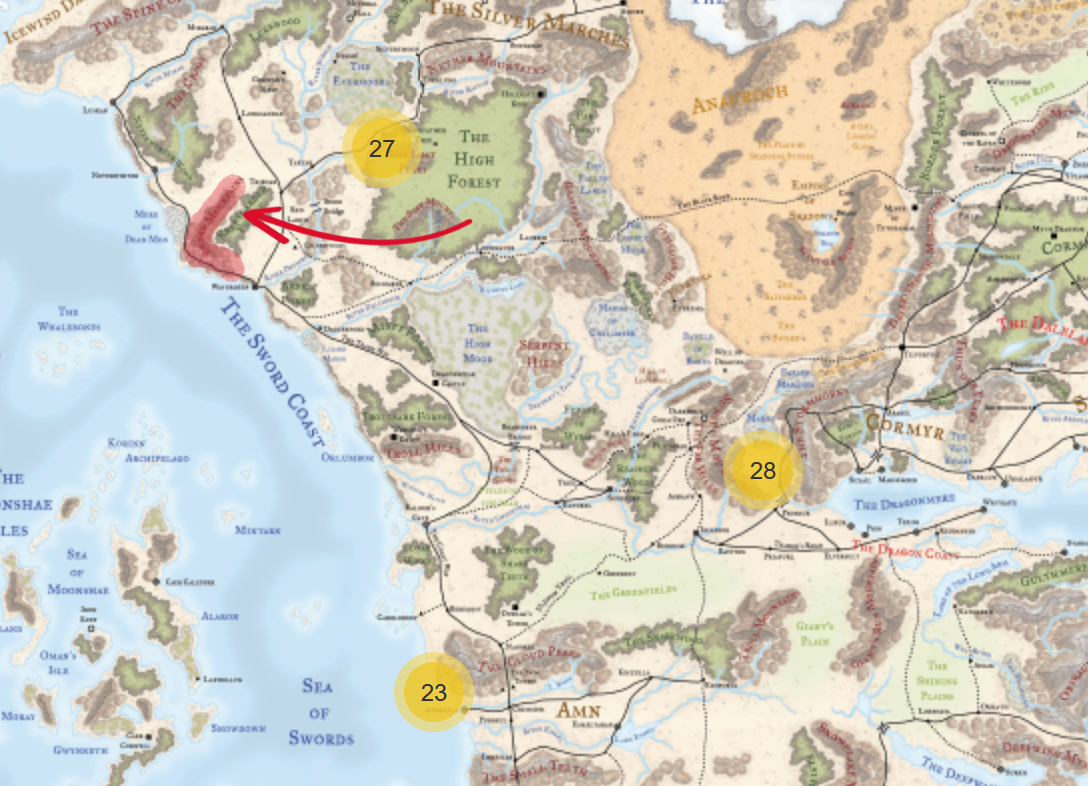
Drizzt Do'Urden's Guide to the Underdark, 2nd Ed. p.60
Buiyrandyn was a tiny drow settlement beneath the northern Sword Mountains due north of the dungeon of Southkrypt and due west of Wyvern Tor. The struggling drow enclave was destroyed centuries ago by illithids and is now the lair of a small clan of hook horrors. Buiyrandyn was notable for spurning Lolth and the other drow gods, and for its most famous resident who dwelt there as a child, Qilue Veladorn, the seventh and most mysterious of the famed Seven Sisters.
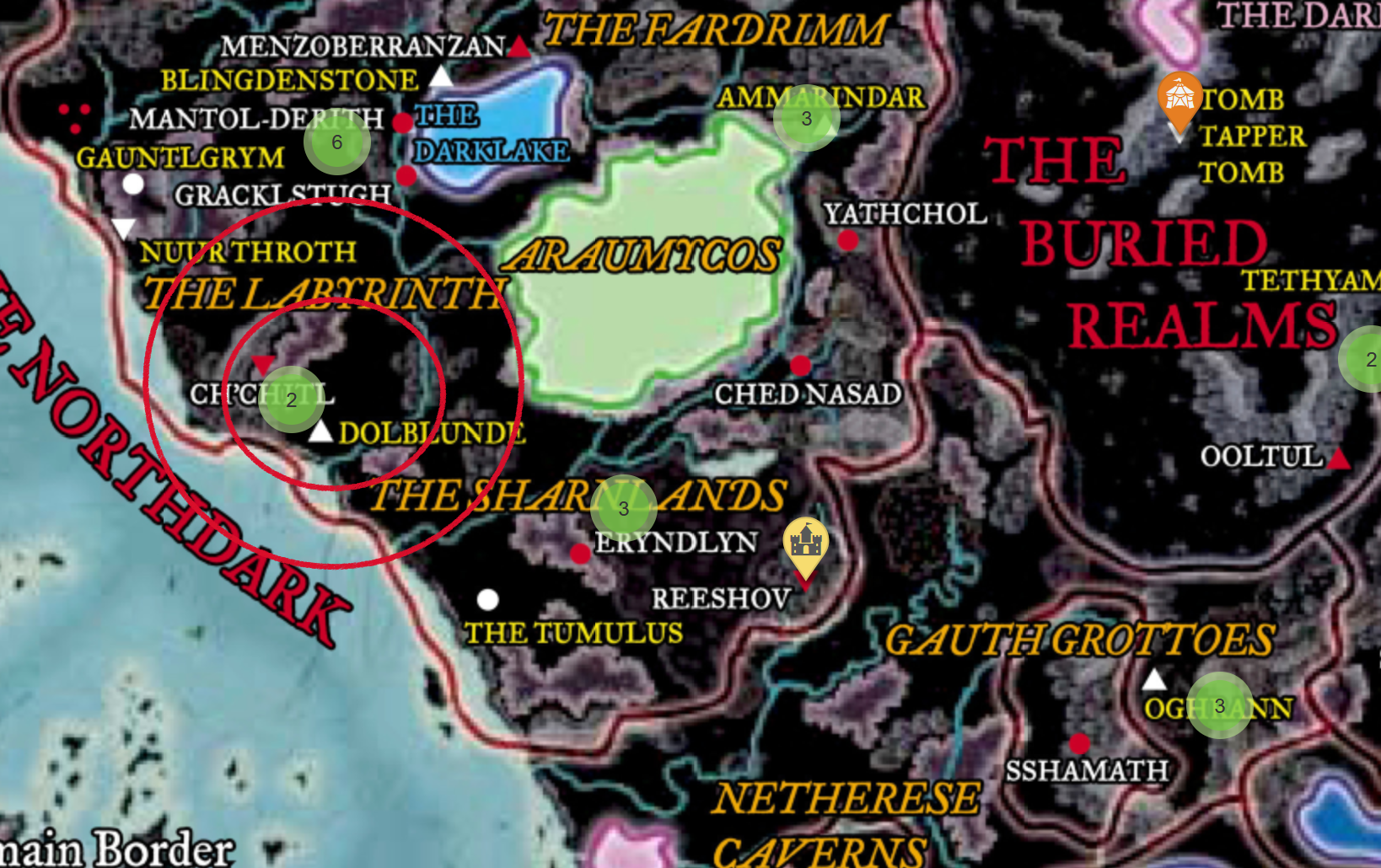
Callidae
Note: This city is from a novel rather than a sourcebook. As such, I am deciding how to include information about it still. The name of it is here for posterity; Please view the Forgotten Realms Wiki for generalized information regarding it.
Chaulssin (+ Chaul'mur'ssin)♥
This city has enough detail to have it's own article! Here is a blurb to give you an idea of the city itself. For more details on its history and inner workings, visit it's page!
City of Wyrmshadows - A Web Enhancement for the FORGOTTEN REALMS® Dragons of Faerûn Accessory
Chaulssin, the City of Wyrmshadows, is home to progeny of centuries of unions between drow and shadow dragons and serves as the secret base for the assassins of the Jaezred Chaulssin. [...] Nearly ten miles beneath the northern tip of the Rauvin Mountains lie the shadowy remnants of the ancient drow city of Chaulssin. The remote location and little known history of the City of
Wyrmshadows make it largely unknown to most Underdark dwellers, let alone inhabitants of the Realms Above, but a secret brotherhood of master assassins (the Jaezred Chaulssin) uses the place as its hidden stronghold for launching strikes on followers of the Spider Queen.
Clorlyth'na'tsheen
Drow Of The Underdark, 2nd Ed. p.20
The majority of drow worship Lolth, the cruel, capricious Spider Queen. She is called “Lloth” by some drow, including those who dwell in the cities of Menzoberranzan and Uluitur. In ancient times, Lolth was known as Araushnee, to drow who inhabited the vanished cities of Clorlyth’na’tsheen and Obbolor (“Spiderhome”).
Dusklyngh
[No information regarding this city is available outside of its mention within the Jaezred Chaulssin document - For information regarding it, see Chaulssin's article.
Dyon G'ennivalz
Note: This city is from a novel rather than a sourcebook. As such, I am deciding how to include information about it still. The name of it is here for posterity; Please view the Forgotten Realms Wiki for generalized information regarding it.
Ched Nasad
This city has enough detail to have it's own article! Here is a blurb to give you an idea of the city itself. For more details on its history and inner workings, visit it's page!
Eryndlyn
Demihuman Deities, 2nd Ed. p. 39
The city of Eryndlyn, located in hidden caves beneath the High Moor, is characterized by barely contained hostilities between the worshipers of Lolth, Ghaunadaur, and Vhaeraun. During the Time of Troubles, the avatar of Selvetarm rampaged through the drow city, attacking strongholds of the followers of Ghaunadaur and Vhaeraun. Priests of Lolth hailed the monster as the swordarm of Lolth, sent to demonstrate her absolute rule. The avatar of Selvetarm was finally driven into the wild Underdark by an alliance between the victimized cults, but not without great losses. It is unknown whether Selvetarm's avatar still remains in the Underdark or if he has returned to the Abyss.
As a result of Selvetarm's rampage through Eryndlyn, droves of drow worshipers in that strife-tom city have allied themselves with the priests of Lolth. A new military order called the Selvetargtlin-a name also associated with the clergy at large-has shifted the balance of power in the cult of Lolth's favor and consequently driven the worshipers of Ghaunadaur and Vhaeraun into an uneasy alliance. It is uncertain how this will affect the long term balance of power in the city.
A few drow in Eryndlyn began to worship Selvetarm in his own right. This displeased Lolth's clergy immensely, and the blas-phemers were quickly driven from the city and into exile. These drow are believed to have recently settled in the Underdark beneath Waterdeep in the hopes of building their own city. Dotrole of Coluotom's faithful boy boononcountered exploring
Drizzt Do'Urden's Guide to the Underdark 2nd Ed. p. 47
Home to more than sixty thousand drow, the city of Eryndlyn lies in hidden caves beneath the High Moor in the upper Underdark. Founded by drow war bands seeking to reclaim legacies of the ancient elven realm of Miyeritar, Eryndlyn dominates the northern Undermoor tunnels. (The southern Undermoor is the domain of derro and illithids, both holding vast cities in the lower Underdark.) Eryndlyn's far-ranging merchants periodically emerge under darkness to trade with unscrupulous merchants along the Sword Coast.
The city is in a great limestone grotto shaped like a squashed melon, more than two miles in diameter. At the bottom of a wide ravine in the heart of the cavern, a shallow lake is fed by two freshwater rivers and drained by a third. The three rivers have carved deep channels in the cavern floor, leaving behind three sprawling plateaus. Most of the drow reside on the plateaus, but many orc, goblin, and troll slaves dwell in shallow caves along the shore of the central lake.
Eryndlyn attained its current status thanks to the relative absence of religious fervor among its early settlers. Shortly after the city's founding, a merchant nobility rose. However, brutal competition between merchant clans drove many wealthy families to secretly curry favor with one or more dark powers. Over time, three major cults emerged: Ghaunadaur, Lolth, and Vhaeraun. After centuries of indifference, religious fervor infected the populace, and priests of all three faiths gained control over the merchant nobility.
Cult-inspired strife resulted in each sect consolidating its influence on one of the three plateaus. The largest plateau lies on the western periphery of the city, dominated by the clergy of Lolth. The northeastern plateau is the domain of Vhaeraun's cultists, while the oft-flooded south-eastern plateau is home to Ghaunadaur's followers. Open warfare has diminished, but hostilities threaten to tear Eryndlyn apart.
Underdark, Sourcebook 3rd Ed. p. 148
(Middle Northdark) Beneath the High Moor lies the drow city of Eryndlyn. About half again as large as Menzoberranzan, Eryndlyn is another mercantile powerhouse and a significant threat to all other realms nearby. War parties from Eryndlyn are frequently encountered in the dungeons and ruins of the High Moor, since the drow of the city are greatly interested in any secret vaults or lore that may remain from the ancient elven realm of Miyeritar, which once stood here.
Unlike many other drow cities, Eryndlyn is openly divided between the followers of Lolth and the worshippers of two other drow deities: Vhaeraun and Ghaunadaur. Lolth’s adherents are as strong as the other two put together, and this fact is all that prevented the Houses that do not worship the Spider Queen from instantly crushing the Eryndlyr Lolthites once Lolth’s silence became obvious.
City of the spider queen 3rd Ed. p. 9
The status quo of this drow city beneath the High Moor depends on an uneasy truce among three religious factions: the followers of Ghaunadaur, Vhaeraun, and Lolth. When one side showed its weakness, the other two were quick to take advantage of that weakness, and the Lolth faction is all but exterminated. Her priestesses lie slain, their followers either killed or enslaved. The western plateau of the city, once controlled by the Lolth faction, lies in ruins still contested by the other two factions. Much like Maerimydra, it is a war zone, and battle erupts whenever gangs or better-organized strike teams from the remaining factions should happen to meet. The strife extends into the outer edges of the two other domains as well.
With both Ghaunadaur and Vhaeraun taking an active interest in events in Eryndlyn, Kiaransalee’s cult has been unable to find a foothold in this city. Her cult has never numbered more than a tiny handful of outlaw drow in Eryndlyn, despite what is actually an unusual amount of religious freedom in the city: With three powerful factions vying for control, few drow are willing to back a fourth party like Kiaransalee’s weak cult
Dragons of Faerûn, Part 3: City of Wyrmshadows
In the Year of the Shadowkin Return (1136 DR), House Jaezred returned to the City of Wyrmshadows and established the House of Hidden Masters in the heart of ruined Chaulssin. Enmeshed in the Shadow Fringe, the abandoned city was a perfect base for the leadership of the Jaezred Chaulssin, as they took to calling themselves, but it was too dangerous a locale in which to raise the next generation of assassins. The patron fathers of the Jaezred Chaulssin agreed to establish fosterages in the guise of minor noble houses in seven drow cities ruled by the Spider Queen’s followers: Ched Nasad, Eryndlyn, Karsoluthiyl, Jhachalkhyn, Maerimydra, Menzoberranzan, and Sschindylryn
(Forgotten Realms Campaign Guide 4e)
Spellcaves of Eryndlyn: Eryndlyn was once a thriving drow city, but religious infighting and threats from without left it nearly abandoned. An earth node near the city absorbed the effects of the Spellplague and has made the cavern the deepest plaguecave in Northdark.
Golothaer
Menzoberranzan Boxed Set 2nd Ed. p.24
[Note: This city is dead in canon: information about it can be found in Menzo's founding. The full story of menzo's history can be found on it's article page, but relevant pieces have been taken for this page.]
Five thousand years ago, the city was founded here by a great high priestess of Lloth, Menzoberra the Kinless (so-named because she had no surviving family), who had fled from the great drow city of Golothaer.
Golothaer was busily destroying itself in civil war, between drow faithful to the Spider Queen, Lloth, and those who worshipped Ghaunadaur. As warring priestesses turned foes to spiders or entombed them beneath tons of shifting rock, drow mages hurled spells to summon gigantic purple worms to devour their opponents, made huge, manyroomed inhabited stalactites break loose from cavern ceilings to crash down on dwellings below, and caused great cracks to open up in the solid rock, to swallow drow armies and the fortresses they issued from. All over Golothaer there was great death and destruction, no safety or peace or happiness — and in the end, no hope of survival.
The proud and powerful priestess of Lloth, Menzoberra, alone of her sister high priestesses, turned away from the fray. She gathered seven families of wealth and power, telling them she was following the will of Lloth, and bade them accompany her to found a new city loyal to Lloth.
Leaving the chaos of war-torn Golothaer, Menzoberra's band set forth into the unknown, trusting to Lloth's guidance. They traveled a long, long time through the Underdark, fighting off many fearsome monsters, and braving the perils of waterfalls, cave-ins, and rockslides in the everpresent darkness.
[...]
The rebuilding of Menzoberranzan began slowly, but quickened as homeless drow and refugees arrived from fallen Golothaer and from Cloibbra, a drow city far to the south that had been sacked by dwarves, svirfneblin, and thaalud working together.
Guallidurth
(Menzoberranzan Boxed Set 2nd Ed. p.4)
Menzoberranzan’s low population makes its ruling Council smaller than those of most drow cities-eight Houses rule, rather than the more usual nine, twelve, fourteen or sixteen. At least one drow city, Guallidurth (deep under Calimshan), has twenty-one Houses in Council.
(Drizzt Do’Urden’s Guide To the Underdark 2nd Ed. p.113.)
The Temple City of Lolth lies deep beneath the Calim Desert, midway between Calimport, the ruins of Teshyll, and St. Noradnarís Hermitage. Located in the middle Underdark, beneath the caverns of Alatorin, Guallidurth is an ancient city thought to date back to the rise of the earliest drow civilizations beneath southern Faeraun circa -9600 DR. As noted above, the drow fought a succession of wars with the Stout Folk of Shanatar that twice led to the fall of Alatorin and the end of golden ages of the dwarves. More recently, the drow battled the humans of Calimshan from -790 DR to the Year of Meager Means (-530 DR) in a series of conflicts known as the Night Wars. When the drow finally withdrew, more than seven hundred fifty thousand humans and other beings had been captured and enslaved by the Spider Queen’s followers.
The Temple City of Lolth is one of the largest enclaves of drow extant in the Realms Below. More than eighty thousand dark elves dwell within the caverns of Guallidurth, with the Matron Mothers of twenty-one noble houses sitting on the Ruling Council and nearly two hundred other houses striving to increase their status and replace them. Whereas in cities such as Menzoberranzan and Ched Nasad the Spider Queen is worshiped uniformly according to the Way of Lolth, in Guallidurth there is no consensus as to how the Dark Mother of All Drow is most appropriately venerated. Each Matron Mother represents one (or more, in some cases) sect, cult, or faction of the Spider Queen’s faithful. One measure of a sect’s relative influence is the relative magnificence of the house of worship it can afford to construct. As a result, Guallidurth contains hundreds, if not thousands, of temples dedicated to Lolth, ranging from simple shrines to grand cathedrals. Many of the city’s temples are either ruined, their congregations long since murdered in the endless religious strife that rages across the city, or abandoned, their congregations able to afford more ostentatious (and defensible) houses of Worship.
Only the unforgivable heresy of drow worshiping other gods unites the Lolthite clergies of Guallidurth in common cause, and even such endeavors are usually doomed to failure by the infighting among members of the various sects. Nevertheless, the drow of Guallidurth have spent the past 50 years attempting to eradicate the Vhaeraun-worshiping drow of the Forest of Mir and the caverns of Ultoksamrin
(Underdark Sourcebook 3rd Ed. p. 155)
Guallidurth
(Middle Old Shanatar)
Also known as the Temple City of Lolth, this metropolis under the Calim Desert is the oldest drow community in the southern Underdark, and one of the largest. More than two hundred noble Houses vie for power in the city, and twenty-one Houses make up its Ruling Council. All the drow here worship Lolth, but each in a different way, so scores of denominations and sects exist within the city. Building a temple to the Spider Queen is seen as the best display of devotion and the surest way to promote a particular drow’s method of worship. Thus, the city is filled with temples, large and small.
Guallidurth is the bane of any other Underdark settlement south of the Wealdath or west of the Alimir Mountains. Its leaders claim all this territory, though they police it loosely. The dark elves’ influence spreads even farther than this area, but they rarely trouble folk who live far away. Still, Guallidurth poses a credible threat to Iltkazar, Oaxaptupa, Oryndoll, and the various beholders under the Lake of Steam. The drow of Guallidurth believe they already “own” the kuo-toa city of Sloopdilmonpolop, so they have not bothered to take it.
Surface historians believe the various Night Wars between the drow and everyone else have been over for roughly 1,800 years. Dwarven historians on the other hand, count at least two other Night Wars since that time that have been waged solely underground, and a few Guallidurthan houses (notably House Mizz’rynturl) believe themselves to be fighting the third Night War, since Iltkazar has shown the temerity to continue existing.
City of the Spider Queen 3rd Ed. p. 10)
The drow of this city beneath the Calim desert have always tried to follow the Will of Lolth—so much so, that the city has been in a constant state of civil war, carved up among sects that vehemently dispute exactly what the Spider Queen’s will is. The neverending struggle among noble houses common to every drow city is paralleled by an identical struggle among cultic factions, each led by the Matron Mother of a noble house. Ironically, the situation has changed very little since Lolth fell silent. A common crisis, which some would take as an incentive to working together, is simply another point of contention in the heated doctrinal debates in the city. Every faction agrees that Lolth is angry with the drow of Guallidurth, and almost every faction considers the Spider Queen’s anger a result of their having failed to exterminate the heterodox groups that oppose them. The eternal infighting continues unabated, even amplified.
Guallidurth has always been a fertile ground for non-Lolthite cults, with the cult of Vhaeraun most prominent among these. About the only thing the Matron Mothers of the city can agree on is that worshiping another deity is even worse than worshiping Lolth the wrong way, so they sometimes manage to join forces to hunt down the heretical cults that spring up like weeds in the city.
These hunts are rarely very effective, rapidly dissolving into infighting, which only strengthens the growing disaffection with the rule of Lolth in the city. In this environment, the cult of Kiaransalee is growing measurably stronger, though it still holds little hope of claiming any real power locally.
(Forgotten Realms Campaign Guide 4th Ed. p. 234)
Guallidurth
Large City; Population 16,000
One of the largest, and certainly the oldest, of the southern drow cities, Guallidurth was a place where the worship of Lolth was left to numerous competing sects, and as many as two hundred noble houses vied for power. But in the years since Lolth’s Silence, a new order has come to Guallidurth.
The various temples were united under the snake-headed scourge, Mistress Mother Fizzri Khaven-Ghell, who systematically cleansed the warring houses until only twenty-four remained, led by First House Loor’Tchaan. This period of “transition” (no one now dares call it a civil war) checked Guallidurth’s expansion for several decades, but in the past thirty years, Guallidurthan patrols have begun to range farther and farther from the confines of their city.
Imberlur
“The residents of this drow city worship Eilistraee instead of Lolth.” Ed Greenwood, Youtube.
This is where fearsome monsters of the Deeper Dark come up into the city from, so Imberlar mounts an official guard over the bridges. Imberlur! This Eilistrae-worshipping drow city under the Border Kingdoms is sometimes referred to as the Pit of Doom by Borderers who think of it (in the words of a carter based in Clovarren hight Iskur Thammren) as "a deep place from which an invasion that will someday doom the entire Border Kingdoms will erupt." However, the truth is very different. Far from being any sort of military powerhouse, Imberlur can just about defend itself and is far more about creating music and poetry and new useful everyday devices than it is about invading or conquering anyone or anywhere.
The citizens of Imberlur, known as "Imberlar", venerate Eilistraee above all other deities and pursue the goals of happiness through creativity and shared fun (playing board games and acting or "party games" and crafting things together), and shared resources (they share food and dine with each other freely rather than one family making and eating meals for themselves; neighbors and even strangers are welcome at the table, and an Imberlar away from the family dwelling will eat and drink at any nearby meal where there's room and food and drink enough). Imberlar also share carts and "work lizards" (large, placid lizards that have shallow walled carry platforms and cages strapped to their backs) with each other, viewing them as common resources everyone should care for, and use only as long as they have pressing need.
Imberlar come to the surface often (by means of dozens of caverns connecting to the surface, notably at both ends of the Neth Peaks; in the Neth Stand just north of Ranrath's Run, due north of Yurbrithee; in a certain cellar in Yallasch; just north and east of the headwaters of the River Rith in Nether Mukshar; in the coastal mountain caverns east of Arthyn; and in the western side of the central Crumblerock Crags west of Irl) to worship the Dark Dancer, by dancing in the moonlight in forest groves and on certain hilltops. One such hill, Stony Top in Nether Mukshar (it's right under the "e" in the map tag for Nether Mukshar in Mike Schley's superb map of the Border Kingdoms), is known to be a place where the goddess herself has danced from time to time, and so is favoured by Imberlar as a site to work magical rituals that involve precise dancing and many participants. They most often do such workings when they desire direct guidance from the goddess, but also to give thanks for abundant fungi harvests, and the acquiring of new trade contacts.
If you're enjoying this video please leave me a like or subscribe. If you want to see other videos in the future please hit the bell icon and if you want a steady stream of Realms Lore please jaunt out to my Patreon, patreon.com/EdGreenwood on Patreon and consider becoming a Protector of the Realms.
"The City That Meets the Eye"
Imberlur is a labyrinth of linked caverns in the shallow Upperdark directly under the surface hills ringed by Ornryl, Boldo's Vale, Dunbridges,Marethoe, and Nightwind. They are ideal for habitation because they host abundant phosphorescent, edible fungi, and streams that well up from deeper layers of the Underdark, cleansed by the fungi they pass through to be sweet, clear drinking water. The general layout of the city looks like a string of pearls curving (bowed out to the southwest) from the northwest down to the southeast, then running east in a wiggling line. The largest cavern of all, known as Larthrylvuth (“Larthryl’s home”) is the northernmost, at the head of the string, and the next three largest caverns (north to south: Aumvuth, Harmaervuth, and Onszvuth) lie along the southwestern most arc of the string). Larthrylvuth is a big communal market and eating place (shared chairs and tables for talking, eating, and dining) surrounded by many habitations (small caverns hollowed out of scores of wall-crevices all around the cavern).
Aumvuth is dominated by bakeries and shops and homes of those who staff them. Harmaervuth is where Imberlur's governance happens, in the form of many meeting chambers that are also used by merchants for daily negotiations that surround a large assembly cavern. Onszvuth is the noisiest place in the city, as it's the hub cavern for most of the larger city workshops (where carts are made and repaired, fungi are processed into food and lubricant oils, mongery is forged or cast and then "finished," and personal adornments and housewares are made). Small workshops tend to be part of the cavern homes of Imberlar, which surround all of these large caverns, the four caverns immediately southeast of Onszvuth along the string (Buelvuth, Larralavuth, Zarundavuth, and Kajrelvuth), and all along the easternmost winding "Run" of the city beyond that, to the small end cavern of Restarrvuth. Onszvuth is separated from Buelvuth by the Varaguth, a deep chasm that plunges for hundreds of feet deeper into the Underdark, and this Varaguth, crossed by three natural stone bridges, is where fearsome monsters of the Deeper Dark come up into the city from, so Imberlar mounts an official guard over the bridges.
Imberlur is softly lit by the pale green, yellow-orange, and reddish glows of the fungi that coat most of its walls, which are either kuthmar (colonies or clusters of jelly-like domes, each dome stuck to adjacent ones from which it budded when they swelled too large and burst their walls) or arraumra (which are feathe- frond-like vines of purple and green that don't glow, but put their energies into growing far and fast along stone and kuthmar domes alike, and often grow tendrils down into the nearest water source, to draw in the moisture they need; their feeding keeps the streams from running throughout the city from ever becoming more than "pools along the flow"). Wherever these fungi grow, the air smells like limes or gooseberries, and is humid, thanks to the emanations of the fungi, which also deaden sound– so the worst "activity din" of the hammerings of making things, and the singing almost all Imberlar indulge in as they work, is softened to the ear. This is useful, as Imberlar don't mark hours and lack a common sleep-wake cycle.
(City traders are well aware that Borderers on thesurface above do ring hour-bells in their cities, and mark the passage of days by sunlight or the lack of it, and those who "go up" report the passing days to city elders in Harmaervuth upon their returns.)
Imberlar tend to be calm, patient, efficient workers, seldom scurrying or in any excited hurry, but the centers of all city caverns tend to see constant traffic at all times, and it's city courtesy not to block the passage of others; those who meet and strike up longer than fleeting converse will out of habit "draw aside" out of the most traveled routes across caverns. There's little privacy in Imberlar homes: doors are rare, and locked doors even rarer. Curtains hung across door openings are the rule, and a tended cluster of bright fungi over a cave mouth denotes a "front entrance." If for some reason real privacy is wanted, a table will be temporarily put on end to serve as a screen or door-barrier, stones put atop its "down" legs for stability. Many homes have the layout of an entry or "common room" cavern that opens into a dining, cooking, and larder cavern, and that has arms of sleep niches or side caverns sprouting off it.
"Imberlar Life"
Imberlar love dressing up and body adornments, but usually dance naked to venerate Eilistraee, and may work naked (to save damage to garments) or wearing whatever's practical for work protection. In keeping with their communal sharing and relative lack of privacy, they place little value on stockpiling things, coinage included. One exception is "remembrances" (keepsakes of unusual journeys, usually to surface locales but more rarely to Deep Dark places which may be valuable or mere oddities). Most Imberlar want to acquire experiences they enjoy, and memories of these, and to become skilled at something they enjoy doing; they tend to delight in achieving innovations in design, looks and shapes of useful things, and in art (sculpture and "lifelike" paintings; a typical Imberlar portrait is a strikingly good likeness. As a community they want to flourish "doing their own things and living their own lives," with friendly relationships with Borderers so they can trade and travel freely and without encountering hostility (though they well understand that many folk hate and fear drow; for that reason, Imberlar drive spiders out of their city and don't use arachnid images or sculptures). They don't want to war with anyone, nor to expand or conquer, but are ready to fight any aggression against them, withdrawing from surface trouble but not retreating from Underdark foes.
To an Imberlar, success is living a good life, being "remembered well," and creating something new and lasting, however small and modest. (One Imberlar merchant is swellingly proud of a distant ancestor who developed a comfortable shape for hand-grips of everyday kitchen tools.)
"Trade"
Imberlar trade almost exclusively with Border lands above them, not with anyone else in the Underdark. They send frequent pairs of armed patrols (one trailing another, to rush in as reinforcements and to send warnings back to the city) out in a wide circuit around the city, and keep watch for monsters from the Deeper Dark emerging from the Varaguth, but otherwise have little to do with the Realms Below. Imberlar sell or barter spellbones for surface textiles, lumber, fruit, vegetables, sharp-flavored cheeses, sweet cordials and liqueurs, and fine footwear ("tall" boots in particular). It is this that makes them notable to wider Faerûn: they are the chief source of spellbones in the Realms.
"Spellbones"
Imberlar make (and sell to surface folk) human-finger-sized translucent gray-white (clay-hued, undyed) porcelain two to three inch long batons they call daarra but everyone else calls "spellbones," that they sell in small, one bone wooden boxes (to prevent unintended breakages). When someone holding a spellbone breaks it, the spell that was cast into it when it was made is unleashed, under the control of the spellbone-breaker (so it's akin to a spell scroll any being can use, without having the Gift or casting a spell or even needing to read).
If you don't know what a particular spellbone does, you're surprising yourself and others with what magic you awaken (purchased spellbones typically have an identifying sentence written on the inside of their box). Veteran adventurers carrying several spellbones often substitute a "long bone" from the leg of an ox or draft horse for the spellbone box, plugging the ends with witled wooden or cork stoppers, and filling the hollow heart of the bone with spellbones individually wrapped in scraps of cloth.
The most popular (that is frequently made and sold) imberlar spellbone spells are bless, cure wounds, feather fall, magic missile, and mending. It's rare indeed to find a spell above fifth level, arcane or divine, waiting within a spellbone but Elminster tells me there's no theoretical upper power limit to spellbone storage.
And there you have it. Imberlur, it's folk, it's city, and what they do.
Ithilaughym
Ithilaughym (not on map) is the drow city under the Vast. (City of Lolth-worshiping drow. One-line mention in the LC adventure "Dark Maiden.") It's also in the list of drow city names in FOR2 - Drow of the Underdark, page 98.
Jhachalkhyn
Menzoberranzan Boxed Set, 2nd Ed, p. 19)
The drow city of Maeralyn, far, far to the south, has invaded the drow city of Jhachalkhyn, a much nearer community where kin (and investments) of House Fey-Branche are – or were; as far as is known, Jhachalkhyn is all but destroyed, and its folk fled or fought in retreat, scattered all over the Underdark. Refugees may come here soon.
(Dragons of Faerûn, Part 3: City of Wyrmshadows, 3.5 Ed, p. 4)
In Eryndlyn, Jaezred Chaulssin provocateurs incited the followers of Ghaunadaur and Vhaeraun to work in concert against the church of Lolth, quickly decimating the ranks of the Spider Queen’s followers. Smaller strikes in Dusklyngh, Jhachalkhyn, and Karsoluthiyl weakened the hold of the ruling Matron Mothers, allowing male-dominated merchant houses to gain in influence.
[...]
Coins have streamed into the coffers of the Jaezred Chaulssin from merchant houses under their control in Dusklyngh, Karsoluthiyl, and Jhachalkhyn, and the Patron Fathers have begun to plot the next step in their efforts to free the drow race from Lolth’s all-encompassing web.
Tyrants of the Underdark Rule Book, 5th Ed. p.18
The city of Jhachalkhyn was all but destroyed by an attack from the drow city of Maeralyn. It thereafter fell under the control of the Jaezred Chaulssin and their shadow dragon patron.
Pronunciation: jah-CHALk-in
Karsoluthiyl
[Placeholder]
Lith My'athar
Note: this city is a Neverwinter nights city. As such, am still deciding how to best approach it's inclusion. For now, please see The Forgotten Realms wiki regarding it's presence within the lore.
Llurth Dreier ♥
This city has enough detail to have it's own article! Here is a blurb to give you an idea of the city itself. For more details on its history and inner workings, visit it's page!
Maerimydra ♥
This city has enough detail to have it's own article! Here is a blurb to give you an idea of the city itself. For more details on its history and inner workings, visit it's page!
Mantol-Derith
Note: This city is from a novel rather than a sourcebook. As such, I am deciding how to include information about it still. The name of it is here for posterity; Please view the Forgotten Realms Wiki for generalized information regarding it.

Menzoberranzan ♥
This city has enough detail to have it's own article! Here is a blurb to give you an idea of the city itself. For more details on its history and inner workings, visit it's page!
Menzoberranzan Boxed Set, 2nd Edition, Book 1 - Pg. 3
Slightly more than 20,000 drow call Menzoberranzan home. This is fewer than most drow cities; most hold 35,000 or more. The bitter, violent rivalries of the city's noble Houses (perpetuated and fostered by the Spider Queen and those who worship her) keeps the population from growing much—but also ensures that the drow of Menzoberranzan are among the hardiest and most cunning survivors, and deadliest fighters, of the Underdark. Most surface realms of forty times the city's population would be hard put to assemble twenty warriors who could hold their own for long against twenty Menzoberranyr fighters.
Menzoberranzan's low population makes its ruling Council smaller than those of most drow cities — eight Houses rule, rather than the more usual nine, twelve, fourteen or sixteen. At least one drow city, Guallidurth (deep under Calimshan), has twenty-one Houses in Council.
Shobalar
Q'Xorlarrin
Nar'Vheen (fallen drow, illithid now)
Boyd, Candlekeep Post - 02 Mar 2024
3) Ithilaughym (not on map) is the drow city under the Vast. (City of Lolth-worshiping drow. One-line mention in the LC adventure "Dark Maiden.") It's also in the list of drow city names in FOR2 - Drow of the Underdark, page 98.
Obbolor
Drow Of The Underdark, 2nd Ed. p.20
The majority of drow worship Lolth, the cruel, capricious Spider Queen. She is called “Lloth” by some drow, including those who dwell in the cities of Menzoberranzan and Uluitur. In ancient times, Lolth was known as Araushnee, to drow who inhabited the vanished cities of Clorlyth’na’tsheen and Obbolor (“Spiderhome”).
Rilauven
[To be added]
This city sits in a place of dubious canon, as it comes from the Icewind Dale II videogame - Within the forgotten realms, videogames exist in a place of Dubiously Canon. As with the novels, still deciding on how to best approach it's inclusion on this page. However, this city is a Vhaeraun-worshipping settlement, as one of his priests helped do a proper overthrow of the Lolth worshipping priestesses within the setting.
Skullport ♥
This city has enough detail to have it's own article! Here is a blurb to give you an idea of the city itself. For more details on its history and inner workings, visit it's page!
Skullport (Sourcebook), 2nd Edition, pg. 4
Skullport, or the Port of Shadow to the learned and informed, is a dismal and dangerous domain populated by the most vile beings the Underdark has to offer. Mercenaries gather to sell their swords and lives to the highest bidder; drow move about shading their sensitive eyes from glowing fungus, driftglobes, and braziers of glow-worms; and slaves go up on the blocks to feed the Calishite and mind flayer demand for labor. In this underworld city beneath Mount Waterdeep, anything and everything can be bought, sold, or traded for a price. Slavers, smugglers, mercenaries, and black-market merchants operate openly in Skullport. In fact, the economy of the Port of Shadow is dependent upon the des-picable practice of buying and selling sentient beings.
The enigmatic Skulls rule and maintain order in the city. These floating disembodied skulls wander about Skullport, which takes its name from their presence, tending to aims only they can fathom and enforcing their sometimes whimsical and often harsh will through the use of cryptic magical abilities. But so long as the actions of a being do not inhibit trade, cause mass destruction, or attempt to wrest control of the Port from the Skulls, his or her actions are ignored by the Skulls and overlooked by the populace of the city.
Skullport is a haven for underworld and illicit activities, especially dangerous ones: Smuggling and smugglers, piracy and pirates, slavery and slavers, drug-running and those who concoct drugs and poi-son all thrive and dwell cheek by jowl in the Port of Shadow. Most folk in Skullport are hiding from or trying to avoid the forces of the law of the surface world or are poor folk trapped in this city of darkness because of personal misfortune-sometimes just the misfortune of being born here.
Sschindylryn
Drizzt Do'Urden's Guide to the Underdark 2nd Ed. p. 68
Sschindylryn’s Gate
Over a decade ago, drow from the distant city of Sschindylryn discovered this ancient gate to another plane less than nine days from Menzoberranzan. Located fifty miles away on a small island in the unclaimed eastern Darklake (described in "Environs of Gracklstugh"), Sschindylryn's Gate hosted fierce battles between mercenaries employed by the rival cities. After five years the Sschindylrynyr garrison was forced back through the gate, which was badly damaged in the battles. A small company of Menzoberranyr warriors, wizards, and priests have guarded the portal since.
Sschindylryn's Gate still functions intermittently, but Menzoberranzan drow do not know how to operate it. As before, the gate only works for creatures who drink three drops of deep dragon blood ten minutes or less before use. This ritual is no longer sufficient, however. The gate now requires someone to cast a spell from the school of Alteration directly on the portal, which then functions normally for a number of rounds equal to the spell's level. Of course, even if they could learn how to work the gate, the Menzoberranzan drow would have no idea where it opens onto.
Forgotten Realms Campaign Setting 3rd Ed. p. 213)
Sschindylryn (Large City, 15,000): This drow city is on the shore of Lake Thalmiir, miles beneath the King’s Forest of Cormyr. The drow of Sschindylryn are skilled in divinatory and travel magic, particularly spells and items that locate food, water, and minerals, and they trade these things with other cities through a network of portals in their city and in the shallow part of the lake. The Sschindylryn drow used to be more warlike, using their portals to make surprise raids on other cities. A major defeat by Menzoberranzan curbed this practice, and they now stick to trading while they rebuild their strength. The city is built on a kuo-toan ruin, both above and below the water, and even the new architecture retains a piscine style. In addition to the magic trade, the drow fish the lake and farm local algae that thrive on faerzress.
City of the spider queen 3rd Ed. p. 10)
Sschindylryn
Miles below the King’s Forest of Cormyr, this drow city is a significant trading power in the Underdark, but a minor military one, at best. A sound defeat at the hands of Menzoberranzan’s armies reduced Sschindylryn’s military power to practically zero, and the city has focused on trade while rebuilding its strength, mastering divination and travel magic to enhance its mercantile activities.
Even the drow tradition of constant internecine conflict has faded in recent years as the city focuses its attention peacefully outward. With Lolth’s silence, the Matron Mothers of Sschindylryn’s noble houses fear they have angered their goddess by becoming too soft and too comfortable. They have begun a steady campaign of intrigue and assassination, but have failed to muster the full strength of their houses behind them. The resulting rash of murders and one-on-one combats has thinned the numbers of Lolth’s weakened clerics while leaving room for males—particularly merchants and wizards, but also the fighters who hold secondary positions in the houses—to claim the true leadership of the city.
Kiaransalee’s cult thrives in this new environment, though it remains small and largely invisible. Each noble house, a festering sore of anger and vengefulness in the wake of the battles among the Matron Mothers, now harbors at least one secretive worshiper of Kiaransalee. Increasingly, fallen priestesses of Lolth are rising as revenants and escalating the conflict. The males who run the city in all but name still frown on the worship of the Revenancer, but do not take anything near the steps that would have been taken before Lolth’s silence to hunt them down and exterminate them.
Dragons of Faerûn, Part 3: City of Wyrmshadows)
In the Year of the Shadowkin Return (1136 DR), House Jaezred returned to the City of Wyrmshadows and established the House of Hidden Masters in the heart of ruined Chaulssin. Enmeshed in the Shadow Fringe, the abandoned city was a perfect base for the leadership of the Jaezred Chaulssin, as they took to calling themselves, but it was too dangerous a locale in which to raise the next generation of assassins. The patron fathers of the Jaezred Chaulssin agreed to establish fosterages in the guise of minor noble houses in seven drow cities ruled by the Spider Queen’s followers: Ched Nasad, Eryndlyn, Karsoluthiyl, Jhachalkhyn, Maerimydra, Menzoberranzan, and Sschindylryn.
Sshamath
This city has enough detail to have it's own article! Here is a blurb to give you an idea of the city itself. For more details on its history and inner workings, visit it's page!
Drizzt Do'Urden's Guide to the Underdark 2nd Ed. p. 87
City of Dark Weavings, Middle Reaches Sshamath is unique among drow cities: a city ruled by wizards, where the priestesses of Lolth are shunted into lesser roles. Once a traditional city of the Spider Queen ruled by matron mothers in accordance with the Way of Lolth, Sshamath evolved into the preeminent market in all Faerûn for enchanted artifacts, spell tomes, and other magical workings. Despite tales of artifacts and relics piled high to be sold for a relative pittance, only an elite roster of surface-dwelling wizards or merchants even knows of Sshamath's general location deep beneath the Far Hills some thirty miles south of Darkhold. Even fewer have wandered amid the stalls of the fabled Dark Weavings Bazaar.
Sulasspryn ♥
This city has enough detail to have it's own article! Here is a blurb to give you an idea of the city itself. For more details on its history and inner workings, visit it's page!
[Source]
[Place Snippet Here]
Telnarquel (The hidden city)
Note: This city mostly has passing mention in the Novel "Silverfall." We've included the confirmation that it's a read drow city, however we do not actually have much information on it, as it is only used as a coverstory for a character within the book.
Greenwoods Grotto, 03-2023
"Quick question from Silverfall: Is Telnarquel (abandoned drow city) a real city or made up by Dove? If it's real, where is it located?”
— ericlboyd
Real. And it's just about directly under Yallasch, in the Border Kingdoms (but DEEP, not right under).
T'lindhet
This city has enough detail to have it's own article! Here is a blurb to give you an idea of the city itself. For more details on its history and inner workings, visit it's page (it is attached to it's sister page about Dambrath)
[Source]
[Snippet preview]
Tradesport
Living City - Isle of the End
This location was part of a organized play program run by the Role-Playing Group Association (RPGA). PDF's of the module are incredibly rare, and I am still struggling to find a direct source for it. However, supposedly the drow of the island worshiped Vhaeraun, and the humans Waukeen.
Ullin'Tharnor
[Source]
This city is a Boyd exclusive - Will put more information on this page when the source for it is found.
Ultoksamrin
This city is part of a larger, connecting series of cities within the Forest of Mir. As such, information on it can be found on it's page, along with Iskasshyoll, Dallnothax, Holldaybim, and Vault of the Cloaked Midnight. However, here is a preview about the sights details.
Drizzt Do'Urden's Guide to the Underdark 2nd Ed. p.115
Many worshipers of the Masked Lord who fled into exile ended up settling in the caverns of Ultoksamrin and on the surface amid the easternmost foothills of the Marching Mountains and beneath the boughs of the Forest of Mir.
At present, this community of exiles includes three settlements: Dallnothax, Holldaybim, and Iskasshyoll.
Each city consists of a few buildings on the surface and extensive holdings in the upper caverns of Ultoksamrin. A fourth settlement, Allsihwann, was destroyed by an allied force of elves and Tethyrian troops. With the destruction of their capital, the heart of this rogue drow realm has withdrawn into the ruling caverns of Ultoksamrin, a mile beneath Mount Sarengard. An expansive cathedral city known as the Vault of Cloaked Midnight nestles within a 1,000-foot-high grotto. Coupled with the Vault’s ecclesiastical support buildings, the entire house of worship, including a temple and altar, claims just over half of the entire cave. The rest is occupied by drow who support the temple.
Uluitur
Drow of the Underdark, 2nd Edition, pg. 20
The majority of drow worship Lolth, the cruel, capricious Spider Queen. She is called "Lloth" by some drow, including those who dwell in the cities of Menzoberranzan and Uluitur.
Undraeth
Polyhedron 140 - Eric Boyd, 2nd Ed, pg. 20
Note: This cities section is incomplete, as I still need to collect information from a small list of places. However, it's publication from the already collected Polyhedron source should give you an idea of it.
The City of the Spider Queen lies in the upper reaches of the Underdark, scarcely a mile beneath the roots of the Aphrunn Mountains of southern Turmish. For centuries, Queen Nathglaryst, a sorceress and priestess of Lolth of incredible power, has ruled this city of 12,000 drow. Nathglaryst is truly mad, and Lolth's love of chaos is fed by the crazed whims of this all-powerful queen. Worshiped as an avatar of the Spider Queen by her subjects, Nathglaryst brooks no rival to her absolute rule. As a result, Lolth's clergy in Undraeth is made up only of low and mid-ranking priestesses, most of whom are direct descendants of the queen. Few of her subjects dare to ascend in power, for doing so is said to inevitably lead to serving as a sacrifice on the altar of Lolth.
What little is know of Undraeth in the Realms Above stems from the two wars that Nathglaryst has waged (and lost) with surface dwellers. In the Year of Tatters (527 DR), the queen's kobold legions failed to conquer the city-state of Hlondeth. Centuries later, circa 1150 DR, the Harpers disrupted her profitable slave trade with the Red Wizards of Thay. When the drow queen mustered her forces to attack the mercenary army hired by the Harpers, Elminster, Khelben, and the growing ranks of Harper wizards collapsed the mineshaft by which they were heading to the surface. Nathglaryst's power base outside of Undraeth was shattered by the Harpers' treachery, and her once growing realm has withered in the face of repeated skirmishes with the hated duergar of Underspires.
Twice stymied in her efforts to forge an empire, Nathglaryst now sees reclaiming the lost legacies of Telantiwar as a critical step toward achieving her dreams of empire. To this end, the mad queen has dispatched agents throughout the Underdark of the South to track down every rumor of Telantiwar's relics and recover what still remains. Her agents are being discovered with increasing frequency in Llurth Dreier, much to the annoyance the aboleth elite, and there are rumors that the Fanatics of the Overflowing Pit will soon march north to crush the self-styled Spider Queen.
Undrek'thoz
Brief History
Underdark (Sourcebook), 3rd Ed, pg. 180
More than a thousand years ago, the various segments of Undrek Thoz were independent drow cities scattered throughout the eastern Middledark. Individually they were weak and susceptible to attack from various enemies. So in 114 DR, representa-tives from several of the segments met and decided to connect their cities through a web of portals for mutual protection. Wisely, they decided that distant allies were best.
Over the next two hundred years, other drow cities from farther west, such as Mezrylornyl and Sshurlynder, joined the web, contributing to the power of the greater Undrek Thoz metropolis. The various segments helped to defend one another against assaults as necessary, and the metropolis grew strong. Since the portals are located deep within the various cities, enemies rarely realize that thousands of reinforcements are minutes away.
Though the cities still retain some of their original distinctive traits, political machinations and intermarriages have caused them to lose much of their individuality. Today the cities are more like one huge metropolis than a collection of allied cities.
Ust Natha (bg2 city)
[To be added]
This city sits in a place of dubious canon, as it comes from the Baldurs Gate canon - Within the forgotten realms, videogames exist in a place of Dubiously Canon. As with the novels, still deciding on how to best approach it's inclusion on this page.
V'elddrinnsshar
Note: This city is from a novel rather than a sourcebook. As such, I am deciding how to include information about it still. The name of it is here for posterity; Please view the Forgotten Realms Wiki for generalized information regarding it.
Zanhoriloch
Note: This city is from a novel rather than a sourcebook. As such, I am deciding how to include information about it still. The name of it is here for posterity; Please view the Forgotten Realms Wiki for generalized information regarding it.
Z'hinda Citadel (Another icewind dale one)
[To be added]
This city sits in a place of dubious canon, as it comes from the Icewind Dale II videogame - Within the forgotten realms, videogames exist in a place of Dubiously Canon. As with the novels, still deciding on how to best approach it's inclusion on this page. However, this city is a Vhaeraun-worshipping settlement, as one of his priests helped do a proper overthrow of the Lolth worshipping priestesses within the setting.
Surface
Ardeep Forest
(Eilistraee)
Cormanthor
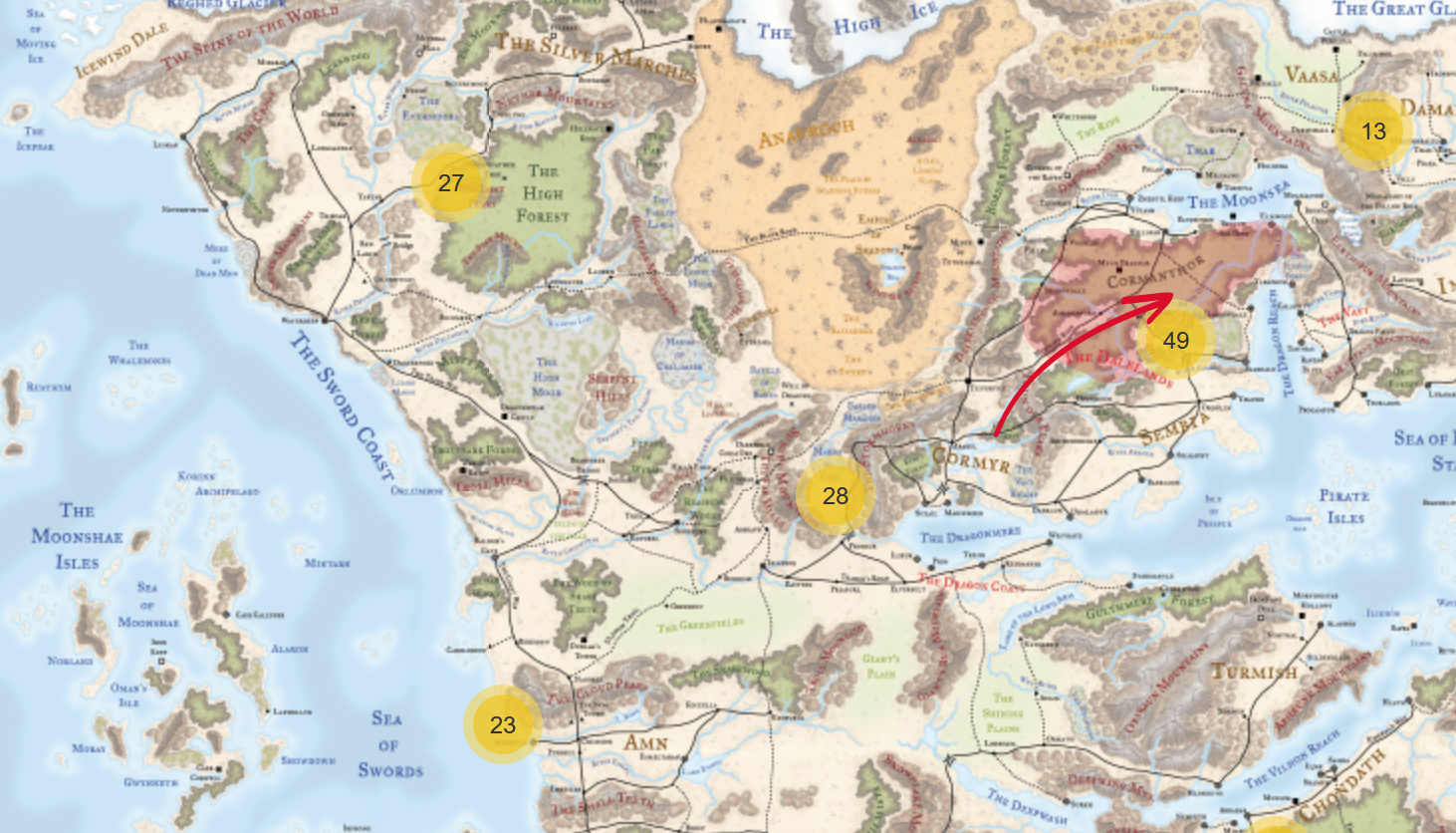
(Lords of Darkness 3rd Ed. p. 30)
Groups: Vhaeraun
Primarily, the drow on the surface wish to survive. After centuries of living in a harsh subterranean environment, they have moved to a place where food and water are plentiful and predators are more easily recognized. No longer do they have to cluster in great cities that become pits of corruption, oppression, and despair. Now they can spread out and sample the strange delights of the surface world.
With the basic necessities of food, clothing, and shelter easily satisfied, the drow began to pursue their long-term agenda of world domination and destruction of their enemies, the surface elves. However, some groups (such as the worshipers of Vhaeraun, and especially the Auzkovyn clan of Cormanthor) have abandoned their traditional racial hatred, and among the settled surface drow these elves are actually a majority.
Forgotten Realms Campaign Setting 3e p. 125
History
Decades ago, a house of Vhaeraun worshipers lost a civil war in Menzoberranzan. Calling themselves House Jaelre, they wandered the deep Underdark, too weak to retake their home city. Around the same time as the Auzkovyn clan came through the portal beneath the Abbey of Swords, House Jaelre drow found portals in the ruined gnome city of Blingdenstone that led into sections of Cormanthor once inaccessible thanks to Myth Drannor's powerful mythal.
Unlike the Auzkovyn clan, House Jaelre drow seek to occupy the elves' original homes, particularly the area around the Elven Court. They're motivated in part by the hope that they can take over the elves' original mythals and wards, then use the elven magic to keep out both the elves and their own drow enemies.
Twisted tower/szith morcane
The Dancing Stone
Dambrath
Forest of Mir
Iskasshyoll
Dallnothax
The High Forest
Vhaeraun
Eilistraee
Waterdeep
The Promenade + dancing haven ♥
Ravens Bluff
Tower Chûmavhraele