THE CORMANTHOR DROW
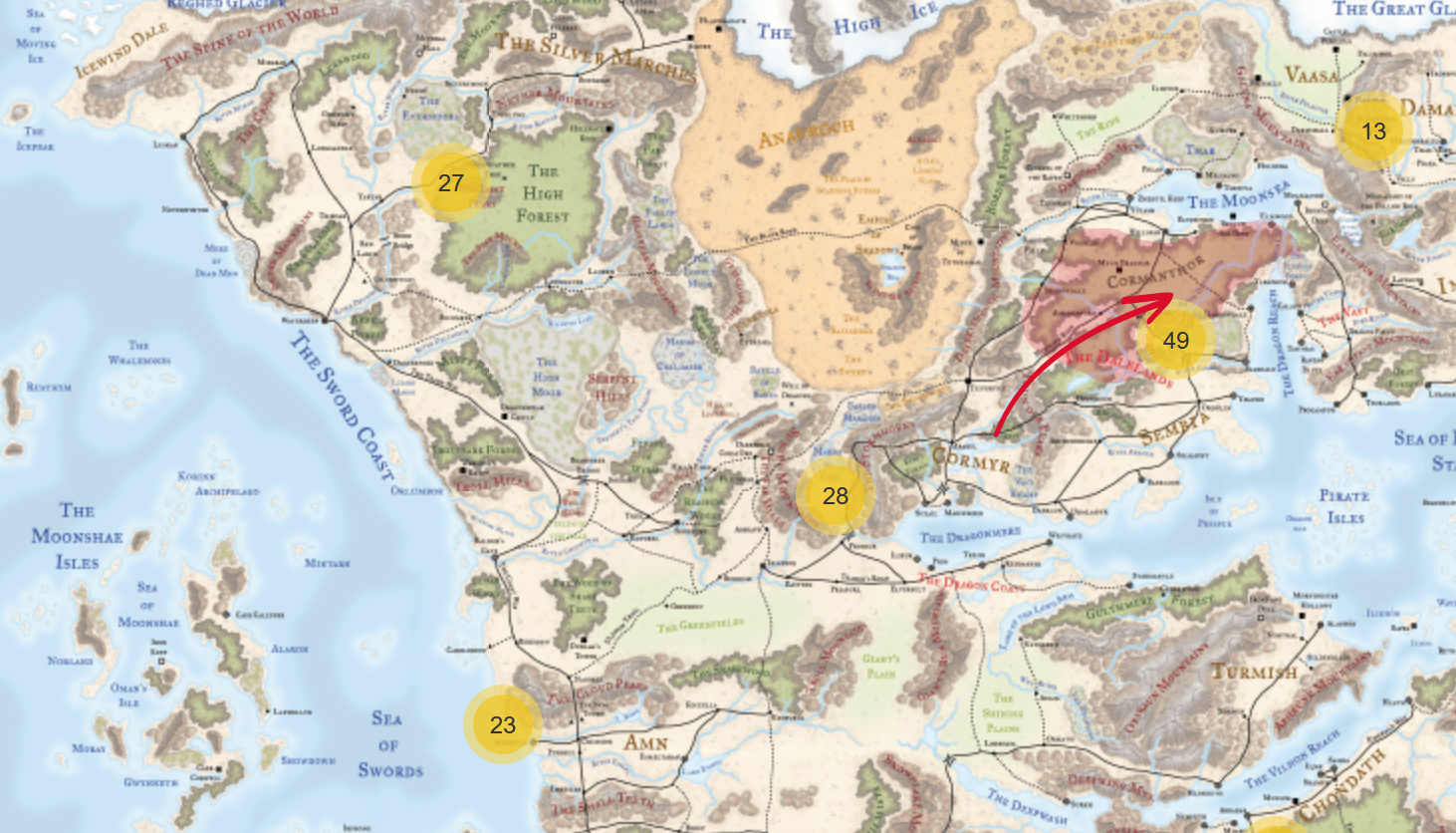
Forgotten Realms Campaign Setting, 3rd Ed, p.125
For many years, the fiends and decaying high magic of Myth Drannor were widely held to be the greatest peril of the Elven Wood, but now an even greater danger has appeared - the return of drow to the surface world. As the last few decades of the Elven Retreat left vast portions of the Elven Court and its surrounding forests virtually unoccupied, some drow factions in the Underdark–particularly those who owe their allegiance to Vhaeraun rather than Lolth - contemplate a return to the surface world. First as small scouting parties, then as larger warbands, and finally as conqueror trains of slaves and belongings, the drow have established themselves in the deep places of Cormanthor.
The drow have not been present in Cormanthor for long, but they’ve made themselves known, with raid against Archendale,‘Battledale, Deepingdale, and Mistledale. Incessant raiding and murders in the forest may not be the worst the drow have to offer Dalesfolk.
The Great Druid of Cormanthor went missing near Myth Drannor shortly after the drow invaded. The story passed on to druids through the animals of the forest is that he perished in a great battle with a demon summoned by drow newly arrived in Myth Drannor. The only consolation for Dalesfolk is that the druids say that the Great Druid killed his demonic attacker as well.
Even more alarming than the prospect of a war in Cormanthor’s shadow is the drow interest in the abandoned realm’s ancient mythals. The drow seek to twist Cormanthor’s ancient mythals into shapes that please them. Elven high magic effects that please such beings, however, are likely to demoralize and enfeeble humans and elves. The drow never create powerful mythals on their own, but with time and study, they may master the magic of the Elven Court and permanently darken the great forest. Those elves who have returned from Evermeet know this and work constantly to conceal old magic from the drow or defend sites too large to hide with the powerful guardians they can find.
Although it is not widely known, the drow who have moved into Cormanthor are divided into several factions. Several Groups of drow compete and even cooperate to turn Cormanthor into their new fortress home. The main factions are described here, with brief notes on other drow forces in Cormanthor.
MOTIVATION AND GOALS
(Lords of Darkness 3rd Ed. p. 30)
Primarily, the drow on the surface wish to survive. After centuries of living in a harsh subterranean environment, they have moved to a place where food and water are plentiful and predators are more easily recognized. No longer do they have to cluster in great cities that become pits of corruption, oppression, and despair. Now they can spread out and sample the strange delights of the surface world.
With the basic necessities of food, clothing, and shelter easily satisfied, the drow began to pursue their long-term agenda of world domination and destruction of their enemies, the surface elves. However, some groups (such as the worshipers of Vhaeraun, and especially the Auzkovyn clan of Cormanthor) have abandoned their traditional racial hatred, and among the settled surface drow these elves are actually a majority.
Clan Auzkovyn (3,505 drow)
Forgotten Realms Campaign Setting 3e p. 125
Auzkovyn Clan (3,505 drow): For centuries the Auzkovyn drow (so called after the long-dead founder of their clan) wandered in the uppermost reaches of the Underdark and occasionally took up residence on the surface. About two hundred years ago, the Auzkovyn carved out a small fastness in the heart of the High Forest, determined to forge a surface homeland despite the wealth of enemies present in that location.
While the Auzkovyn wore away their strength in constant warfare, the wood elves of the High Forest–never proponents of the Elven Retreat– grew stronger and more vigorous, intent on reestablishing the ancient elven kingdom of Eaerlann. The surface drow of the High Forest recognized the growing strength of the wood elves and realized that they had little but incessant warfare to look forward to.
After long and secret effort, the High Forest drow created a portal that led into Cormanthor–specifically into the Underdark near the Abbey of the Sword. Although the Tempus-worshipers deflected the Auzkovyn assault by destroying this first portal, the rest of the High Forest drow quickly forged a second to join their vanguard in the forests north of Battledale.
Unlike House Jaelre, the Auzkovyn clan does not wish to settle into old elf havens such as the Elven Court. The Auzkovyn feel most comfortable as woodland nomads. At various times, they range in large or small groups over nearly the whole of Cormanthor, setting up temporary camps on the ground, in the treetops, and sometimes in cave entrances to the Underdark.
Most of the Auzkovyn drow offer sacrifices to Vhaeraun, even if not all worship him as their patron deity. Unlike the other surface drow who've invaded Cormanthor, the Auzkovyn are willing to accept elves, half-elves, and possibly even Vhaeraun-worshiping humans into their clan, which may work to their advantage in the long run.
As Vhaeraun worshipers who aren't set on occupying specific territory, the Auzkovyn drow get along fairly well with House Jaelre. Of course, for evil drow factions, "getting along well" means they don't slit each other's throats after they've hit each other with sleep-inducing arrows.
Obsul Ssussun, "The Door to Light" (Drow Spells for the Surface World) By Sean K Reynolds
This black book is small -- barely wider than an elf's hand. A blackrothéleather cover painted with two Elven runes encloses pages of fine thin parchment. Tiny Elven letters written in a jagged hand form words on the pages.
Last Record: Zulifein T'orgh of Sshamath, Vhaeraunian drow wizard, 7 Hammer, 1373 DR.
Description: This small book was designed for elven hands -- drow elf, but elf nonetheless. The Elven runes on the cover spell Obsul Ssussun, meaning "Door to Light" in Undercommon. The writing inside is in Undercommon and in a masculine hand, with small but jagged letters. The text is black, with a few small notes in the narrow margins made in red ink. No illustrations break up the jagged text. The book is in good condition and of recent manufacture. It does not radiate magic.
One of the bands of Auzkovyn drow roaming the forest of Cormanthor was led by a veteran drow wizard known only as the Widower. According to the rumors about him, he once served as the consort and house wizard to a matron mother in a Lolth-controlled city. Vhaeraun spoke to him in his dreams, guaranteeing escape from the city and a position of status among free drow if he assassinated the matron mother. The wizard agreed, and he throttled his lover in her sleep, fleeing under the Masked Lord's shadow, never again speaking his name to any other drow and binding his identity tightly with spells Vhaeraun placed in his mind. Vhaeraun led him to a group of Auzkovyn drow who had recently lost their leader in a clash with a group of Spider-Kissers. The Widower, as he now called himself, took control of the leaderless group and kept it safe from its enemies for nearly two years. The Widower had a friendly (for drow) relationship with Jezz the Lame of House Jaelre, and from time to time the Widower's group would team up with warriors from that house in raids against enemy drow camps or dangerous elven sites. He worked with a Vhaeraunian cleric to create at least two spellbooks of the Masked Lord's favorite spells, giving both arcane and divine versions so clerics, sorcerers, and wizards of the Auzkovyn drow could use them. Door to Light is one of these books.
The Widower abandoned camp one night late in 1372 DR without a word about his destination. He left behind a small bundle of papers and Door to Light; the contents of the papers are unknown other than they said that followers of Vhaeraun were to use the book in their war against Lolth. The book was given to the Widower's secondwizard, a promising student named Zulifein T'orgh. The most recent sighting of Zulifein places him in the Far Hills, in the general area of a known tunnel to the Underdark. He was alone (rather than with other members of his nomadic group) and his purpose near the city remains unknown.
Contents: The opening pages of Door to Light describe three spells, all of which have arcane and divine versions. These spells are considered unusual spells, and any spellcaster who wishes to use them must first decipher them as described in the Arcane Magical Writings and Divine Magical Writings sections of Chapter 10: Magic of the Player's Handbook. Following the spell pages is a page of notes on the vhaerath (a type of outsider created by Vhaeraun to serve him on Faerûn) as well as notes on how to summon them using summon monster II or similar spells.
The spells the book contains are as follows:
- elf disguise
- soul charge
- Vhaeraun's nightshield
For more details regarding spells, see: Church of Vhaeraun
Price: 550 gp (spellbook value only, though as its pages contain arcane and divine versions of spells, a buyer who can use only one or the other type would offer much less). A buyer interested in planar lore might pay up to 100 gp more for it (or only 100 gp if the buyer can't use it as a spellbook). The church of Vhaeraun is willing to pay a flat 2,000 gp for the book, no questions asked. If presented to a group of Auzkovyn drow, they would offer to pay in drow goods and throw in lifetime safe passage through Auzkovyn-patrolled territories in Cormanthor. (The booksellers in question would receive tokens of passage representing this agreement.)
Last Known Bearer: Zulifein T'orgh of Sshamath, Vhaeraunian drow wizard
Zulifein was born in the male-dominated drow city of Sshamath, a younger son of a middle-ranked city wizard. Raised in an environment where his gender and his profession made him superior to the common folk of his home, Zulifein grew bored and sought interesting ways to entertain himself. Starting with torturing animals, he advanced to torturing slaves and eventually drow commoners. After a series of torture-murders that his father covered up with bribes to the city guards, Zul made the mistake of abducting a plaything of Ryld Coborel, one of the city's most powerful wizards, and when he realized his error he fled before Ryld discovered the offense. Heading upward, he threw in with a group of Auzkovyn drow, selling his services as a wizard in exchange for his life. Zul came to the surface via portal like many of his adopted clan and has spent dozen(sic) months living in Cormanthor. When his group was attacked by a team of Lolth-worshiping drow and their leader was killed, Zul was pushed into a leadership role by the survivors but was saved from that task by the appearance of the Widower. The mysterious senior wizard took Zul under his wing and named him as his second wizard.
When the Widower left in the middle of the night, Zul inherited the Door to Light and some of the Widower's notes. Some in the group pressured him to be the new leader, but Zul wanted neither the responsibility nor the attention and deferred to Divolg Luen, the leader of the group's rangers. With Door to Light in his hands (a prized item for its religious and arcane value even if its sale value is significantly less), Zul felt he could buy off Ryld's desire for vengeance by presenting the book as a gift. At the next opportunity, he left his fellows and fled to Cormyr, using the elf disguise spell to avoid attention. He then traveled via trade route to the Western Heartlands, researched the location of a tunnel to the Underdark, and is now looking for that tunnel so he can follow it to his home city. When he gets there he will remain in disguise so he can learn if Ryld's anger has cooled and if there is a bounty on his head; once he finds out, he'll figure out the best way to present the book and extricate himself from this tangle.
Zulifein T'orgh: Male drow wizard 6 (transmuter); CR 7; Medium humanoid (elf); HD 6d4; hp 15; Init +4; Spd 30 ft.; AC 17, touch 15, flat-footed 13; Base Atk +3; Grp +2; Atk or Full Atk +7 melee (1d6-1/18-20, rapier) or +8 ranged (1d4/19-20, masterwork hand crossbow); SQ darkvision 120 ft., drow traits, light blindness, spell resistance 17; AL NE; SV Fort +2, Ref +6, Will +5; Str 8, Dex 18, Con 11, Int 16, Wis 10, Cha 14.
Skills and Feats: Concentration +9, Decipher Script +8, Hide +6, Knowledge (arcana) +6, Knowledge (dungeoneering) +8, Knowledge (nature) +6, Listen +3, Move Silently +11, Profession (torturer) +5, Search +5, Spellcraft +8, Spot +3; Daylight Adaptation, Scribe Scroll, Stealthy, Still Spell, Weapon Finesse.
Languages: Common, Draconic, Drow Sign Language, Elven, Goblin, Undercommon.
Drow Traits: Zulifein has immunity to magic sleep effects. If he merely passes within 5 feet of a secret or concealed door, he is entitled to a Search check to notice it as if he where actively looking for it. He has Martial Weapon Proficiency (rapier), Martial Weapon Proficiency (short sword), and Exotic Weapon Proficiency (hand crossbow) as bonus feats. He gets a +2 racial bonus on saves against enchantment spells and effects and a +2 racial bonus on Listen, Search, and Spot checks (already figured into the statistics above).
Light Blindness: Abrupt exposure to bright light (such as sunlight or a daylight spell) blinds Zulifein for 1 round. On subsequent rounds, he is dazzled for as long as he remains in the affected area.
Wizard Spells Prepared (5/5/5/4 per day; caster level 6th): 0 -- detect magic (2), mage hand (2), message; 1st -- disguise self (2), expeditious retreat, ironguts (Magic of Faerûn), Vhaeraun's nightshield; 2nd -- cat's grace, false life, invisibility (2), spider climb; 3rd -- analyze portal (Forgotten Realms Campaign Setting), fly, slow (2) (DC 16).
Spellbook: 0 -- As above plus acid splash (+6 ranged touch), arcane mark, detect poison, disrupt undead (+6 ranged touch), ghost sound, mending, open/close, prestidigitation, ray of frost(+6 ranged touch), read magic, resistance, touch of fatigue (+6 ranged touch; DC 13); 1st -- As above plus cause fear (DC 14), color spray (DC 14), elf disguise, identify, launch item (Magic of Faerûn), low-light vision (Magic of Faerûn), magic weapon; 2nd -- As above plus minor image (DC 15), rope trick; 3rd -- As above plus soul charge (DC 16).
Possessions: Bracers of armor +2, ring of protection +1, rapier, masterwork hand crossbow with 50 bolts, boots of elvenkind, 2 potions of cure light wounds, 2 pearls (for the identify spell; 100 gp each), rope, 194 gp.
Important Characters of Clan Auzkovyn: (See above passage for all)
The Widower
Divolg Luen
Zulifein T'orgh of Sshamath
House Jaerle (7,945 drow)
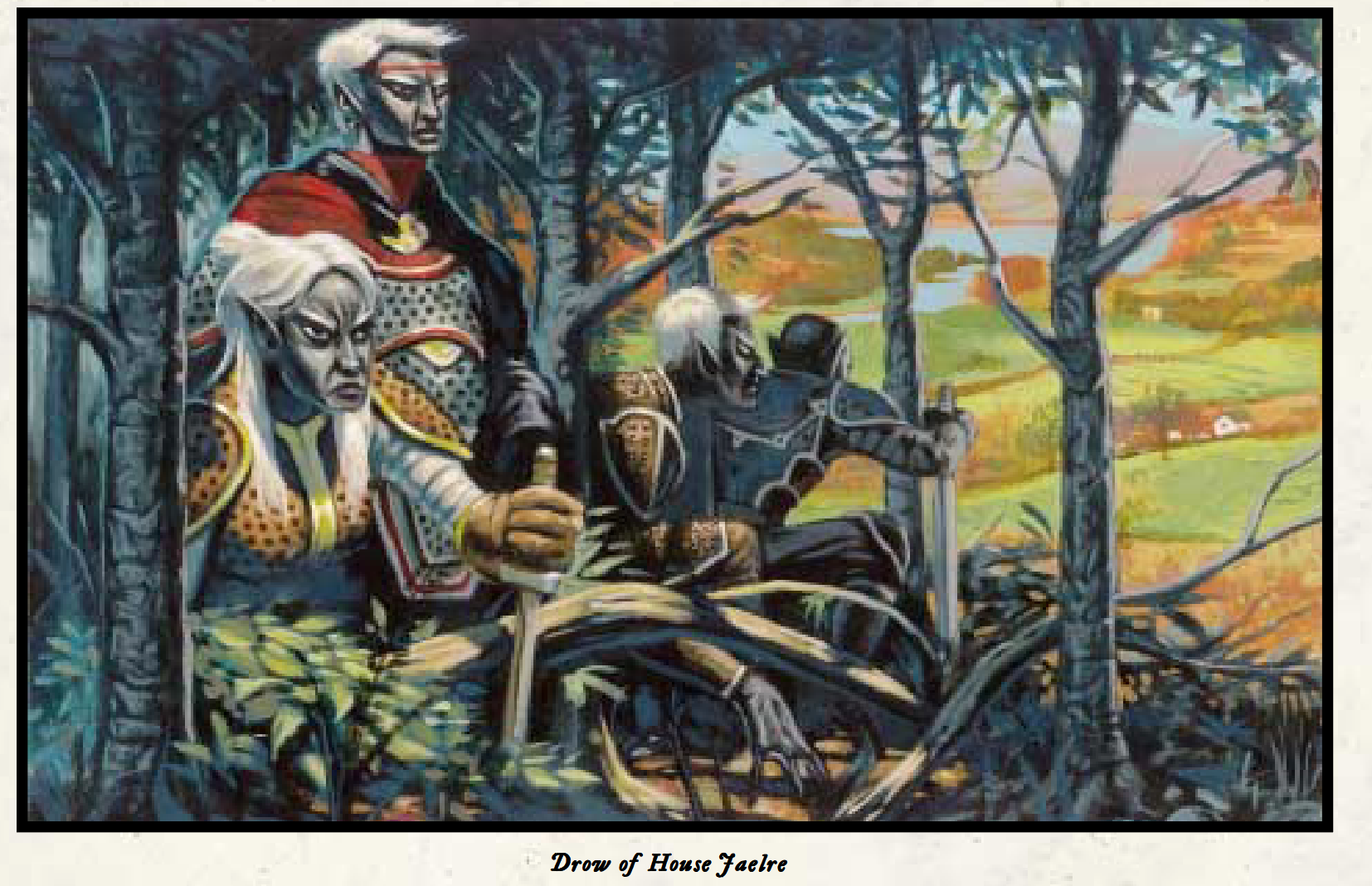
Forgotten Realms Campaign Setting 3e p. 125
History
Decades ago, a house of Vhaeraun worshipers lost a civil war in Menzoberranzan. Calling themselves House Jaelre, they wandered the deep Underdark, too weak to retake their home city. Around the same time as the Auzkovyn clan came through the portal beneath the Abbey of Swords, House Jaelre drow found portals in the ruined gnome city of Blingdenstone that led into sections of Cormanthor once inaccessible thanks to Myth Drannor's powerful mythal.
Unlike the Auzkovyn clan, House Jaelre drow seek to occupy the elves' original homes, particularly the area around the Elven Court. They're motivated in part by the hope that they can take over the elves' original mythals and wards, then use the elven magic to keep out both the elves and their own drow enemies.
A crafty drow sorcerer-rogue named Jezz the Lame heads the forces of House Jaelre charged with creating distractions in the Dales. These events help to keep the Dalesfolk's attention away from developments in the old Elven Court. At the moment, Jezz is having great success slashing into Mistledale.
(Lords of Darkness 3rd Ed. p.30) The largest group of drow on the surface is the followers of House Jaelre. The leaders of this group have established smaller, finite goals for themselves. Rather than having a disorganized plan to take over the world or destroy all its enemies, House Jaelre plans to take over old elven settlements (particularly the old Elven Court in Cormanthor), study the mythals and remnants of elven high magic, and find a way to tune these powerful wards to not only keep out enemies from the surface, but to repel any enemy drow who might try to take their prize from them. To distract people from its activities in the Elven Court, House Jaelre executes precise and small-scale raids upon parts of the Dales. These strikes occur in places far from the Elven Court, so when the Dalesfolk are sufficiently agitated to send militias and adventurers in search of the drow, they never connect the attacks with the location of the Elven Court, and often end up fighting enemies of House Jaelre, such as raiding parties of Lolth-worshipers. Of course, if the house has a chance to eliminate such a raiding party itself at little or no risk, it takes the opportunity, which is why some adventurers find small groups of drow bodies bearing symbols of the Spider Queen.
House Jaelre is led by four drow:
Jezz the Lame (NE male drow Rog6/Sor6), Belarbreeza (NE female drow Wiz14), Tebryn (male drow Ftr5/Rog5), and Nurkinyan (NE male drow Clr14 of Vhaeraun). Jezz leads the raiding parties that distract the outside world from the house’s true activities. Belarbreeza leads a team of drow mages in unlocking the secrets of the mythals. Tebryn is the leader of the military forces that guard the inner drow strongholds, and Nurkinyan is the spiritual leader of the house and nominally the leader to whom the other three report.
The Elven High Court
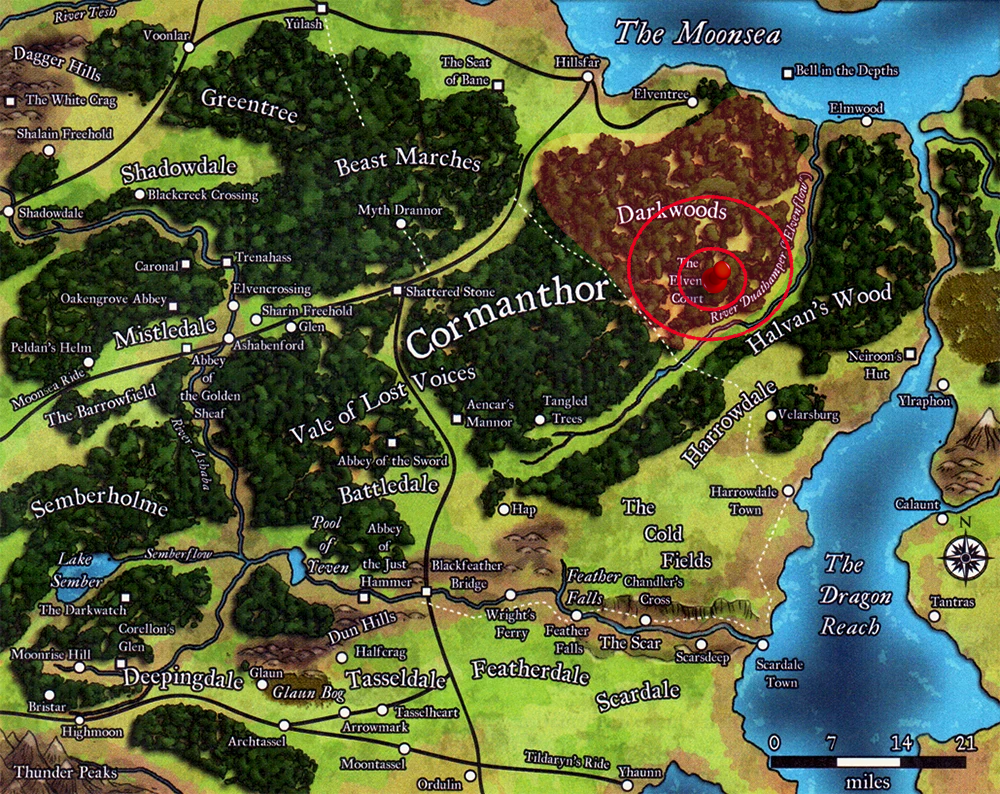
Cormanthyr - Empire of Elves, 2nd Ed, p. 106
Note: All information about the Elven High Court and it's surrounding forest is from before House Jaelre settled within the woods. However, for the sake of perhaps understanding why the Elven Court was targeted to be settled, information on it's various magic and monsters have been pulled and placed on this page.
History
Nearly twelve millennia ago, the Descent of the Drow brought a truce to the Crown Wars. Clan elders, High Mages, and holy elves in all the elven settlements across Faerûn received a summons from Corellon Larethian the Creator while in states of reverie; they were to prepare for Court to decide the fate of the Crown Wars and the future of the elves. Almost instantly (i.e., two days after the first reverie-message), these elves began disappearing at dawn when they first greeted the sun. Their disappearances were consistent with legends of Corellon summoning an elf to his side, so few elves worried about the abductions. In all, 500 elves (125 of each surface elf race and 125 aquatic elves) magically arrived in a deep, untouched wood far to the east of any elven realms yet established. "Here," Corellon's voice proclaimed, "is the Place and Time of Elven Court. Now you all must decide your future, for the path on which you all walk leads to destruction."
Elven Court as the Place of Judgement
For the next nine centuries, the founders of Elven Court built homes and temples amid the trees and around the deep wells, pools, and underground rivers of the aquatic elves. As this site was divinely chosen and visited, many temples rose up around the central clearings that became Elven Court. Even with all this work to establish a colony here, the elves knew this was a judgment place and that they must come to an accord over how to resolve the conflicts of the Crown Wars.
Even though the summoned elves were a mix of clan elders and High Mages and common elves (even some fair-haired youths of only 150 winters!), Elven Court was always per-ceived and operated as a settlement of peers. Their old hierarchies were set aside to allow for free-dom of expression and discussion among the Court members. There also was little need for law or government therein, as their duty (and the diligence of the Seldarine) kept the peace; these 500 elves knew hey had to determine their race's future, and any other troubles seemed petty in contrast. All elves were equals here, for they were called to judge themselves, not measure themselves by social status or magical prowess. The elves of Elven Court looked long and hard at themselves and their brethren to find where the Peoples' path had strayed. By the Time of Judgment, the original 500 elves placed amid a virgin wood had grown to a small city of temples, halls, tree dwellings, and a population of 673. The First Proclamation was to oust the corrupt and power-mad ruling clan Vyshaan from Aryvandaar, and the Fifth Crown War erupted as the Vyshaan resisted the Court's ruling. Within 200 years, it was over, and the elves moved to colonize more of Faerûn to both avoid the connotations of remaining in the old lands of Aryvandaar and to settle virgin woods untouched by the violence and disarray of the Crown Wars. Many of the elves born and raised at Elven Court returned to the eastern forest and established the first settlements of Arcorar: Semberholme, Uvaeren, Rystall Wood, and Jhyrennstar.
Elven Court as a City & Realm
After the settlement of Arcorar (the forest around the Elven Court), Elven Court became almost exclusively a place of religious pilgrimages, given its number of grand temples to the Seldarine. As a place of hidden power due to Corellon's manifestation here, it was chosen as one of the sites for the creation of the moonblades, and the priests and High Mages created 25 of the mystical blades here (though legends speak of the moonblades numbering near 100 in all).
It also became the unofficial "center" of the Arcorar Forest, as the leaders of the four individual realms all deferred to the even-handed judgments of the elders at Elven Court. While no empire would pull these domains together until Cormanthyr, Elven Court was considered the seat of leadership for all those dwelling in the forest.
Elven Court was neutral ground for all the forest's clans and races, a place where all elves were peers and peace presided over all assemblies. This sense of equanimity and equality came from the fact that no weapons were allowed to be drawn at the heart of Elven Court (though the few defenders of the realm patrolled the perimeters doubly well for that security). The Gods' Walk and all temple grounds around it were considered holy ground until the fall of this Old Elven Court.
In celebration of a two-millennia-long peace between the dwarves of Sarphil and the elves of Arcorar, a feast was held at the Hall of Ages in Elven Court on Midwinter Night -4400 DR. The Dark Court Slaughter began on that longest of nights, as drow and duergar flooded up from below, estab-lishing various warzones about the city but concentrating on the Hall of Ages. The fight saw the deaths of both the Coro-nals of Rystall Wood and Jhyrennstar and 23 clan leaders from among all the clans of Arcorar.
During the Slaughter, Elven Court heard the clash of weapons for the first time in its history. Unfortunately, the overwhelming drow conjured magics that kept the city cloaked in inky blackness during the day, allowing the skir-mishes to stretch for days. Summoned monsters destroyed much of the city, while their drow mistresses took to corrupting the many temples. While most of the Seldarine temples were collapsed by disintegration spells on the support columns, the Creator's House received special treatment: The inside of the temple was reshaped by drow wizards and priests into a massive stone web. The center of the web acted as a gate which brought droves of spiders large and small. This un-ending crawl of spiders and the desecration of the holiest place in Elven Court made the elves despair and abandon the city. While the drow remained in Elven Court slightly longer, they too abandoned the site and returned to the Underdark.
In the five millennia since its fall, Old Elven Court has lain forsaken by the elves who built it. Arcorar's many realms became the single empire of Cormanthyr under the Coronal Kahvoerm Irithyl, and the Elven Court (as a decision-making body) simply became a part of the gleaming capital city of Cormanthor. The ruined city is a place of nightmares and walking fears for most elves, though the Sy Tel Quessir brave the edges of the ruins to hunt and kill many monsters before they wander into other settled areas. While most elves still refer to the territory as Old Elven Court, the green elves and many soldiers in Cormanthyr's armies refer to the area as the Darkwoods. Their primary concerns are keeping the monsters out of their hunting and burial grounds to the southwest of this area.
All the elves of Cormanthor mourn the loss of this once-great city, but they cannot restore it to greatness for three reasons: The entire army would be needed to clear the Dark-woods of monsters, and this would still take years; the army is needed on far more fronts, with the constant threat of the Lands under Shadow, the encroachments from the north and south, and elsewhere; and Myth Drannor fulfills the Old Court's purpose as a place of unification, peace, and the center of the empire. Until such time that Myth Drannor cannot perform these duties or the army can free the temple-city from evil, Old Elven Court and the Darkwoods remain nearly empty of elves or any other of the good sylvan races.
Old Elven Court & Environs
Geography
The Darkwoods and Old Elven Court lie in the eastern sector of Cormanthor, and this territory covers a roughly 20-mile area of forest centered on the old city. The Darkwoods live up to their name, as the trees and foliage here are noticeably darker in hue, no matter what type of plant. Carnivorous plants have taken hold of some areas, so beware of strangleweed and hangmans' trees along the eastern edges of this area.
Due to a drow curse set during the Dark Court Slaughter, all the waters (fountains, streams, and deep pools) within the Court and the Darkwoods are a deep, near-black purple color. Still translucent and odorless, the water is still perfectly fresh water for the plants and animals and N'Tel'Quess; to nondrow elves, however, the water is mildly poisonous when ingested and it causes fever and illness (-1 Str & Con for a day per drink of water; save vs. poison or instant death to an aquatic elf breathing the waters). If the purplish water is bot-tled and removed from the Darkwoods (i.e., more than 10 miles away from Old Elven Court), the color fades after 24 hours and the water is normal in all respects. Of course, this curse affects water (but not ale or wine) brought into the Darkwoods, infesting it with the purple coloration after 24 hours within the area.
Population
The predominant lifeforms within the areas of Old Elven Court are spiders (of all types and sizes), gargoyles, fomorian giants, mites and other gremlins, and massive nocturnal packs of gibberlings. Nonliving creatures that inhabit the Darkwoods include banshees, spectres, and ghosts, all of which are the tortured spirits of dead elves and dwarves who fell 5,000 years ago. There are many more creatures found all about the Darkwoods, from hags to zombies, but the above are the most likely candidates aside from birds, squirrels, and the small game that permeates Cormanthor.
Of the sylvan races, only centaurs and various green elf clans dare approach the Darkwoods. Soldiers all (but not ex-clusively warriors), they patrol the borders and near-interior, keeping the evil creatures contained. They will intercept any who attempt to enter the Darkwoods for their own safety and to protect the Old Elven Court from mere looters. If adventurers convince them they mean no ill of the elven dead therein, they are saluted for bravery (or chided for foolhardiness, if deemed too inexperienced) and given some warnings about traveling through Darkwoods (e.g., about the water and loca-tions of some monster lairs).
Magic
There is an unknown but assumed vast amount of lurking magic among the ruins of Elven Court's temples. In its heyday, the Courť's temples and buildings (including the living tree buildings that have grown wild in the interim) were riddled with minor and major magics, similar to Myth Drannor today. The drow curses and magics which corrupted many other as-pects of the once-proud city have infected these as well, though some magics are maintained as they were but are used in more malevolent ways than their designers ever intended.
The magics embedded in now-shattered concert shells once allowed all within an amphitheater to hear the beauty of an elven bard's song but now magnify the terrifying howls of leucrotta and banshees therein.
The Plaza of Dance once sponsored great galas where elves danced lightly on air; its magic long twisted by the nearby destruction and dissolution of the temple to Hanali, any who enter the plaza suffer the effects of a re-verse gravity field, as the magic roughly grabs entrants and flings them skyward, where they either land outside the courtyard or fall back into the field, only to be tossed ever higher. (Contact with the field tosses a being 20 feet into the air in a slight arc; there is a 30% chance of contacting the field again, and then the being is flung 30 feet up and out of the courtyard, suffering appropriate falling damage in either case).
Any arrows or missiles fired or thrown within the bound-aries of Old Elven Court (marked by cobblestone trails and stone markers) will veer away from a target after flying 20 feet and sail outside of the nearest city bound-aries; targets inside that distance can be hit by the mis-siles with a THACO penalty of -4. Missiles always veer straight up and then out toward the nearest edge of the city, where the missile falls directly to the ground. This magic ignores all distance limits, magical or ability bonuses, or types of missiles (such as arrows of slaying), so a stone could fly up to 500 yards to plop harmlessly in the grass, no matter who or what flung it. This explains the random piles of good arrows, sling bullets, and even magical missiles from a necklace of missiles people find outside the city limits.
The great Feast Hall in the Hall of Ages lies exposed to the sky, its ceiling destroyed during the Dark Court Slaughter by errant lightning bolts and other forceful magic. However, the magical fields on the still-whole but scarred table that dominates the room yet hold, and food placed on the table maintains its temperature and doesn't spoil. Many of the carnivorous monsters, but most especially the gargoyles, drop their kills upon the table, where they will stay fresh (and warm, in their just-killed state) until consumed.
Architecture
This city in its prime was a beautiful place of High-Magic-born stone temples and grand living tree homes. The Deci-sion Place was entirely elven and often magically created, so very few buildings were made with brick and mortar. Now, in its ruin, only the landmarks below are more than rubble over-grown with ivy and strangleweed, and the beauty of the re-maining buildings has been marred by their partial ruination and continued abuse by monsters that lair within the woods.
Landmarks
While the landmarks were few and far between even when Elven Court was a thriving community, those few that existed were ruined by the drow & duergar attacks during the Dark Court Slaughter. Since the abandonment of Old Elven Court, the forest reclaimed much of the area. Crawling ivys, flowers, lichens, mosses, and bushes now cover much of the rubble-strewn courtyards, streets, and fallen buildings. Fountains still lie within the city limits, though only one still pumps a slow trickle of purplish water into an ivy-choked basin.
Now, at the height of Myth Drannor's power, there are only a few major sites here that retain any hints of their former use, while all others are restored to nature or too thoroughly destroyed to identify.
The Creator's House
Ruined Ground Dwelling-Grand; 3-Story Temple
From the outside, the southern facade of this once-grand oval temple was shod in gold and its five graceful spires towered over the surrounding trees. Now, two of the towers are broken open at their tops while a third is fully destroyed, its outer wall rended by massive claws along its entire length. The high arched roof of the temple has massive holes in it, but it is largely intact and can provide some shelter. Its two-story high stone double doors are broken, one door broken lengthwise (its jagged remnants still swinging on the left hinges) while the other is shattered entirely, the rubble littering the stairs leading up to the doors.
Once inside the greatest temple of Elven Court, its desecration is fully realized. All the floor mosaics have been marred or destroyed by clawed creatures far greater than man-size. The twelve massive support pillars that line the central aisle leading to the altar have been altered by magic, and a stone-shaped web links the pillars together, its branches and orien-tation leaving it 14 feet above and parallel to the floor. The center of the web is 15 feet in diameter and it glows with a purplish light. Every nook and cranny within the temple's structure is thick with webs, though these are more standard spiders' silk webs (with only a few being the webs of giant spi-ders). A number of marble statues of Corellon lie pushed off their pedestals and shattered amid dust and webs.
The most dangerous site in nearly the entire forest of Cor-manthor, the fallen temple to Corellon is the source of much of Elven Court's corruption. Thanks to drow magic, the temple and surrounding grounds are infested with spiders of all shapes and sizes. The Spiders' Gate at the center of the stone web (100 feet from the doors and 40 feet down from the ceiling) summons a random number of spiders from some unknown source. However, it is a reactive magic, and the presence of certain beings or types of beings activates the gate's magic.
Any elf inside the temple walls activates the gate, drop-ping 2d20 standard, poisonous, or hairy spiders into the temple 1d4 rounds after the entrance of the elf. This gate activates itself, repeating the above effect, for each individual elf in a party (i.e., four elves cause 8d20 spiders to be summoned here).
The presence of magical items (any type) activates the gate, summoning 1d12 large or huge spiders for every magical item carried into the temple. If the items are rings, scrolls, or potions, add 2 to the resulting roll.
Finally, the Spiders' Gate is also sensitive to spells and latent memorized magic. Should any spells, spell effects, or spellcasters come within 50 feet of any part of the stone web, the gate erupts into purple flames which spread along the web, licking and crackling. Each spell or caster (priest and wizard classes and any spellcasting rangers or paladins) of 6th level or less causes the gate to produce 1d4 giant spiders (50% standard, 30% flying spi-ders, 20% driders). Spellcasters or effects greater than those levels each see 1d6 phase spiders emerge from the gate. The presence of a High Mage in this temple causes the gate to emit 1d4 gargantuan spiders as well as the maximum amount of each of the other types of spiders (rather than rolling randomly).
The above effects are cumulative, so an elf thief under the influence of a potion of invisibility wearing a ring of jump-ing causes the gate to emit 2-40 (2d20) smaller spiders and 3-14 (1d12+2) large/huge spiders. Once his elven High Mage friend joins him (wielding a staff of the magi and wearing a ring of protection), though, the gate erupts with 40 more lesser spiders, 14 more large/huge spiders, and 1-4 gargantuan spiders. In general, two adventurers against 60-112 spiders of all sizes had best run for their lives, as many elves before them have!
The Hall of Ages
Ruined Ground Dwelling-Grand; 3-Story Hall and Temple
This building is among the grander remains in Old Elven Court. The first floor contains a temple to Labelas (long ruined by summoned fire lizards and like creatures, the golden statues all partially slagged and lying in resolidified pools of gold), while the floors above were the kitchens and pantries and guest rooms that all supported the top floor, the greatest feast-hall in all of Arcorar. This was the focus of the drow and duergar attack, and yet it is one of the few surviving buildings.
As stated above, the roof of this massive marble building is shattered and gone, the whole upper floor exposed to the ele-ments. Various holes appear throughout the 35-foot-high walls due to spells or other attacks during the Slaughter. Lower parts of this building are covered in climbing ivy with bright yellow flowers (yellow musk creepers), though they grow to the roof where holes in the walls allow them new purchase to continue climbing. The northwestern corner of the building is collapsed in a heap of rubble, the tunneling underneath it the cause of the destruction. Creatures careful in climbing up the pile of rubble can reach the top of the breach and enter the building's second floor through its old pantries.
Garrison of Fletching Green
Ruined Fortified Ground Dwelling-Major; 3-Story Garrison
This wide, round stone tower lies on the far northern out-skirts of the Old Elven Court (100 yards north of the city limits). It it once acted as the primary garrison for the armed protectors of the Elven Court and was constantly staffed by archers and rangers. Set in the center of a wide, green clear-ing, the tower itself seems whole and untouched by time or by the chaos that permeates the Darkwoods. The only extra-neous feature on the tower beyond its roof crenelations are three gargoyles set in the walls; they act as downspouts for draining water off the flat roof, sending it down through stone drains beneath them to cellar cisterns.
Any who approach from above can find a secret trap door leading down into the tower, but it is sealed with a wizard lock cast by a 19th-level wizard and has remained unbroached for centuries. Those who try to enter the tower through its apparently open door at ground level gain a rude surprise. Green slime vomits out of the gargoyle over the door, which strikes the character with a THACO 12; affected creatures easily flow down the drains in liquid form, leaving no clues as to the danger. This effect is triggered by proximity; anything solid approaching within eight feet of the door (walking, flying, or otherwise) causes the green slime to continue to flow until such objects are moved. The doorway is also trapped with an invisible wall of force over the opening; con-tact with this field has a 70% chance of knocking a character into the slime.
Elven Court Today
Though the Elven Court lies in rubble and ruin, folk of Myth Drannor still hear talk of Elven Court as a present-day as-sembly. No longer an actual, physical site (much to the surprise of many N'Tel'Quess), Elven Court is a congregation of the Coronal, elf nobles, High Mages, druids, and what appear to be treants and dryads in quiet groves surrounding any of the settlements. When an elf refers to a ruling made by Elven Court, he abstractly refers to these assemblies.
Elven Court is now a ritualized communion of present-day elven leaders. Gatherings last anywhere from four to 24 hours and cannot be convened without the presence of at least one tree-spirit: A number of elves who chose to be buried in spe-cial ceremonies under the roots of Cormanthyr's trees have become part of Cormanthor physically and psychically, and are henceforth tree-spirits. Rather than communing with the Call of Arvandor, they commune with the trees and the lifeweb of all plantlife on Toril. A special ritual known to High Mages, ranking druids, and the Coronal calls to the tree-spir-its and 2d4+1 of them answer a Call to Court.
When called, a tree-spirit inhabits any type of tree within 50 yards of the summoning person(s). A face similar to the spirit's former self forms within the bark, and once complete, the tree-spirit can speak and participate in Elven Court. Phys-ically, summoned tree-spirits are identical to treants, and they have all the attendant abilities of the same. In addition, a tree-spirit can look into the mind of an elf in reverie who leans against its trunk, and this is often the quickest way to provide information to the tree-spirits. Obviously, tree-spirits can manifest in the forms of dryads, hamadryads, nymphs, and even satyrs or shambling mounds, should they choose to do so for more mobility; their powers are identical to the forms they adopt, though they can shed their form and place their consciousness within a tree or redisperse it into the lifeweb in a second.
When in session, the eldest tree-spirit presides over that Elven Court, though the Coronal is the active agent of that spirit, directing the questioning and discussion for the bene-fit of the elder spirit. Issues that do not concern the trees and the overall health of Cormanthyr seem frivolous to the spir-its, and they abstain from these "lesser" discussions. Their value comes in their inherent ability to see the wider forest and the broad spectrum, rather than the distractions of mortal life. These Courts are called only to debate and come to a conclusive decision on a major change that either is not covered in or changes elven laws and society, such as the cre-ation of moonblades, the alliance of the races at Cormanthyr, and the opening of Myth Drannor to all good peoples.
Elven Court can convene anywhere in Cormanthor, though the summoning of the prerequisite three tree-spirits takes 1d12 hours longer if done more than 40 miles away from the burial sites in the eastern woods near Old Elven Court. While possible, long-standing traditions prevent an Elven Court from being summoned within 10 miles of the Vale of Lost Voices; the dead here are not to be disturbed.

House Jaerle Outpost
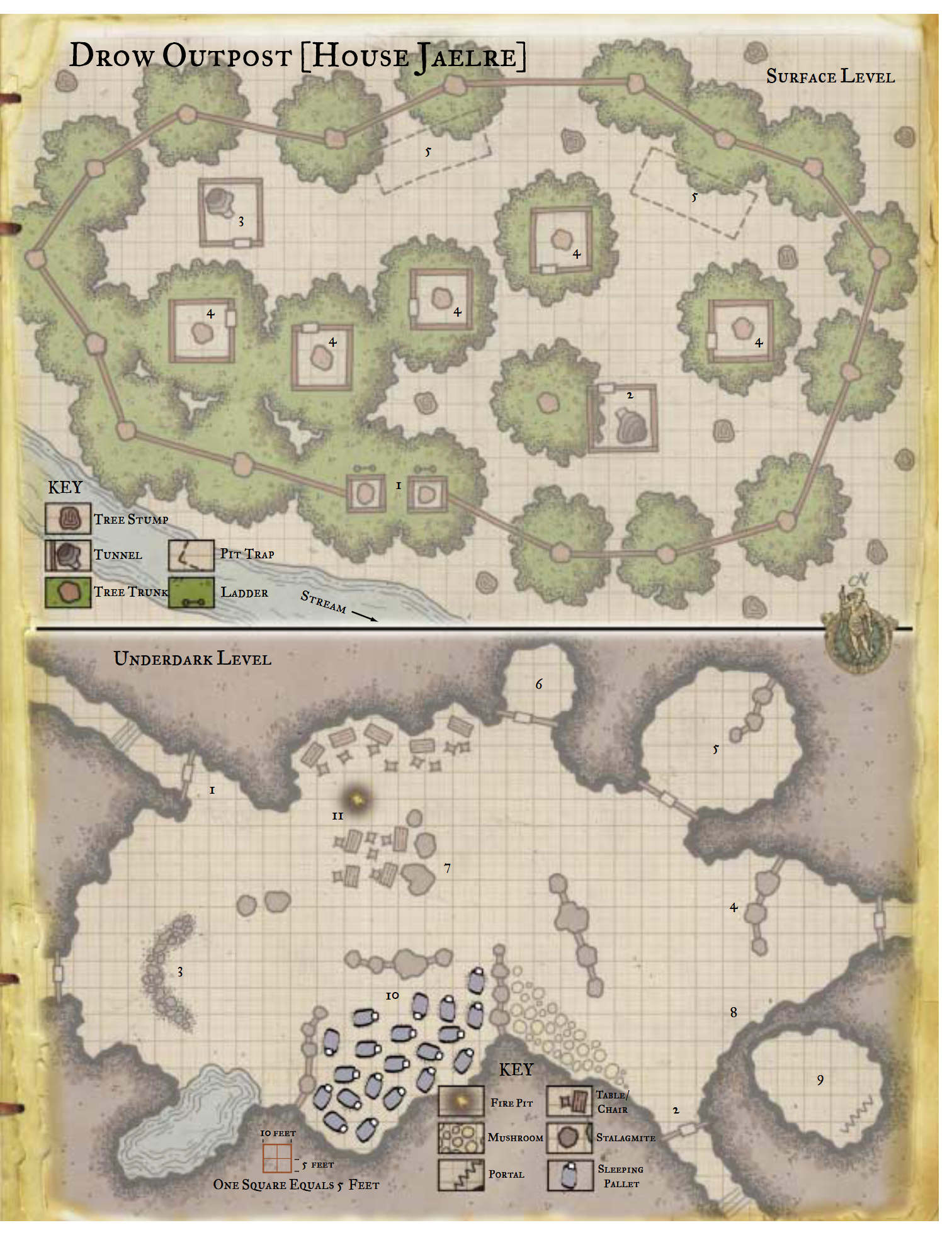
Lords of Darkness, 3rd Ed, p. 34
House Jaelre
The largest group of drow in Cormanthor is House Jaelre, worshipers of Vhaeraun intent on controlling the abandoned elven mythal in that forest. House Jaelre has many camps, outposts, and fortresses within the borders of Cormanthor, some of them of surface-elf construction, others assembled by the drow themselves. One such drow-built outpost is described here, a place where raids into the Dales can be planned and executed without drawing attention to drow activity elsewhere.
Headquarters: The Elven Court, Cormanthor.
Members: Nearly 8,000.
Hierarchy: Militaristic.
Leaders: Belarbreeza, Jezz the Lame, Nurkinyan, Tebryn.
Religion: Vhaeraun.
Secrecy: Low (although headquarters are kept secret from people outside this faction).
OUTPOST LAYOUT
This section describes the layout of an outpost of House Jaelre in the forest of Cormanthor. The outpost is on a low hill near a broad stream and is built above two small entrances to the upper-Underdark. House Jaelre uses this outpost as a semi-permanent base, making raids into the Dales or upon any bands of spider-kissers (Lolth-worshipers) they encounter. The subterranean level of the outpost is approximately 300 feet underground.
A total of fifty drow use this as a base, with about half of them away from the site at any time (usually patrolling the surface or the tunnels radiating outward from the Underdark). Half of those present are on the surface, the other half in the level below. One-fourth of each group is likely to be in trance or otherwise unprepared for combat (not wearing armor, and so on), leaving about nine drow on the surface and nine underground either on guard or ready to fight at a moment’s notice.
The drow live by finding edible plants on the surface, hunting, and harvesting edible fungi from a garden in the Underdark portion of their lair. Supplies are brought in from other camps, taken from slain opponents, or traded for with other groups.
The drow at this outpost include:
Valas, senior mage (NE drow male Wiz9)
Velonor, senior cleric (NE drow male Clr9 of Vhaeraun)
Ginafae, senior scout (NE drow female Rog8)
Drisinil, junior mage (NE drow female Wiz4)
Sorn, junior cleric (NE drow male Clr4 of Vhaeraun)
2 captains (NE drow Ftr5)
3 lieutenants (NE drow Ftr4)
20 scouts (NE drow Rog3)
20 soldiers (NE drow Ftr3)
SURFACE LEVEL
The surface portion of the outpost consists primarily of a fenced-in area 600 feet across. The 4-foot-high fence is made of roughly hewn wooden planks that are nailed to tree trunks that define the perimeter of the outpost. Trees near the outpost have been felled to provide a clearer line of sight for lookouts as well as to provide wood and to make it impossible to enter the compound simply by climbing from branch to branch.
Within the camp are a number of simple wooden shelters made of rough planks and built around one of the tree trunks. Each shelter has a simple wooden door with a wooden latch (no lock). Each is designed with a narrow opening at the top adjacent to the tree trunk, allowing an escape by climbing if using the main door would be problematic. Even if the shelters were set afire, a resident could easily escape through the front door, the top opening, or even by kicking the planks apart (Strength check DC 12 from the inside).
The trees within the camp are close enough to each other that a person can walk from branch to branch at up to half his or her speed without needing to make Climb checks.
1. Wooden Gate
The wooden buildings surrounding these two tree trunks are built more sturdily than any of the shelters in the outpost. They are joined at the top to form an arch, and a flimsy two-piece wooden gate is attached to the frame. Ladders on the north side of the small buildings allow easy access to the tree line. One sentry is on duty watching this area at all times
2. South Cave Entrance
This shelter guards the entrance to the 5-foot-wide tunnel leading downward to the Underdark level. The tunnel heads south-east, then begins several switchbacks before entering area 2 in the Underdark level. The total length of this tunnel is approximately 500 feet.
3. North Cave Entrance
Similar to area 2, this 5-foot-wide tunnel winds its way downward over about 600 feet of distance to reach area 1 in the Underdark level.
4. Shelter
Each of these simple structures is the sleeping area for up to six drow. Because about half of the outpost’s population is on patrol at any time, usually no more than two or three drow are in each of these shelters. Because of the cooperative philosophy that Vhaeraun-worshipers share, there are no separate quarters for any of the leaders; a drow of any rank can be found in one of these shelters.
5. Pit Trap
These large areas are 20-foot-deep pits that have been covered over with a light framework of planks, rope, brush, dirt, and carefully cut strips of sod (Search check DC 20 to notice). Any creature that weighs less than 40 pounds can cross it safely, but all others must make Reflex saving throws (DC 20 to avoid falling into it). The pit functions as a deterrent and a sort of alarm, because the breaking wood and falling items can be heard throughout the entire outpost.
UNDERDARK LEVEL
This large cavern has a ceiling about 40 feet high in the center, tapering down to between 10 and 15 feet at the edges and in the tunnels. No lights are used here, since the drow rely on darkvision. The entire area is patrolled by a very young deep dragon allied with the drow; the dragon has a small lair in area 7. The southwest alcove has a shallow pool of fresh water that has trickled down from the stream above. The pool contains hundreds of tiny, blind cave fish that feed on waterborne fungus and aquatic creatures too small to be seen. These fish are sometimes caught and eaten by the deep dragon when it gets bored.
The doors on this level are simple wooden doors and have no locks. They are all well maintained (not stuck), and each has a bar that can be used to secure the door from the inside (break DC 22). The doors to the west, northwest, east, and southeast are normally kept barred and only opened if the person on the other side knows the proper password (changed daily).
1. North Entrance
This door leads to a tunnel that eventually emerges on the surface in area 3.
2. South Entrance
This door opens on a tunnel that ends on the surface in area 2.
3. Western Guardpost
Two guards are on duty here at all times, watching over the western and northwestern entrances. The wall of rubble is 3 feet tall and provides one-half cover (+4 AC, +2 Reflex save bonus) for any creature fighting from behind it.
4. Eastern Guardpost
Three large stalagmite pillars have been supplemented by a 3-foot wall of rubble that connects them to the north wall. The combination of wall and pillars provides three-quarters cover (+7 AC, +3 Reflex save bonus) for any creatures fighting from behind it.
5. Alchemist’s Lab
This lab is the territory of Valas, second cousin of Jezz the Lame and primary spellcaster of this outpost. Here he prepares the potions and alchemical items used by the drow of this outpost. He always prepares one invisibility and one passwall spell each day so he can secretly reach area 9 if he has to. He is under standing orders to aid in the defense of the Underdark level of the outpost but to retreat if he believes the defenders might fall.
The room is divided into two sections: the actual lab to the west and a small sleeping area for Valas to the east. When he sleeps or is deep in his work, he keeps the door barred (from the inside) to keep him from being disturbed or attacked. The lab section of the room contains all the materials needed for an alchemist’s lab (see Chapter 7 of the Player’s Handbook), giving him a +2 circumstance bonus on Alchemy checks. Valas can also make drugs, and provides doses of kammarth and ziran (see the appendix) to the leaders of the outpost to distribute among the rest of the group.
6. Privy
This simple lavatory feeds a small colony of active fungus that gives off a sweet odor. A few clusters of stranger fungi also grow here and are used by Valas as ingredients in potions and alchemical concoctions.
7. Dragon’s Lair
This is the lair of Jhanilmexa, a very young deep dragon discovered as a wyrmling and befriended by the drow of House Jaelre. She is given fish from the stream above, occasional slaves (who are eventually eaten), and small treasures to add to her hoard. Her treasure is located within a small space she dug at the base of the large pillar. The access tunnel is 8 feet long. It can only be traversed by a small character, and only with difficulty (Escape Artist DC 25). She normally moves through the tunnel in her serpentine form.
Jhanilmexa: Female very young deep dragon; CR 4; Small dragon (earth); HD 9d12+9; hp 67; Init +4; Spd 40 ft., fly 150 ft. (average), burrow 20 ft., swim 30 ft.; AC 19 (touch 11, flat-footed 19); Atk +9 melee (1d6+1, bite), +4 melee (1d4, 2 claws); SA Breath weapon (corrosive gas, 4d6, 20-ft. cone, DC 15); SQ Blindsight 60 ft., cold and fire resistance 10, detect magic at will, freedom of movement at will, immunities (charm, paralysis, sleep), keen senses (darkvision 200 ft.), snake form 3/day, constant true seeing; AL CE; SV Fort +7, Ref +6, Will +7; Str 13, Dex 10, Con 13, Int 14, Wis 13, Cha 12. Skills and Feats: Bluff +9, Concentration +9, Diplomacy +9, Escape Artist +8, Knowledge (Underdark local) +11, Listen +10, Scry +10, Search +12, Spot +10; Alertness, Cleave, Improved Initiative.
Snake Form (Su): A deep dragon can assume its serpentine (legless) form three times per day at a very young age. This form is the same size as the dragon, but is able to move through smaller tunnels because it has no legs. The dragon’s AC worsens by 6 in this form. It moves at 30 feet, flies at 10 feet (poor), and swims at 30 feet. It loses all claw attacks in this form, but can constrict opponents (+3 melee), dealing 1d8 damage. If the dragon hits with this attack, it can make a free grapple check (without provoking an attack of opportunity). If it wins this check, it grabs and constricts its victim, automatically dealing the above damage every round until the opponent dies or breaks free.
Possessions: Gems: malachite (30 gp), red spinel (130 gp), violet garnet (600 gp).
8. Secret Entrance
A thick cluster of stalagmites and stalactites has grown together to create a wall across this portion of the tunnel. Despite this obstacle, footprints in the dust on the floor lead up to this point and disappear into it. However, no secret door is here. The chamber beyond (which can be detected by scrying or entered by a creature in gaseous form, an incorporeal creature, or a Diminutive creature) is normally accessed by the drow with the help of Valas, who uses a passwall spell to open a way through.
The barrier can be broken through with tools or weapons, but because the barrier is more than 5 feet thick, doing so takes a great deal of time. Should Valas feel the outpost is being overrun, he barks an order in Undercommon for the other drow to fall back and assemble near this area, at which point he casts passwall to make an opening to area 9. Once the way is clear, the drow move into area 9, at which point Valas activates the portal there to allow them to escape.
If the drow are prevented from entering area 9 or the portal itself, they scatter and leave the cavern through the western or eastern exits, losing their pursuers among the twists
and turns of the tunnels.
9. Portal Room
This oval chamber is cut off from the rest of the cavern by a nearly impenetrable wall of stone. The far end of the room contains a portal to a larger base of House Jaelre. The portal was created by Valas (using a teleportation circle spell from a scroll) and only functions once every tenday. It is activated by the touch of a drow hand (even a dead or amputated one). If a retreat is called, Valas activates the portal when the drow are within a double move of the gate (allowing them to jump through it before it closes on Valas’s next turn).
If the heroes pursue the drow through the portal, whether immediately or after a tenday or more, they reach an Underdark drow stronghold of House Jaelre miles away. More than a hundred drow, all expecting invaders to come through their portal, await the unlucky party. In all likelihood, if the heroes haven’t come through in the first few days after the drow retreat, a force of drow teleports to the outpost to scout this area, determine the situation, and possibly destroy the portal.
10. Trance Area
Any drow in trance or relaxing are likely to be in this portion of the cave.
11. Mess Area
Any off-duty drow who aren’t sleeping are probably here, eating a quick meal, preparing their weapons, and talking to each other in low voices or in the sign language of drow.
Important House Jaerle Characters:
Jezz the Lame (NE male drow Rog6/Sor6), Jezz leads the raiding parties that distract the outside world from the house’s true activities.
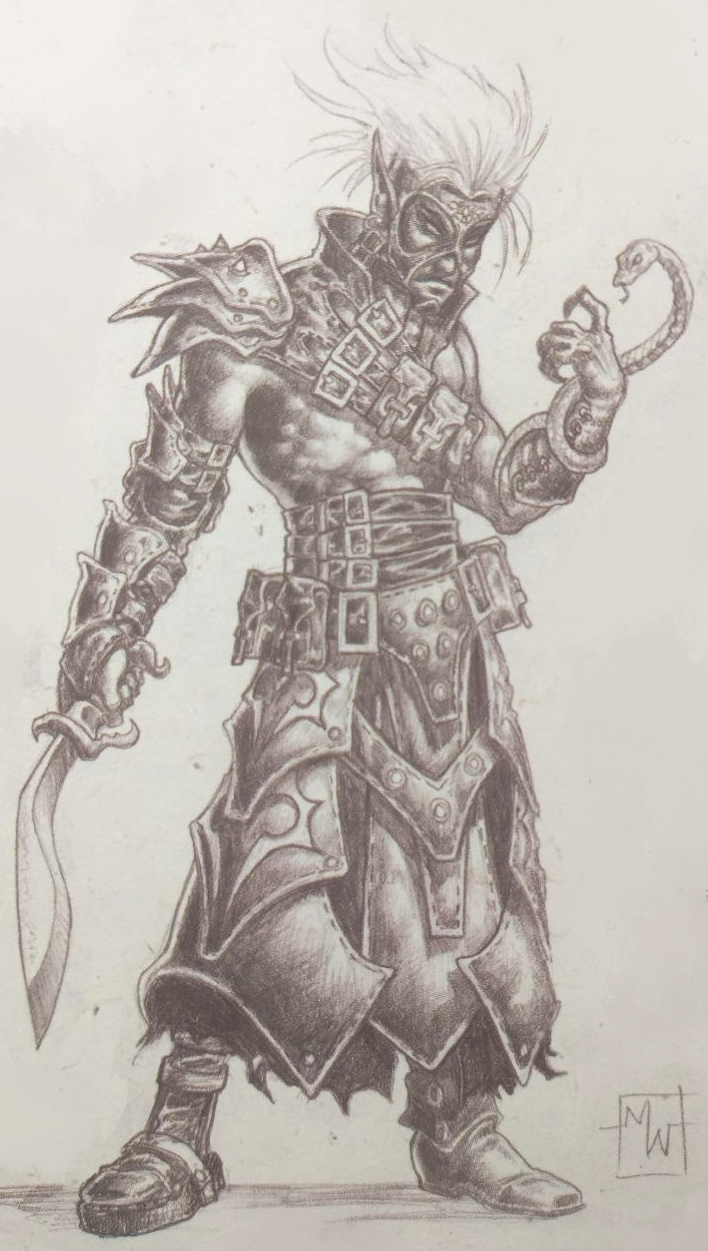
Forgotten Realms Campaign Setting 3rd Ed. p. 126
Jezz the Lame: Jezz the Lame is one of the leaders of House Jaelre, commanding the drow who make raids on the Dales to divert attention from those who now reside in the old elven sites of Cormanthor. Jezz scouted for his tribe while they wandered the Underdark. His leg was badly broken during a fight with an umber hulk in which a cavern ceiling collapsed. His companions thought him dead, but he managed to drag himself into their camp a tenday later. One of the clerics was able to snap the healing bone and reset it in a normal position, but the old injury still pains him from time to time, and he wears a special brace and shoe to help him walk more easily.
Young and confident, Jezz knows how hard he can push the Dalesfolk before they become so enraged that they descend upon the forest in great numbers. He prefers to keep his band small and his followers ready to move on short notice. Given his charisma and the respect his followers have for him, if House Jaelre does manage to obtain a permanent foothold in the forest, Jezz may be presented as a speaker to the outside world.
Keheneshnef: Male viper familiar; CR 1/2; Tiny magical beast;
HD 1/4 d8 (12 HD); hp 18; Init +3; Spd 15 ft., climb 15 ft., swim 15 ft.; AC 20 (touch 15, flat-footed 17); Atk +12 melee (poison, bite); Face/Reach 2 1/2 ft. by 2 1/2 ft. /0 ft.; SA Poison (initial and secondary damage 1d6 temporary Con, DC 11, onset time 1 min-ute); SQ Improved evasion, scent; AL NE; SV Fort +4, Ref +10, Will +8; Str 6, Dex 17, Con 11, Int 8, Wis 12, Cha 2.
Skills and Feats: Balance +11, Climb +12, Hide +18, Listen +15, Spot +15; Weapon Finesse (bite).
Shadowdale scouring of the land 3rd Ed. p. 122
Creatures: Jezz the Lame is one of the leaders of House Jaelre, which in turn is part of the Masked Brigades (note: pg.7 as the collective forces of House Jaelre and the Auzkovyn clan are known) who are currently engaged fighting the Army of Myth Drannor in the great forest of Cormanthor to the east. His limp is the result of an old injury, forcing him to wear a special brace and shoe to walk more easily. Jezz is in Shadowdale as an emissary from the Masked Brigades to the Zhentarim. Young and confident, Jezz has has remained at the Twisted Tower during the uprising to learn as much as he can about the Zhentarim response, viewing this as a golden opportunity to gather tactical information about House Jaelre’s current allies.
Jezz the Lame: This humanoid has smooth, black skin and pale white hair. He is slightly shorter and slimmer than a human. He wears supple leather armor, carries an exotic-looking blade, and wears a brace on his right leg.
Viper: This snake was hidden in the humanoid’s sleeve and is wrapped tightly around his arm
Tactics
Jezz the Lame seeks to observe as much of the uprising and the Zhentarim response as he can, while still successfully escaping. If attacked by the PCs, he immediately tries to flee, using cat’s grace, fly, invisibility, obscuring mist, and his natural abilities to escape.
Designers notes:
For continuity purposes going forward in published Realmslore, it is assumed that Eregul the Freestave, Scyllua Darkhope, Forthar Helvenstron, Malathon, and Esvele Graycastle are dead. It is assumed that Jezz the Lame survives, having been manipulated by the PCs, and returns to the Masked Brigades, angered by the Zhentarim betrayal. In addition, it is assumed that Lord Mourngrym survives, resigns his lordship, and heads east to rejoin the Knights of Myth Drannor, and that Azalar Falconhand is installed as the new Lord of Shadowdale.
Jezz the Lame CR 14 hp 50 (13 HD)
Male drow scout CAd 7/sorcerer 6
CE Medium humanoid (elf) Init +10; Senses darkvision 120 ft.; Listen +16, Spot +16
Languages Common, Chondathan, Draconic, Drow Sign Language, Elven, empathic link, Undercommon
AC 24, touch 17, flat-footed 19; uncanny dodge Resist evasion; SR 24 Fort +5, Ref +12, Will +9 (+11 against spells, spell-like abilities, and enchantments)
Speed 40 ft. (8 squares)
Melee +2 keen kukri +16/+11 (1d4+2/15–20 plus poison)
Base Atk +8; Grp +8
Atk Options poison (drow poison, Fort DC 13, unconscious 1 minute/unconscious 2d4 hours), skirmish
Combat Gear 4 doses drow poison, Keoghtom’s ointment, 2 vials stone salve
Sorcerer Spells Known (CL 6th):
3rd (4/day)—fly
2nd (6/day)—cat’s grace, invisibility
1st (7/day)—disguise self, feather fall, obscuring mist, shield
0 (6/day)—detect magic, detect poison, ghost sound
(DC 14), mage hand, mending, ray of frost (+13 ranged
touch), read magic
Spell-Like Abilities (CL 13th):
1/day—dancing lights, darkness, faerie fire
Abilities Str 10, Dex 20, Con 11, Int 16, Wis 14, Cha 19
SQ able to notice secret or concealed doors, battle
fortitude +1, fast movement, poison use, share spells,
familiar (viper), trackless step, trapfinding
Feats AlertnessB (if familiar within 5 ft.), Daylight
AdaptationPG , Exotic Weapon Proficiency (kukri),
Improved Initiative B , Stealthy, Weapon Finesse, Weapon
Focus (kukri)
Skills Balance +12, Bluff +12, Climb +5 (+7 with rope),
Concentration +10, Diplomacy +13, Disguise +9 (+11 to act in character), Escape Artist +5 (+7 rope), Gather
Information +6, Hide +17, Intimidate +11, Jump +7,
Knowledge (arcana) +8, Knowledge (local
Cormanthor) +8, Knowledge (nature) +5, Listen +16,
Move Silently +21, Ride +10, Search +10, Sense Motive +7,
Spellcraft +15 (+17 decipher scrolls), Spot +16,
Tumble +12, Use Magic Device +9 (+11 with scrolls)
Possessions
Combat gear plus +5 silent moves leather armor, +2 keen kukri, ring of protection +2, glove of storing, Murlynd’s spoon, rope of climbing, 17 gp, 15 sp
Battle Fortitude (Ex) Bonus on initiative checks and Fortitude saves while wearing light or no armor and carrying a light load. Included above.
Daylight Adaptation (Ex) Jezz does not suffer the normal light blindness of drow. He is still vulnerable to light-related spells or effects that affect all creatures regardless of race.
Skirmish (Ex) +2d6 bonus on damage rolls and +2 bonus to AC in any round in which Jezz moves at least 10 feet.
Viper Familiar CR — hp 25 (13 HD)
NE Tiny magical beast (augmented animal)
Init +3; Senses scent, Listen +15, Spot +15
Languages empathic link, speak with master
AC 20, touch 15, flat-footed 17
Resist improved evasion
Fort +4, Ref +10, Will +8
Speed 15 ft. (3 squares), climb 15 ft., swim 15 ft.
Melee bite +11 (1 plus poison)
Space 2-1/2 ft.; Reach 0 ft.
Base Atk +8; Grp –3
Atk Options deliver touch spells, poison (Fort DC 10, 1d6
Con/1d6 Con)
Abilities Str 4, Dex 17, Con 11, Int 8, Wis 12, Cha 2
Feat Weapon Finesse
Skills n/a
Belarbreeza (NE female drow Wiz14) - (Lords of Darkness): Belarbreeza leads a team of drow mages in unlocking the secrets of the mythals.
Tebryn (male drow Ftr5/Rog5) - (Lords of Darkness): Tebryn is the leader of the military forces that guard the inner drow strongholds.
Nurkinyan (NE male drow Clr14 of Vhaeraun). - (Lords of Darkness): Nurkinyan is the spiritual leader of the house and nominally the leader to whom the other three report.
Tzirik Jaelre - Cousin of Jezz the Lame and Priest of Vhaeraun. For more details, see: War of the Spider Queen
The second was unusually short and stocky, with brawny shoulders and a bald pate, dressed in a breastplate of black mithral and masked with a ceremonial veil of black silk. - (Condemnation)
The veiled priest studied them. His expression was virtually unreadable behind the veil. - (Condemnation)
Note: There is another known member of House Jaelre - Valan Jaelre. Showing up in the 4e adventure of Council of Spiders, he appears after the house has fallen and is working with the Jaezred Chaulssin. Given the Jaezred Chaulssin’s disassociation with Vhaeraun in that era, there is no proof that he is a follower of the Masked Lord
Setting information relevant to the groups in the area
Related to Both Cormanthor Vhaeraunite Groups
Note: As with other things regarding this document, these blurbs only exist to give mild context to the environment around these two Vhaeraunite groups. Thus, they might not make sense in the stand-alone of this document. If they interest you, further reading of 3e’s Forgotten Realms Campaign Setting is recommended to fully contextualize the setting.
Neutral Cities
Forgotten Realms Campaign Setting 3e p. 137
Shadowdale is the best known of all the Dales because of its history of successful battles against drow, Zhents, and would-be conquerors such as Lashan of Scardale. Although small, Shadowdale makes up in quality what it lacks in quantity of citizens. The dale is notorious as a home for adventurers who now prefer a quieter life but are capable of exerting extreme force when necessary. [...] Given Shadowdale’s history as a battle zone between humans and drow, it’s ironic that Lord Mourngrym has thus far kept his military out of the struggle against the Vhaeraunian drow. The surface drow settling into Cormanthor have chosen not to raid or infiltrate Shadowdale. Other dales accuse Mourngrym of turning his back on the Dalelands’ common plight. The truth is probably that Mourngrym is more worried about other threats that he does not discuss out loud for fear of distressing the anxious delegates to the Dales Council.
Enemies
Lords of Darkness 3rd Ed. p.30
No surface creatures hate the drow more than other elves. Elven stories tell of Araushnee’s betrayal and her attack on the Seldarine, the drow’s instigation of the Crown Wars (whether this is true or not), and horrible acts committed by drow raiders against elven communities. Even the most open-minded and tolerant elf has a hard time accepting the presence of a drow, even one who claims to be good and whose good can be verified (magic can disguise much, after all). After millennia of indoctrination, the elves have a hatred for the drow that approaches obsession.
[...]
Drow are hated and feared by almost every creature that knows of their existence. Good beings tend to attack at the first chance. Even groups of rival drow are likely to attack, particularly if one of the groups worships Lolth and another doesn’t.
Other subraces of elves, no matter what alignment, react negatively to their fallen kin, and most other good creatures feel that anything a true elf wants to kill is probably something very wicked indeed.
Enemy organizations
Forgotten Realms Campaign Setting 3rd Ed. p. 125
Spider-kissers (1,168 drow): This term is a catchall for Lolth-worshiping drow who splintered off the other groups or came into Cormanthor through other Underdark ways. They have no intention of permanently settling the surface. Rather, they plot to retake their home cities using the traditional drow engine of social change: civil war. The Lolth-worshipers (Ssinssriggorbb) prefer to cluster around entrances to the Underdark, even if that does make them vulnera-ble to raiders, from the Underdark cities.
Underdark Raiders: The Blingdenstone portals that allowed the House Jaelre drow to enter Cormanthor have also enabled ambitious Menzoberranzan commanders to follow. Menzoberranzan raiders switch between raiding their former comrades and raiding Dalesfolk. (The latter action has the bonus of being blamed by victims on the drow settling Cormanthor.)
Eldreth Veluuthra:
Champions of Ruin 3rd Ed. p. 78
The Eldreth Veluuthra is a group of fanatical elf supremacists who have vowed to remove the human scourge from the face of Faerûn. It views humanity as a blight upon the land, little better than an infestation of vermin in dire need of a genocidal housecleaning. Its members operate throughout Faerûn, particularly in ancient elf homelands as well as in those forests largely abandoned during the Elven Retreat, including Ardeep, the Border Forest, the Chondalwood, Cormanthor, the High Forest, the Moonwood, the Neverwinter Woods, and the Winterwood. Wherever human civilization threatens elf interests, the Eldreth Veluuthra works to slow or halt human encroachment—by any means necessary.
Lords of Darkness 3rd Ed. p.131
One of the most notable aspects of the organization is that it does not include any divine spellcasters. The members of the Eldreth Veluuthra worship only the deities of the elven pantheon, but—paradoxically—none of the elven deities are of an alignment that is favorable to the organization. Some of the Eldreth believe that the group should admit drow clerics to gain easier access to healing and restorative magic. But others find that notion abhorrent and refuse to take the easy way out.
(Cloak and Dagger 2nd Ed. pg. 63) By operating along the fringes of traditional elven home-lands, the Eldreth is drawn into conflict with traditional elven foes such as orcs, goblinoids, foresters, and hunters. Members of this society are no friends of drow, but they cooperate with the Ssri’Tel'Quessir against humans. Increasing activity by the followers of Vhaeraun in territories guarded by the Eldreth suggests that such alliances will become increasingly common.
Champions of Ruin 3rd Ed. p. 79
Cormanthor: The elf homeland of Cormanthor is the site of one of the organization’s greatest setbacks. After the Elven Court of Myth Drannor was abandoned during the Elven Retreat, the Eldreth Veluuthra laid plans to set up a base and begin to reclaim the entire forest. But before the group could complete its move, it was driven out by the invading drow of House Jaelre. Since then, any Eldreth Veluuthra operating in the area have adopted the tactic of disguising themselves as drow while attacking human travelers and settlements, thus setting the stage for escalating reprisals between these two hated groups.
Obviously, to become a member of the Eldreth Veluuthra, one must be an elf. Only true elves need apply. This means that drow are forbidden, as are any half-elf combinations. [...] The organization also targets races that it views as elven abominations, such as any of the half-elf crossbreeds. A number of voices within the organization have argued in favor of ending the war against the drow, but this is unlikely to happen—most of the members hate dark elves nearly as much as they hate Humans.
MAJOR GEOGRAPHICAL FEATURES
Forgotten Realms Campaign Setting 3rd Ed. p. 131
Harrowdale’s borders can’t be missed: Cormanthor to the north, the Dragon Reach to the east, and the Cold Field to the southwest. The dale itself is mostly farmlands, which turn to orchards closer to the sea and to the Velarswood at its center.
The Cold Field: South of Harrowdale and north of Scardale, this treeless moor is haunted by the spirits of warriors who fell in dozens of battles here. In summertime, shepherds of Harrowdale and rural Scardale graze their sheep along the high grass, since the sheep care less than the shepherds about the spirits sleeping restlessly in the unmarked graves beneath the hills. In winter, only fools venture into the Cold Field’s confines.
Velarswood: Harrowdale’s woodcutters and loggers stay on the fringes of this ancient wood. Cloakers, trolls, stirges, bonebats, and more dangerous predators hunt the interior of the forest, and they are hunted in turn by worshipers of Eilistraee who have a hidden temple in the wood’s northern reaches. The drow who worship the Dark Maiden spend much of their time in Cormanthor now, fighting against the Vhaeraunian drow, but they don’t leave the temple unguarded.
Forgotten Realms Campaign Setting 3rd Ed. p. 128
Darkwatch: North of the Glaemril, deep enough in the forest that only elves have good cause to stumble upon it, lies a long, dark rift in the forest floor marked by blackened and twisted trees. As far as the Elven Court and the magicians of the Dales can ascertain, at one time the rift was the prison of an enormously evil deity of decay and corruption. It is not known whether it was the now-dead god Moander in one of its early forms or some other evil being. Neither is it known if the monster is still within its prison, for none have dared descend into the unnatural darkness between the rift’s steep sides.
What’s certain is that the rift is a nexus for evil spirits and dark gods. Madness infects forest creatures and magical beasts that stray into the area, sometimes driving them into a killing frenzy. Priests of Cyric, the Prince of Lies, relish the energies swirling around the rift. They visit the Darkwatch as a sort of unholy invigoration, though none stay for long. Even the Vhaeraunian drow shun the Darkwatch
Enemy Villages
Forgotten Realms Campaign Setting 3rd Ed. p. 128)
Bristar (Village, 701): Just south of Lake Eredruie, the moon elf village of Bristar weathered the years of the Retreat by affirming its ties to Deepingdale instead of joining the nearby community of Semberholme in allegiance to the Elven Court. Now that the Retreat has ended, Bristar is one of the largest elven communities remaining in Cormanthor. Bristar contributes a company of archers to the Deepingdale militia while patrolling vigorously against drow scouts and raiders.
Highmoon (Large Town, 3,505): After Silverymoon in the far north, Highmoon is the most integrated human, elven, and half-elven town in Faerûn. The city is only three hundred years old and growing fast. Before the advent of the Vhaeraunian drow, plans to expand the city’s walls bogged down because of a lack of support for military preparedness against hypothetical enemies. Now that the Auzkovyn drow of the High Forest haunt the southern reaches of Cormanthor, expansion and fortification of Highmoon’s walls is proceeding apace.
Ashabenford (Small Town, 1,869): Ashabenford is the largest town in Mistledale, the market center for its widespread farmers, and as generally pleasant a place as anyone could hope to visit. The House Jaelre drow of Cormanthor have begun a campaign of fast raids and skirmishing to weaken the folk of Ashabenford and distract them from the new drow strongholds rising in the Elven Court. The cottages, homes, and businesses along the east bank of the River Ashaba weren’t built for defense—and defense is what Ashabenford needs most now.
Glen (Village, 701): This dwarven village of stone-and-thatch cottages has a secret. The “Deep Mine” on the outskirts of town isn’t a mine at all, but a tunnel into the Underdark. It allows the dwarves of Glen to trade with their fellows as far away as the Great Rift, via an amazing Underdark tunnel called the Long Road that runs south under the entire length of the Sea of Fallen Stars.
The secret of Deep Mine has started to leak into the general Mistledale community. Mistrans might be more concerned about the Underdark connection if they weren’t already fighting off the Auzkovyn and House Jaelre drow. At least Glen’s dwarves do a good job of policing their Underdark passageways, unlike some worshipers of Tempus in Battledale that the Mistrans could name.
REGIONAL HISTORY
Deepingdale was founded by the half-elf sorcerer Imryll Eluarshee. Known as the Deeping Princess, Imryll forged a society in which humans, half-elves, and elves could join in a common vision centered on the elven ways and lore of living in the great forest without destroying it in human fashion.
Deepingdale’s relationship with the elves and the Elven Court has always been cordial and has gotten better over the centuries. Half-elf ancestry is a point of pride among the Deepingfolk. Even during the peak of the elven Retreat, Ulath and the other half-elves and humans of Deepingdale maintained excellent relations with the elven communities of Bristar and Moonrise Hill. Unlike other Dalesfolk leaders who have mixed feelings about the end of the Retreat, Lord Ulath extends a warm welcome to elves who wish to settle in Deepingdale or fight against the Vhaeraunian drow for their ancestral homes in Cormanthor. Ulath even welcomes drow worshipers of Eilistraee, judging that they may have the best access to magic capable of turning back the followers of Vhaeraun and Lolth.
Access to potent magic is a special concern of Ulath’s since the passing of his trusted advisor, the wizard Rhauntides. Skillful and wise magicians can find employment with Ulath while he searches for Rhauntides’s successor.